



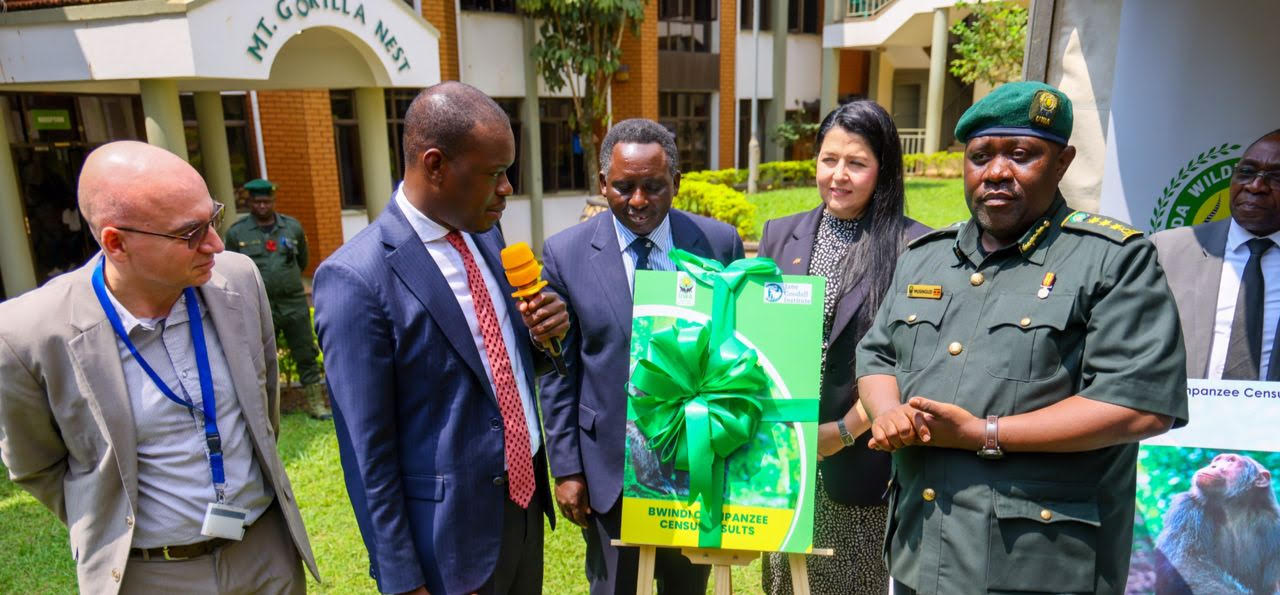
A landmark chimpanzee census has confirmed the presence of an estimated 426 chimpanzees across Bwindi Impenetrable National Park, significantly advancing scientific understanding of great ape populations within one of Africa’s most critical biodiversity hotspots.
The findings, officially launched at Uganda Wildlife Authority headquarters in Kampala, represent the first systematic and scientifically validated population estimate of chimpanzees in the park, long recognised globally for its mountain gorillas.
Conducted between May and June 2025, the census was led by the Jane Goodall Institute Uganda in partnership with UWA and the Greater Virunga Transboundary Collaboration, among others. It was implemented alongside Bwindi’s sixth mountain gorilla census, enabling a more integrated assessment of the park’s great ape populations.
A designated UNESCO World Heritage Site, Bwindi has long been a global model for gorilla conservation. However, chimpanzee presence in the park had remained largely speculative for decades due to the absence of robust, site-specific data.
Using standardised line-transect survey methods, including Standing Crop Nest Count and Marked Nest Count approaches, researchers surveyed 320.9 square kilometres across all four park sectors—Buhoma, Ruhija, Nkuringo, and Rushaga.
Rather than direct sightings, Lead researcher Michael Jurua explained that they relied on nest count methodologies, a globally accepted primate research technique based on the principle that each chimpanzee constructs approximately one nest per night. By factoring in nest production and decay rates, researchers generated statistically robust estimates of population size and density.
The census established an average density of 1.33 chimpanzees per square kilometre, confirming that chimpanzees are widely distributed across diverse habitats, from mixed Afromontane forest to higher-elevation montane ecosystems. This challenges earlier assumptions that the species was rare or confined to marginal areas within the park.
He noted that one of the most significant findings is the ecological overlap between chimpanzees and mountain gorillas, with field teams documenting nesting sites of both species in proximity. This positions Bwindi among the few ecosystems globally where multiple great ape species coexist within a single protected landscape, opening new avenues for research into interspecies interactions, disease dynamics, and climate resilience in tropical forests.
In addition to chimpanzees, researchers recorded other large mammals, including forest elephants, as well as a range of primates and vegetation characteristics—data that strengthens integrated, ecosystem-wide conservation planning.
The survey detected minimal signs of human disturbance across transects, suggesting that large portions of the park remain ecologically intact and capable of sustaining viable chimpanzee populations.
According to Dr James Musinguzi, Executive Director of UWA, the findings mark a turning point in conservation planning:
“For the first time, we have clear scientific evidence confirming a substantial and widely distributed chimpanzee population within Bwindi. This strengthens our ability to plan, protect and manage the park using evidence-based approaches.”
Similarly, James Byamukama, Executive Director of JGI Uganda, emphasised that the census closes a long-standing knowledge gap:
“Chimpanzees are not a marginal presence but an integral component of Bwindi’s ecosystem. This baseline will guide conservation planning, monitoring and regional biodiversity strategies.”
The census directly supports the implementation of Uganda’s National Chimpanzee Conservation Strategy (2023/24–2032/33) by providing reliable, site-specific population data to guide decision-making.
Key applications of the findings include: Strengthening long-term population monitoring systems, Informing habitat protection and law enforcement strategies, Enhancing disease prevention protocols between humans and primates, and Aligning conservation investments with priority landscapes.
Speaking at the launch, Martin Mugarra Bahinduka, Minister of State for Tourism, Wildlife and Antiquities, underscored the importance of science-led conservation:
“The findings reinforce Bwindi’s status as a critical habitat for great apes and provide the evidence needed to guide sound conservation decisions, particularly in the face of climate change and increasing pressure on natural resources.”
Beyond conservation, the results also present opportunities for sustainable tourism diversification. While Bwindi has traditionally been marketed as a gorilla tracking destination, the confirmed chimpanzee population could support regulated chimpanzee tracking, research tourism, and conservation-based travel experiences, particularly in underutilised sectors such as northern Bwindi.
Experts caution, however, that any tourism expansion must remain strictly science-led and conservation-driven, with strong safeguards to minimise ecological disturbance.
The census establishes a critical scientific baseline for tracking chimpanzee population trends over time, with researchers recommending repeat surveys every five to seven years.
More broadly, the findings redefine Bwindi not only as a sanctuary for mountain gorillas but as a complex great ape ecosystem of global significance.