


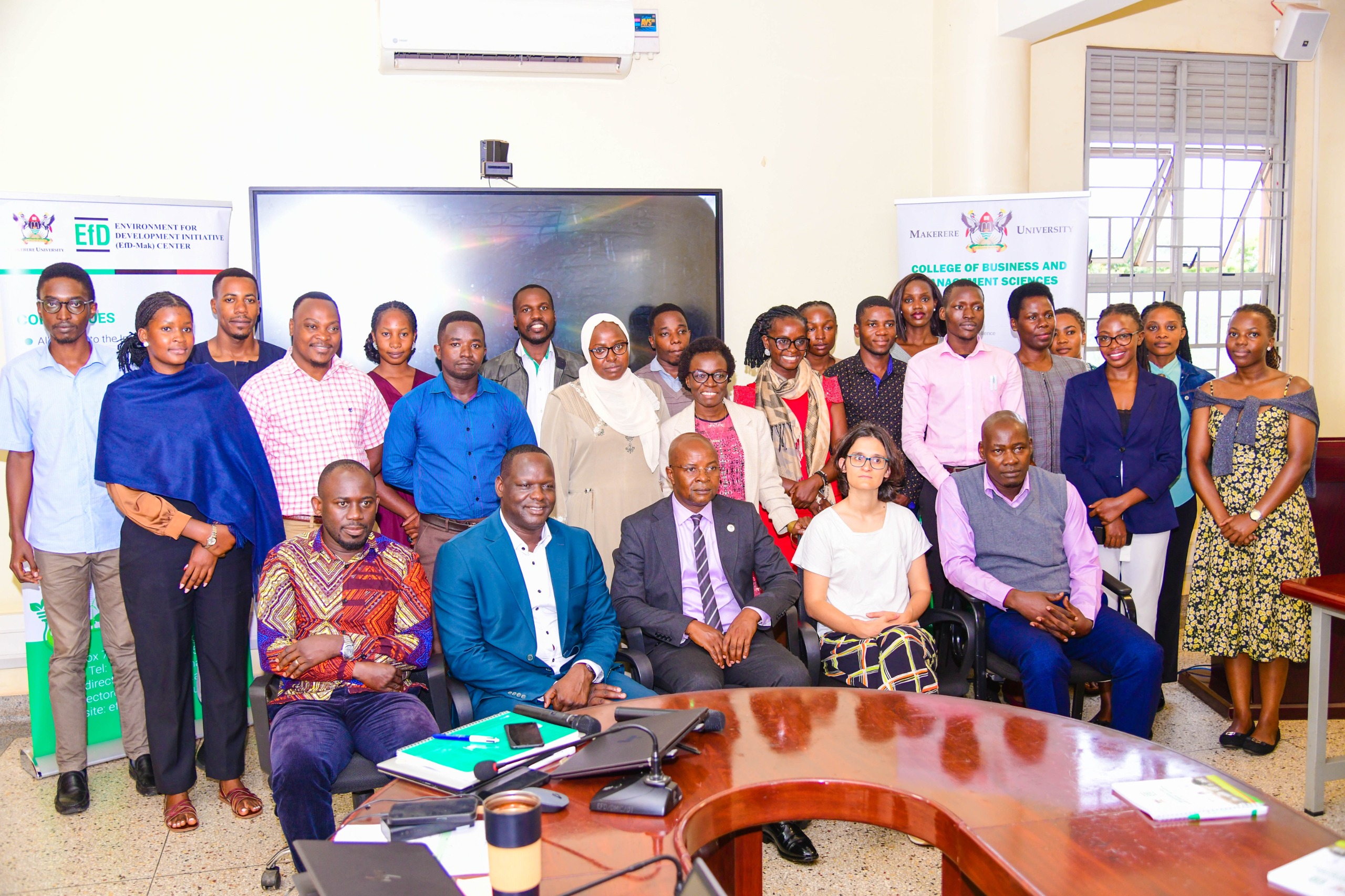
KAMPALA — Dr Nathalie Ferrière, an Associate Professor of Economics at Sciences Po Aix, has challenged the long-held assumption that foreign aid is solely a Western endeavour, warning that a lack of donor diversity can leave recipient countries like Uganda vulnerable to the political shifts of a single dominant power.
She made the remarks during a high-level seminar examining whether international donors cooperate or compete, and what that means for development outcomes. During the seminar, organised by the Environment for Development (EfD) Makerere University Centre, Dr Ferrière presented new research on donor behaviour in foreign aid.
In her presentation, Ferrière challenged conventional assumptions about foreign aid, highlighting the growing number of actors involved. “The idea that only Western countries provide Official Development Assistance is incorrect. Many non-Western countries also contribute,” she said.
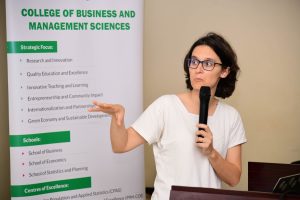
Her research focuses on how donors interact—whether through cooperation, competition, or coordination. “Do they compete? Do they cooperate? Do they coordinate? This type of interaction is at the core of my research,” she explained.
Research and collaboration
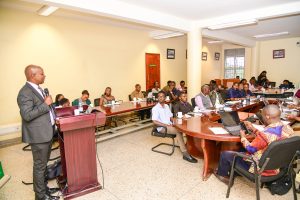
Opening the session, Professor Edward Bbaale, the Principal of the College of Business and Management Sciences (CoBAMS), welcomed the visiting scholar and emphasised the importance of such engagements in advancing the university’s research agenda.
He noted that the collaboration reflects Makerere’s strategic shift toward becoming a research-intensive institution. “We recognise that we must go beyond teaching and pursue significant breakthroughs in research… A key pillar of this transformation is internationalisation—through collaboration and partnerships,” he said.
Rethinking Donor Behaviour
Using evidence from family planning aid, Dr Ferrière found that donors often follow the lead of dominant actors such as the United States. “When the US reduces funding, other donors eventually also reduce their funding, rather than compensating,” Ferrière said.
She warned that reliance on a single dominant donor can be risky. “A more diversified donor base may increase stability and reduce vulnerability to political shifts in any one country,” she added.
Academic Debate: Competition or Herding?
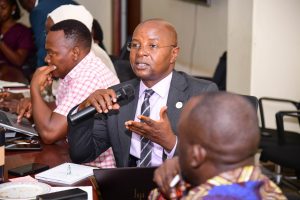
Dr John Bosco Oryema, a lecturer at the Makerere University School of Economics (CoBAMS), commended the study’s methodological rigour while raising questions about how to interpret donor behaviour.
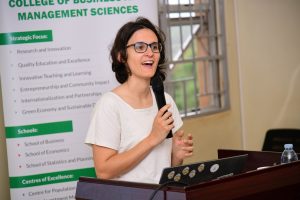
“The key question is whether what we observe is competition or a form of herding behaviour… almost like a contagion effect,” he said.
Dr Oryema suggested that donor dynamics could also be viewed through the lens of industrial organisation. “In this framework, we have a dominant leader—the United States—and other donors act as followers… this becomes a game-theoretic interaction,” Oryema added.
Who Benefits from Aid?
Dr Paul Wabwiga, a lecturer of economics at the School of Economics, challenged the audience to think about the broader implications of aid flows for recipient countries. “In contexts like Uganda… who actually benefits? Is it the donors, the recipients, or both?” he asked.
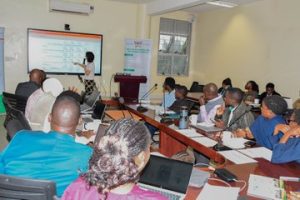
He also pointed to the instability created by shifting policies such as the Mexico City Policy. “What is the net effect over time? … the frequent policy shifts suggest a high degree of instability in aid flows,” Dr Wabwiga noted.
Balancing Cooperation and Competition
Responding to the discussants, Ferrière argued that donor competition is often driven by strategic interests rather than development outcomes. “Donor competition is not primarily about achieving better development results… it is often driven by commercial interests and political influence,” she said.
At the same time, she cautioned against complete coordination among donors. “If donors act like a cartel, it can reduce the bargaining power of recipient countries,” she explained.
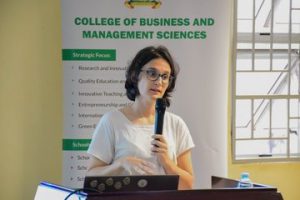
Instead, she called for a balanced approach. “What is needed is a mix of cooperation, but especially between donors and recipient countries,” Ferrière added.
She also highlighted inefficiencies in current systems, noting that donors sometimes duplicate work already done by local institutions. “In Uganda, national institutions already collect detailed data, yet donors sometimes fund parallel data collection exercises,” she said.
Ferrière identified future research areas, including examining aid dynamics at sub-national levels and understanding how governments respond to aid flows. “Economics is not only about data and econometrics. It is equally about understanding underlying mechanisms,” she said.
Inspiring the Next Generation
Closing the seminar, Prof Bbaale praised the presentation and urged students and faculty to draw inspiration from such engagements. “Our goal is not only to teach econometrics… but to help you see it as a tool for solving real-world problems,” he said.
He reaffirmed Makerere’s openness to global academic partnerships. “Whenever you are in Uganda, please consider this your academic home,” Bbaale told the visiting scholar.
The seminar underscored the growing need to rethink how aid is allocated and coordinated, particularly as developing countries navigate increasingly complex global funding landscapes.