


KAMPALA — African education experts have called for a fundamental rethink of curriculum design, arguing that education systems across the continent must move beyond importing universal models and begin building curricula rooted in African languages, knowledge systems, communities and realities.
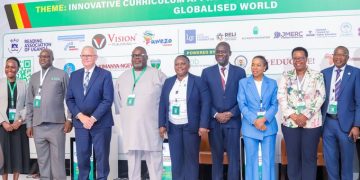
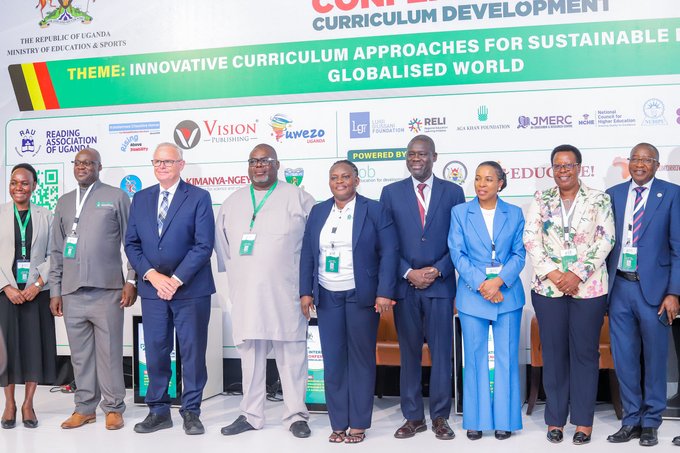
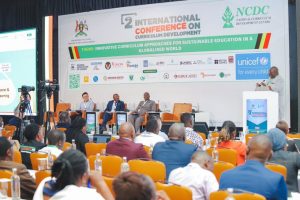
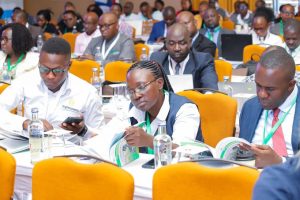
The call was made Thursday at the 2nd International Conference on Curriculum Development at Speke Resort Munyonyo in Kampala, where educators and researchers from Uganda, Zambia, the United Kingdom and elsewhere examined how curriculum can prepare learners for a rapidly changing world without disconnecting them from their societies.
The two-day conference, organised by the National Curriculum Development Centre (NCDC), is running under the theme “Innovative Curriculum Approaches for Sustainable Education in a Globalised World.” But beneath the language of innovation and globalisation was a more difficult question: whose knowledge is shaping what African children are taught?
Prof. Benson Banda, Director of Zambia’s National Science Centre and one of the keynote speakers, rejected the idea that Africa’s problem is simply that its curricula need constant reform.
“The question is not, ‘How do we improve the curriculum?’” Instead, he asked: “How do we redesign education so that it truly works for Africa, by Africa and with Africa?”
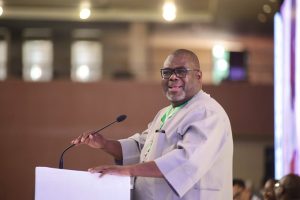
Banda said African countries have become accustomed to reforming education systems without adequately reflecting on whether previous reforms have worked. “My concern is that in Africa we are very fond of reform. We reform, reform, reform, reform. But why don’t we do more reflection?”
He warned that curriculum decisions affect generations and should therefore not be treated as merely technical exercises by ministries and curriculum specialists. “Curriculum is the life of billions. If we do not point it properly, we shall shoot the generation; we shall shoot the future.”
The colonial curriculum question
Banda’s argument moved beyond the conventional debate about competency-based education. He questioned whether the competencies being promoted across Africa are themselves sufficiently grounded in African realities.
Drawing on an analysis of curricula across 19 African countries, he said many education systems have adopted competencies such as critical thinking, creativity, communication, collaboration and problem-solving, but often struggle to translate them into classroom practice.
He said only five of the countries studied explicitly addressed entrepreneurship, three addressed environmental sustainability and only one explicitly identified Ubuntu — the African philosophy emphasising shared humanity and collective responsibility — as a competence.
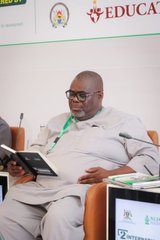
“And that is why you find that even within one ministry, people are fighting each other. They cannot collaborate because an important ingredient is missing: Ubuntu.”
He said the problem is not necessarily the absence of ambitious policy language, but the gap between what policy documents promise and what learners actually experience. “You have a situation where policy documents say one thing, but practice says something else.”
The result, Banda argued, is an education system that can produce examination success without necessarily producing useful knowledge. “So we teach the examination; we do not teach the learner.”
His most striking warning was directed at the relationship between globalised education and local identity.
“Learners who can recite the periodic table but cannot name a local plant are dangerous.” “We are creating a generation that is globally relevant but locally irrelevant.”
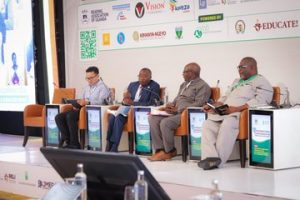
For Banda, decolonising the curriculum means asking what children see around them and whether their education teaches them to understand, investigate and transform it.
As an example, he pointed to agriculture.
“As I drove from here to Mbale town yesterday, I saw rice, potatoes, sugarcane and maize. How much of that is reflected in the curriculum?” “I saw agriculture everywhere. How much of that is in the curriculum?”
He questioned why African children should always be directed towards problems defined elsewhere when their own communities are full of unresolved scientific, environmental and economic challenges.
“Why should we go to China to find a problem to solve? Why not solve the problem in the swamp? Why not solve the problem in the grass?”
Indigenous knowledge
Dr Syafiq Mat Noor of the University of Leeds in the United Kingdom pushed the argument further, saying decolonisation cannot simply mean taking an existing Western-oriented curriculum and inserting a few African examples into it.
Mat Noor, who works on curriculum development and Indigenous knowledge, said Banda’s central question moves the debate from technical curriculum reform towards questions of identity, authority, knowledge, power and purpose.
“It requires us to ask not only what is included in the curriculum, but whose knowledge is recognised, whose experiences are represented, who participates in curriculum decisions and what kind of future education is intended to create.”
He argued that genuine curriculum transformation requires what he called “epistemic justice” — recognising historically marginalised knowledge systems as intellectually legitimate and valuable — and “epistemic sovereignty,” meaning the authority of communities to determine how their knowledge is interpreted and used.
“The challenge, therefore, is not merely to contextualise an existing curriculum.”
“It requires us to confront the colonial hierarchies that continue to determine which forms of knowledge are considered universal, scientific and technically legitimate, and which are treated as local, informal or supplementary.”
Mat Noor warned against treating Indigenous knowledge as decoration for an otherwise unchanged curriculum.
“Indigenous knowledge cannot simply be treated as a collection of interesting facts extracted from communities and inserted into textbooks.” “It is not merely an example added to a Western curriculum framework.”
Instead, he said Indigenous knowledge embodies relationships between knowledge, land, language, spirituality, ethics and communities. “The task is not simply to use Indigenous knowledge to help learners acquire globalised or regionalised competitiveness.”
“It is also about understanding how African and Indigenous knowledge systems themselves construct ideas of competence, intelligence, learning, sustainability and education.”
He said Africa must therefore move from being a consumer and adapter of educational models to becoming an authority in determining the foundations of its own education systems.
“Africa should not merely receive, adapt or localise models developed elsewhere.” “African scholars, teachers, communities and learners must possess the epistemic authority to determine the foundations and purposes of their education.”
Teacher at the centre
The speakers also questioned whether curriculum reforms can succeed when teachers — the people expected to implement them — remain disconnected from curriculum design and assessment.
Banda described the teacher as the central figure in the entire education system. “To me, the teacher is a superhero. He or she is more important than all these separate components we keep discussing.”
He questioned the separation between the people who design curricula, those who assess learners and those who teach them. “What mandate does the teacher have in this discourse?”
Mat Noor similarly argued that teachers should not be regarded merely as people who implement decisions made elsewhere.
“Professional development should be sustained rather than episodic. It should be collaborative rather than imposed. It should be connected to teachers’ classrooms, communities and local environments.”
He said teachers should instead be recognised as “knowledge professionals and curriculum makers.”
For him, decolonisation also means changing who participates in curriculum decisions. “If curriculum development is to be genuinely decolonised, participation cannot be added only after the major decisions have already been made.”
He said teachers, children, families, elders and community knowledge holders should participate in defining educational priorities, selecting knowledge, developing teaching methods and determining how learning is assessed.
‘The learner must have a voice’
Dr Robin Nandy, UNICEF Representative to Uganda, said Uganda’s development ambitions depend on how effectively the country invests in the knowledge and skills of its young population.
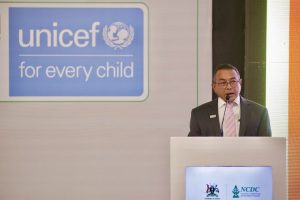
Nandy said roughly 70 to 75 per cent of Uganda’s population is below the age of 30, while more than half are children, making curriculum decisions particularly consequential.
“Uganda cannot achieve its development ambitions without investing in the knowledge and skills of its young people.”
UNICEF’s current Uganda programme similarly identifies stronger education and learning systems, better learning outcomes and the transition from learning to gainful employment as priorities for 2026–2030.
Nandy also pointed to Uganda’s learning crisis, citing the latest World Bank-UNESCO Learning Poverty estimates that about 82 per cent of primary-school-age children are unable to read and understand a simple age-appropriate text at the expected level.
The conference, he said, should therefore not become an exercise in producing another curriculum document that fails to change what happens in classrooms.
He urged curriculum designers to include young people themselves in decisions about what they should learn.
“Include your stakeholders.” “And when we talk about stakeholders, we usually mean teachers. But I am also talking about students as stakeholders in curriculum development.”
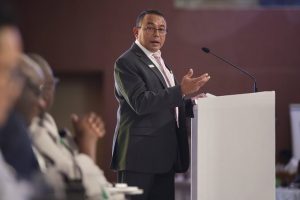
Nandy said curriculum designers should ask a deceptively simple question: “What should Ugandan children need 20 years from now to contribute to the economy and society of their country?”
That question exposes another weakness in conventional curriculum design: adults designing education for a future they may not fully understand.
Nandy also challenged the continued description of communication, collaboration and analytical thinking as “soft skills.” “The so-called ‘soft skills’ — which I think we should now stop calling soft skills — are extremely important.”
He said digitalisation, artificial intelligence and emerging technologies must be incorporated into education, but warned that innovation should not deepen existing inequalities. “Whatever we do should also narrow inequalities, not broaden them.”