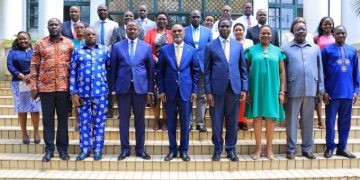



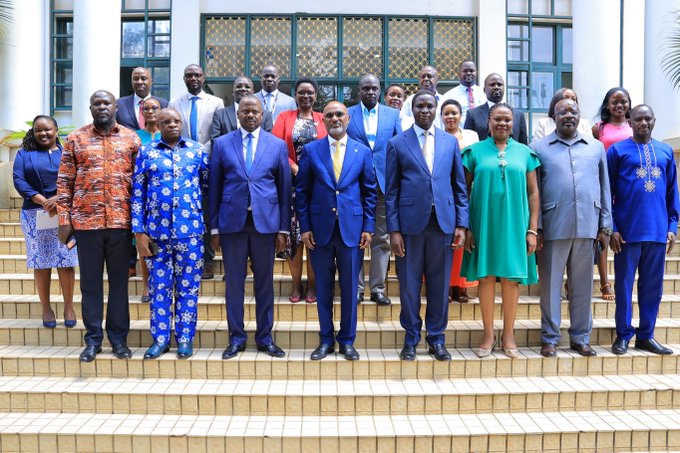
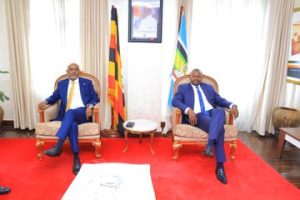
KAMPALA — Ambassador Adonia Ayebare has officially assumed office as Uganda’s Minister of Foreign Affairs, pledging to strengthen the ministry’s diplomatic work, improve communication with Uganda’s missions abroad and restore discipline within the country’s diplomatic service.
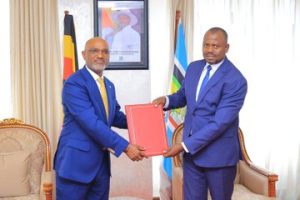
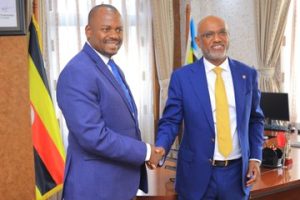
Ayebare assumed office on Wednesday, August 12, 2026, taking over the portfolio from Hon. Haruna Kyeyune Kasolo, who had been holding the position in an acting capacity since June 22, 2026.
The handover at the Ministry of Foreign Affairs headquarters in Kampala marked Ayebare’s return to an institution where he has spent much of his diplomatic career.
Speaking after assuming office, Ayebare said he was returning to familiar territory, having joined the ministry as a Third Secretary and worked through various levels of the diplomatic service.
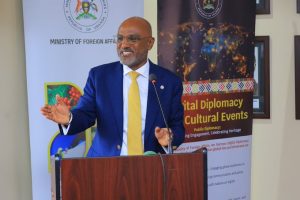
“I think this ministry is very easy to fix. Very easy to fix. It has the best people in government,” Ayebare said.
He commended the ministry’s recent handling of the repatriation of Ugandans from South Africa, saying the operation demonstrated the importance of the ministry’s core mandate of protecting and advancing Ugandan interests abroad.
He said his immediate focus would be creating a working environment that enables officials to perform their duties effectively, including improving communication between the ministry headquarters and Uganda’s diplomatic missions.
Ayebare said there should be no justification for delays in providing missions with instructions or responding to their requests, particularly when diplomats are dealing with sensitive and rapidly changing situations abroad.
“Now that I have come here, there is no excuse why we cannot support missions in real time, because those colleagues really work under difficult circumstances and they really do a good job,” he said.
He also promised to maintain an open-door policy, encouraging ministry staff to communicate with him directly, including through WhatsApp, on work-related matters.
Ayebare Warns Against Embassy Quarrels
The new minister issued a strong warning against internal disputes within Uganda’s diplomatic missions, saying such conflicts damage the country’s image and undermine diplomatic and commercial interests.
“I will not entertain petty problems in missions,” he said.
Ayebare urged heads of departments and officials at headquarters to help ensure that disputes within missions are resolved before they affect Uganda’s relations with host countries.
“Quarrels are a sideshow,” he said, arguing that persistent disagreements can cause foreign ministries in host countries to view Ugandan embassies as problematic.
He said the ministry should focus on building sustainable relationships, which he described as the essence of diplomacy.
“Diplomacy, the way I really simplify it, and I always talk about it at universities, is to build relations—simple and sustainable. The rest is really a result of that,” Ayebare said.
Calls for Accountability of Ambassadors
Ayebare also called for stronger accountability mechanisms for heads of Uganda’s diplomatic missions, including the implementation of formal performance charters.

He said he had worked as Uganda’s representative in New York for several years without signing such a charter with his supervising minister.
According to Ayebare, a formal accountability framework would help clarify the responsibilities of ambassadors and prevent situations in which heads of missions operate without sufficient oversight.
“If you don’t have the tool, you can have impunity, and the heads of missions also become governors,” he said.
He also rejected a simplistic distinction between career diplomats and political appointees, saying both categories can serve Uganda effectively if they meet the required standards.
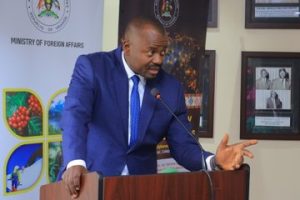
“Political appointees are not necessarily bad, and career diplomats are not necessarily the best. I think we are all Ugandans. We have the same interests. It is the quality,” he said.
He urged the ministry to eliminate tensions between career diplomats and political appointees and instead establish structures that hold everyone accountable.
Pushes Economic Diplomacy
Ayebare also endorsed the ministry’s efforts to strengthen economic and commercial diplomacy, but said such programmes should be measured by tangible results rather than the number of meetings or investment promotion events conducted.
“My only humble observation—and I am a student of Economic and Commercial Diplomacy (ECD)—is that it has to be about results. It has to produce results,” he said.
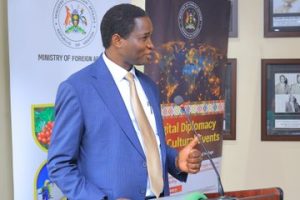
He cited Uganda’s engagement with Starlink, describing it as an example of the type of investment and economic engagement the diplomatic service should pursue.
Ayebare said his previous assignment in New York had not included a dedicated economic and commercial diplomacy team, but this did not prevent him from pursuing investment opportunities.
The ministry has identified the expansion of economic and commercial diplomacy among its priorities, with Ambassador John Leonard Mugerwa, who represented the Permanent Secretary at the handover, highlighting the acquisition and renovation of Uganda’s diplomatic properties abroad and the ministry’s expanding economic diplomacy efforts.
Global Challenges
Ayebare said Uganda’s foreign policy must also respond to growing global challenges, including geopolitical tensions, climate change, global health concerns and armed conflicts.
He argued that issues such as climate negotiations and carbon markets require strong diplomatic engagement and closer coordination between the Ministry of Foreign Affairs and other government agencies.
He cautioned against other ministries attempting to undertake diplomatic functions without adequate coordination with Foreign Affairs.
“The core mandate of MOFA is doing diplomacy and building relations. We need to go back to the basics of doing diplomacy,” he said.
Ayebare also called for regular meetings of senior ministry management to ensure that strategic decisions are made and implemented.

He proposed monthly meetings, including virtual sessions where necessary, saying senior management should provide political direction and move beyond simply discussing problems without resolving them.
Hon. Haruna Kyeyune Kasolo, who had been serving in an acting capacity, welcomed Ayebare and expressed readiness to draw on his extensive diplomatic experience.
Kyeyune highlighted Uganda’s expanding bilateral, regional and multilateral engagements during his tenure and the work of Uganda’s diplomatic missions in advancing the country’s interests abroad.
Ayebare said his work would begin immediately, pointing to upcoming diplomatic priorities, including Uganda’s engagement at the United Nations General Assembly and support for Uganda’s candidate for UN Secretary-General, Amb Olara Otunnu.