


ENTEBBE — Finance Minister Henry Musasizi has urged accountants to strengthen fiscal discipline, accountability and evidence-based decision-making, saying the profession is central to ensuring that public resources translate into tangible development outcomes.
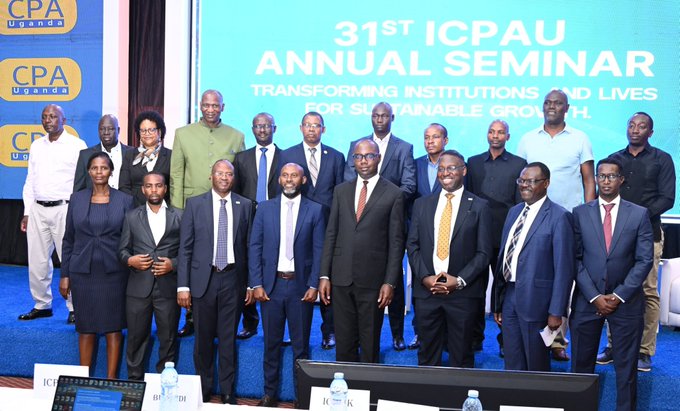
Musasizi made the call while officiating as Chief Guest at the 31st Annual Seminar of the Institute of Certified Public Accountants of Uganda (ICPAU), held on Wednesday at Imperial Resort Beach Hotel in Entebbe under the theme “Transforming Institutions and Lives for Sustainable Growth.”
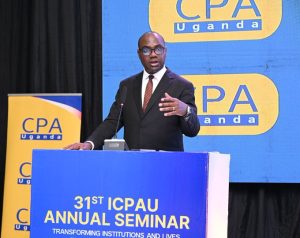
“As the profession evolves, accountants must embrace technology, strengthen their skills and uphold the highest standards of integrity to remain trusted partners in Uganda’s economic transformation,” Musasizi said.
He said accountants should move beyond recording and reporting financial transactions to providing analysis and insights that can guide policy, investment and institutional decisions.
“Evidence-based decision-making is fundamental to accelerating economic development, promoting sustainable business growth and avoiding costly policy and investment mistakes,” he said.
Musasizi noted that much of the evidence used in financial decision-making is generated, analysed and validated through the accounting function, placing accountants at the centre of economic management.
“Accountants are strategic partners in ensuring prudent fiscal management, effective public service delivery, and sustainable economic development,” he said.
Accountants and the national budget
The Minister highlighted the role of accountants across the three stages of Uganda’s national budget—planning and preparation, execution and control, and accountability and reporting.
He said reliable financial information enables government to track revenues and expenditure, safeguard public assets, manage liabilities and establish whether resources are producing their intended development outcomes.
Accountants, he added, have an important role in monitoring public finances in real time, including cash flows, spending limits and financial commitments before payments are made.
Such monitoring, Musasizi said, can help government prevent the accumulation of domestic arrears and contain large fiscal deficits.
He also called on accountants to adapt to technological changes transforming financial management, including artificial intelligence, blockchain and digital financial management systems.
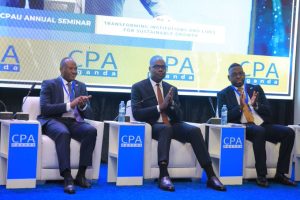
The minister reaffirmed government’s commitment to working with ICPAU to strengthen the accountancy profession and ensure it remains relevant to Uganda’s changing economic environment.
Put the customer at the centre
In his keynote address, CPA Patrick Ayota, Managing Director of the National Social Security Fund (NSSF), challenged professionals to rethink how institutions achieve sustainable growth.
Ayota argued that organisations should look beyond cost reduction and focus more deliberately on understanding customers, creating value and identifying new opportunities.
“Cost-cutting is a short-term fix. The real opportunity is on the revenue side, understanding your customer, creating value and finding new growth opportunities,” Ayota said.
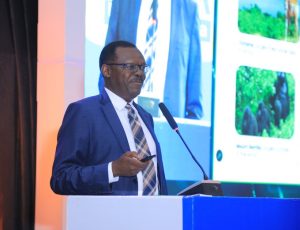
He urged finance professionals to work more closely with marketing, customer service and other departments to understand what customers need and improve the experience they receive.
Ayota also emphasised the importance of efficient internal processes, employee satisfaction, technology and clear communication in building institutions capable of sustained growth.
Accountants must think beyond numbers
Opening the seminar, CPA Timothy Ediomu, President of ICPAU, challenged accountants to rethink their role as the business environment changes.
He called for continuous professional development, greater use of technology and a renewed commitment to integrity, saying accountants must increasingly provide strategic advice rather than simply report financial figures.
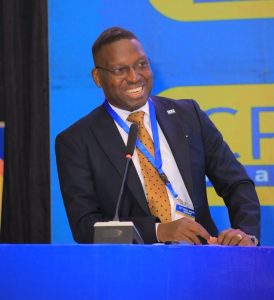
The three-day seminar has brought together accounting professionals, business leaders and other stakeholders for discussions on institutional transformation, technology, leadership and sustainable growth.
CPA Derick Nkajja, Secretary and CEO of ICPAU, welcomed participants and encouraged them to make the most of the professional engagement.
Leadership is more than performance
CPA Francis Kamulegeya, a business leader and social entrepreneur, focused on talent management and succession during his session.
He warned organisations against assuming that strong performance automatically translates into leadership potential. “A high performer is not automatically a future leader,” Kamulegeya said.

He urged leaders to deliberately identify high-potential employees, create environments where they can develop and prepare them for leadership before assigning them positions of responsibility.
Measuring both results and behaviour
Marsha Nyonyozi, Chief of People and Culture Transformation at dfcu Bank, addressed the role of organisational values and behaviour in employee performance.
“What gets measured gets attention. But how you deliver it matters just as much,” Nyonyozi said.
She explained how organisations can integrate customer service into performance management by linking it to individual performance measures and exposing employees to real customer experiences in branches and call centres.
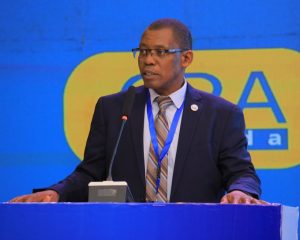
Her approach, she said, requires organisations to measure not only what employees achieve, but also how they achieve it.
The discussions at the seminar reflect a broader shift in the accountancy profession, with professionals increasingly expected to combine technical financial expertise with technology, leadership, strategic thinking and an understanding of the wider economic and institutional environment.