


Education scholars and policymakers in East Africa have been challenged to rethink how education policies are developed and implemented, with calls for stronger regional collaboration, locally relevant reforms and greater attention to inequalities affecting learners.
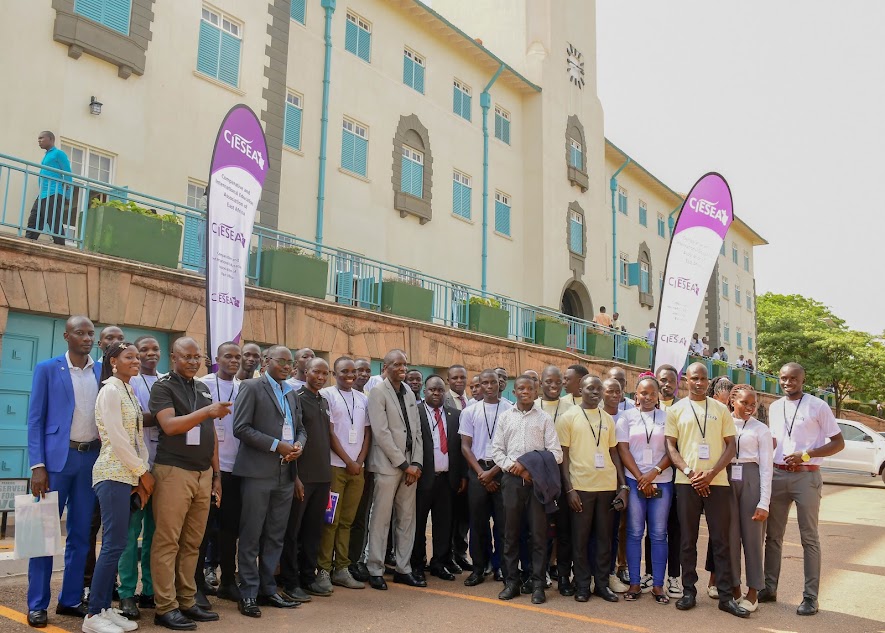
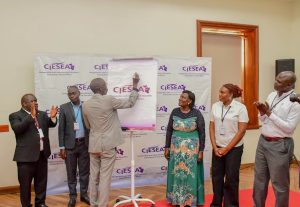
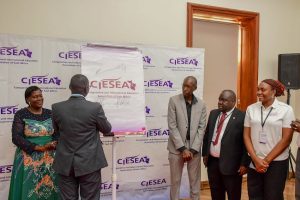
The call was made on Saturday, November 28, 2026, during the launch of the Comparative and International Education Association of East Africa (CIESEA), hosted by Makerere University’s College of Education and External Studies.
The association aims to enhance the quality and delivery of Comparative Education in higher education institutions by bringing together scholars, researchers, educators and policymakers to examine education systems, share knowledge and influence policy across the region.
Prof. Anthony Mugagga, Principal of the College of Education and External Studies, who represented Makerere University Vice Chancellor Prof. Barnabas Nawangwe, called for stronger collaboration among institutions and the development of education systems that reflect African realities while remaining internationally compatible.
“Set the bar very high. We need shared learning among institutions to improve our education systems,” Mugagga said.
He cautioned against importing education policies simply because they had worked in other countries, arguing that reforms must be examined in relation to the social, economic and cultural conditions in which they are expected to operate.
“Our education system was established largely by missionaries and colonialists. Unfortunately, they introduced their own ideologies and philosophies, many of which were not African,” he said.
Mugagga argued that Uganda and other East African countries needed to develop education systems that preserve their values while equipping learners to operate in an increasingly interconnected world.
He cited differences in the education structures of Uganda and Kenya, saying regional harmonisation should focus on compatibility rather than making the systems identical.
“We need to harmonise our education systems so that East African countries have compatible systems. They do not necessarily have to be identical,” he said.
Mugagga also questioned the pace and direction of education reforms, particularly the implementation of Uganda’s Competence-Based Curriculum, arguing that teacher preparation should be central to the process.
He said reforms should not begin with learners in classrooms while leaving teachers and institutions responsible for training them inadequately prepared.
“Should we first train teachers and then introduce changes in classrooms, or should we begin with learners and work backwards?” he asked.
He further cautioned against adopting technology without considering the circumstances of schools, noting that some countries in Europe were reconsidering the use of mobile phones in classrooms after earlier embracing them.
“Here in Uganda, we are still pushing to introduce phones into classrooms, yet we know that some schools do not even have electricity,” he said.
Mugagga called for research into teacher education, language instruction, assessment, learner transitions and equity for girls and learners with disabilities.
Regional collaboration and international standards
Dr Charles Muweesi, Director of the Directorate of Institutional Advancement at Busitema University and president of CIESEA, said East Africa had lacked an organised regional platform through which scholars of Comparative Education could coordinate research and share experiences.
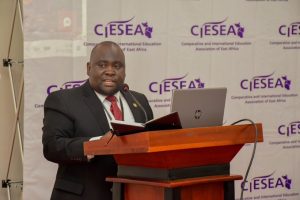
He explained that Comparative Education examines education structures, systems and policies, allowing countries to identify practices that work elsewhere and determine how they can be adapted to local circumstances.
“We ask: What works well here? What works well in another country? What does not work in either setting?” Muweesi said. “We then guide learners on how to contextualise good practices and eliminate those that are not suitable.”
He said scholars from East Africa had participated in international conferences, research collaborations and academic publications, but the absence of a regional association had limited their ability to coordinate their work and benefit collectively from those engagements.
“That is why we are privileged to launch this society. It is not just for Uganda but for the entire East African region,” he said.
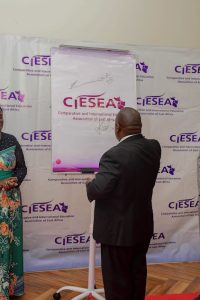
Muweesi said one of the association’s priorities would be to promote comparable education standards across the region, allowing qualifications and training obtained in one country to be recognised in another.
He pointed to the growing adoption of Competence-Based Education and Training (CBET), saying universities in the region were expected to align their curricula with the approach.
“By 2027, universities are expected to have converted their curricula to this approach,” he said. “The intention is to ensure that what a learner studies in Kenya can be compared with what another learner studies in Uganda.”
Muweesi said the association would also prioritise membership growth, research and innovation, bringing together undergraduate and postgraduate students, lecturers and other people interested in Comparative Education.
Policies must respond to local realities
In his keynote address, Dr Robert Tomusange, a lecturer at Mountains of the Moon University in Fort Portal and CIESEA Secretary General, warned that education systems often compare results without investigating the conditions under which learners produce them.
He illustrated the problem using two learners assigned to investigate a challenge in their communities. One has access to a phone and adult assistance at home, while the other must wait until the following day to use a shared school device.
Although both learners may be assessed using the same criteria, Tomusange said their circumstances are different. “Results travel much further than the explanations behind them,” he said.
He argued that comparing performance without examining access to resources, available time, language and other circumstances could produce misleading conclusions about learners and schools.
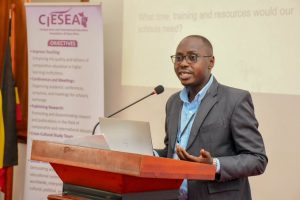
“Comparative Education allows us to examine the circumstances behind educational outcomes rather than simply accepting the results at face value,” he said.
Tomusange said the discipline should not be restricted to comparing countries, but should also examine differences between schools, classrooms, communities and individual learners.
He also raised concerns about education policies imported from other countries without sufficient consideration of local conditions.
“I would argue that many of the policies we have today are knee-jerk reactions to initiatives that have worked elsewhere. We assume that because something succeeded in another country, it will automatically succeed here,” he said.
He called for education policies to be informed by evidence, adequate financing, teacher preparation and the participation of communities affected by the decisions. “Our first responsibility should be to address our local problems before turning to external challenges,” he said.
Tomusange said the association could bring together ministries, curriculum development agencies, examination bodies and district authorities to develop policy briefs and build consensus around education reforms.
He also called for more inclusive assessment methods that recognise differences in learners’ circumstances and individual contributions, particularly in group assignments. “Are we assessing learners fairly when their circumstances are different?” he asked.
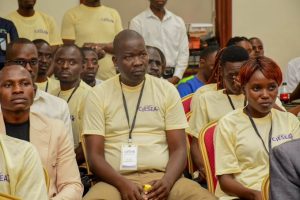
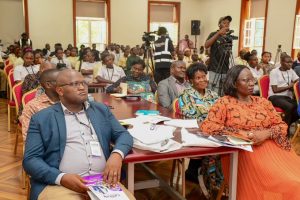
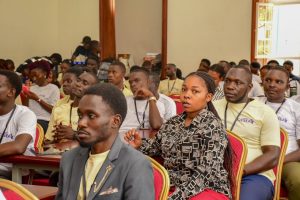
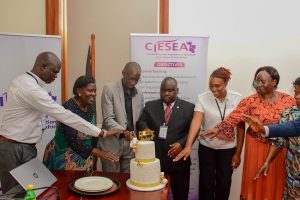
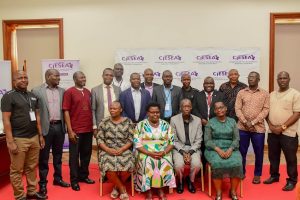
The launch brought together educators, researchers and representatives of academic institutions from across the region, with the association expected to provide a platform for regional and international collaboration in Comparative and International Education.