


President Yoweri Kaguta Museveni has urged European investors to expand their investments in Uganda’s manufacturing, energy, agriculture and infrastructure sectors, saying productive investment is essential for creating jobs, expanding markets and accelerating economic transformation.
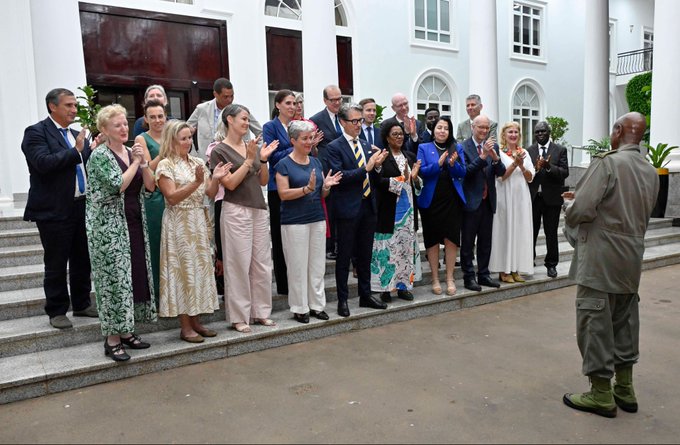
The President made the call at State House Entebbe during a meeting with European Union ambassadors and investors, where he highlighted Africa’s growing population and expanding consumer market as opportunities for European businesses.
“This is what we have been advising our European friends to look at, because Africa is a big potential market with its fast-growing population,” President Museveni said.
He said Uganda was seeking investments that would increase domestic production, create employment and strengthen trade links between Uganda and European markets.
President Museveni welcomed ongoing and proposed European investments in infrastructure, arguing that projects connecting Uganda to wider markets would benefit both investors and the country.
“All these projects are music to my ears. By constructing these projects here, you are linking the market of Uganda to that of Europe. Why can’t anyone see that?” he asked.
The President said political stability and a supportive business environment were necessary to attract long-term investment. He attributed instability in some African countries partly to identity-based politics, including tribalism and religious divisions, as well as misunderstandings about the role of the private sector in economic development.
He said Uganda needed to sustain conditions that allow businesses to invest, expand production and employ more people.
Museveni calls for affordable electricity
President Museveni identified the cost of electricity as a major factor affecting the competitiveness of Ugandan manufacturers, arguing that affordable power would enable businesses to produce goods at lower costs.
While welcoming private investment in hydropower generation, he called for greater attention to electricity tariffs, alongside improvements in railway transport and access to financing for productive enterprises.
He urged the European Investment Bank to increase financing for strategic infrastructure, particularly railway development, electricity generation and distribution, and selected road projects.
On roads, he encouraged European investors to explore construction and financing arrangements, including tolling models where appropriate.
The President said infrastructure investment should be assessed partly by its capacity to connect producers to markets, lower transport costs and improve the movement of goods within Uganda and across borders.
He also pointed to the Uganda Development Bank as a source of financing for businesses engaged in productive activities, saying the government had retained the institution to support investments that expand production and create jobs.
President defends tax incentives for investors
President Museveni reaffirmed the government’s support for tax incentives intended to attract investment, particularly in manufacturing. He emphasised the importance of ensuring that eligible businesses benefit from a 10-year tax holiday.
He argued that the government’s priority should be to attract businesses that produce goods and employ Ugandans, with economic activity generating public revenue through consumption and income taxes.
“We are not interested in direct tax. What we want from you is jobs and production, and I will get taxes indirectly through consumer tax and income tax,” President Museveni said.
His remarks underline the government’s position that tax incentives can help attract investment and expand the country’s productive base.
However, the effectiveness of such incentives depends on whether the investments generate sufficient employment, production and wider economic benefits to justify the revenue forgone through tax exemptions.
Agriculture and agro-processing opportunities
The President also urged European investors to explore opportunities in agriculture, irrigation, fish farming and agro-processing, citing Uganda’s agricultural resources as a potential foundation for industrial growth.
He identified maize and soya beans as examples of locally available raw materials that could support animal-feed manufacturing and other processing industries.
President Museveni said greater investment in agro-processing would increase the value of agricultural produce, strengthen livestock production and create additional markets for farmers.
He also highlighted plans to expand irrigation and fish farming to improve agricultural productivity, increase household incomes and provide alternative livelihoods for communities living near environmentally sensitive wetlands.
The proposed investments would complement efforts to move beyond exporting raw agricultural commodities towards processing more of Uganda’s produce locally.
Environmental protection and investment
President Museveni also welcomed investments aimed at addressing environmental challenges associated with oil development, stressing the need to protect Uganda’s freshwater resources.
He linked environmental sustainability to the conservation of forests and other natural resources, highlighting the need to balance economic development with the protection of ecosystems.
The meeting provided a platform for discussions on Uganda’s investment priorities and the potential contribution of European capital, technology and business partnerships to the country’s economic transformation.
President Museveni’s appeal centred on a clear economic proposition: Uganda needs investors who can turn its raw materials, infrastructure and growing consumer market into productive enterprises that generate jobs and expand exports.
Whether that proposition translates into increased investment will depend not only on Uganda’s market potential, but also on the cost of doing business, reliable infrastructure, access to affordable financing and the policy conditions under which investors operate.