


In Part 8 of Guardians of Kikurungo, we climbed Kinyamugara, the Kingdom of Millet, bringing us to the end of our journey. But some journeys leave something behind — a way of seeing the world, a memory, a responsibility.
Part Nine — Final Chapter
The Guardians We Become: Carrying the Hills Into the Future
Every generation inherits a world it did not create and leaves behind a world it must answer for. The final question of Kikurungo is not what we received, but what we choose to protect.
By Rogers Atukunda
*
For nine parts, I have taken you back to a place that existed long before I knew I would one day write about it.
Every journey eventually returns to where it began.
For me, that journey returns to the hills of Kikurungo and Kashangura.
It returns to the paths where I walked as a child.
It returns to the kraals where cattle carried the history of families.
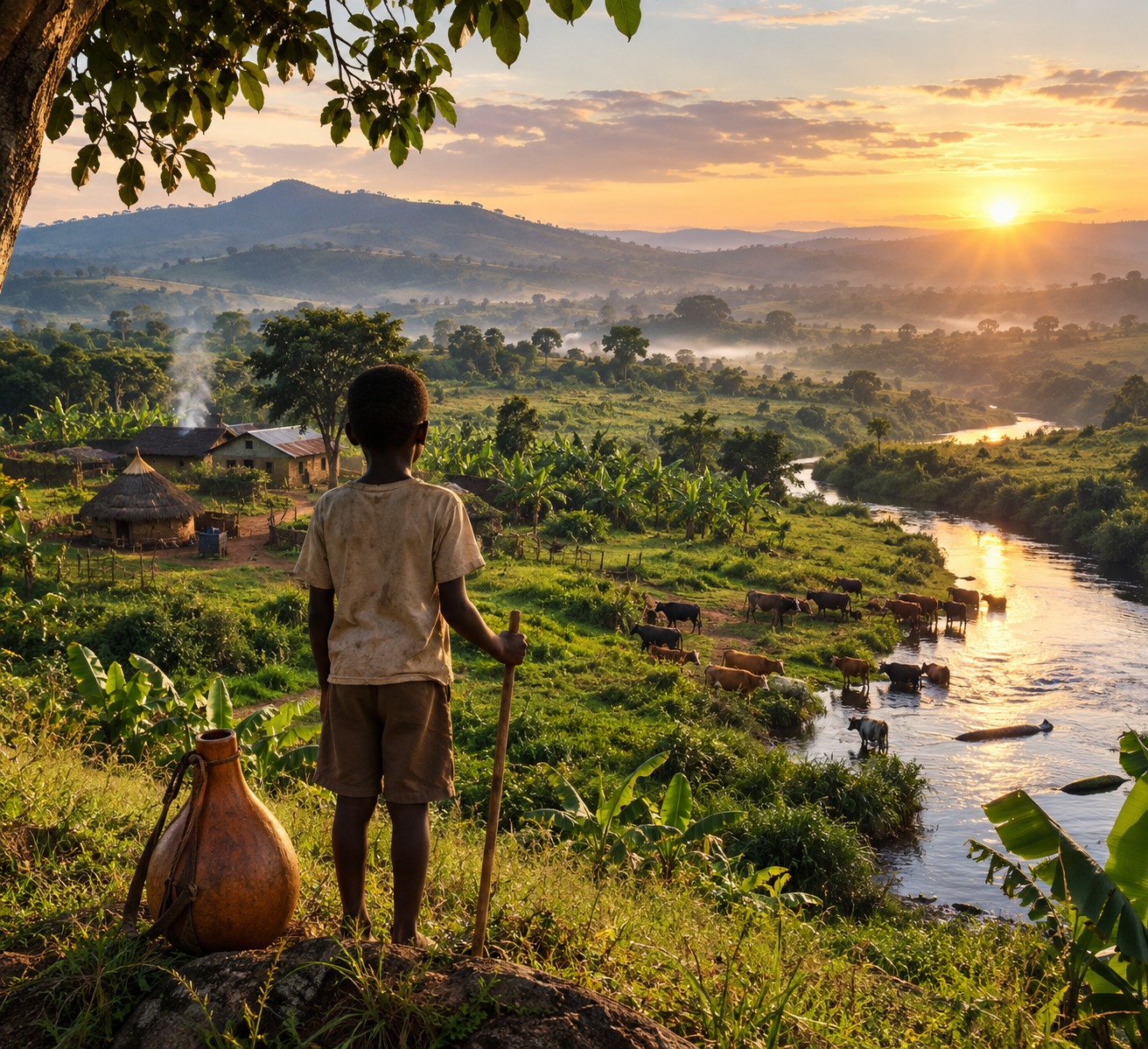
It returns to the gardens where millet grew under the watch of farmers who understood the language of seasons.
It returns to the homestead where my grandmother carried her orubango and where my uncle Ishaka Nterwa demonstrated that courage was not a word but a responsibility.
It returns to the dogs that guarded our home.
Champion.
Kadoma.
Simba.
It returns to Kasa, the princess of the herd who ruled without a crown.
These memories are not simply stories from childhood.
They are lessons.
The Question Every Generation Must Answer
Every generation inherits something.
A landscape.
A culture.
A language.
A tradition.
A story.
But inheritance comes with a question.
What will you do with what you have received?
Will you protect it?
Will you transform it?
Will you forget it?
The greatest danger facing heritage is not always destruction.
Sometimes it is indifference.
Things disappear because people stop noticing their value.
A hill becomes just a hill.
A cow becomes just livestock.
A seed becomes just food.
An old story becomes just a story.
Until one day, someone realises something precious has vanished.
Every generation receives a world it did not create.
The question is whether we will consume it, forget it, or protect it for those who come after us.
The Meaning of Guardianship
When I began writing these memories, I thought I was writing about my childhood.
But the deeper I travelled into the memories, the more I realised I was writing about a philosophy.
Guardianship.
A word I did not know as a child.
A responsibility I understood before I knew its name.
My grandmother was a guardian.
She protected family.
She protected generosity.
She protected tradition.
My uncle Ishaka was a guardian.
He protected people.
He protected cattle.
He protected the vulnerable.
The cattle keepers were guardians.
They protected animals and knowledge.
The farmers were guardians.
They protected seeds and the land.
The dogs were guardians.
They protected the home.
Even the hills were guardians.
They protected memory.
The Snake We Chose Not to Kill
There was a large black cobra that lived beneath the bridge over the Omukabare River in Kashangura. We called it Enkywera (a spitting cobra).
It was enormous. When it crossed the road, it left a mark that looked almost like the track of a motorcycle tyre. One side of its tail had been cut off —a farmer called Kwerema had accidentally injured it while digging — but somehow the snake survived and continued to live beneath the bridge.
What made Enkywera unusual was not its size.
It was the fact that nobody killed it.
This was strange because there was a constant war between humans and snakes.
I remember an encounter with snakes at the river. I was fetching water when two huge green mambas began fighting only a few metres from me. I was so absorbed in what I was doing that I had not noticed the danger.
My sister Grace did.
She saw them before I did and saved me.
We killed snakes whenever we found them, and snakes, given the chance, would bite us. Yet Enkywera seemed to have been granted an exception.
Everyone knew where it lived.
Everyone knew when it usually crossed the road.
Sometimes we would even sit at the bridge with our legs swinging suspendly above the flowing river, waiting simply to watch the snake pass on its way to the river to drink.
The snake itself seemed to behave as though it knew it had been granted a special privilege.
Perhaps it was simply its enormous size, but Enkywera never seemed to hurry when crossing the road. It usually crossed the road at around 3 pm and went back to the forest at around 6 pm.
It moved slowly and confidently, crawling across as though the road belonged to it and it had somewhere important to go. It would only raise its head when we children made too much noise swimming in the river, briefly looking in our direction before continuing with its business.
Even the cattle did not seem afraid of it. Grace remembers that they would come down to the river and drink alongside Enkywera, quietly quenching their thirst in the same water. There was no panic, no scattering of the herd. Somehow, the snake and the cattle had learned to share the river.
For some reason, whenever we returned from school at the wrong hour, we searched the ground for the track it made while crossing the road and even felt a sense of loss for not having witnessed the spectacle of the day.
Why did nobody kill it?
I asked Grace recently, because the question had stayed with me.
Her answer was simple. Enkywera had never attacked anyone. It was old. It was peaceful. And people believed that if you killed it, you would have to take herbs to protect yourself from a curse.
Perhaps that was the explanation.
Or perhaps it was something deeper — a village understanding that did not need to be written down.
Nobody called it conservation. Nobody held a meeting and agreed that Enkywera should be protected. There was no rule, no sign and no punishment for killing it.
And yet, somehow, the whole village behaved as though there were a rule.
That is what fascinates me now.
We feared snakes. We killed them. But we made room for this one.
Perhaps guardianship sometimes begins like that — not with a declaration, but with a decision repeated so many times that it becomes a way of life.
As children, we did not have words like biodiversity, conservation or coexistence.
We simply knew that some things were dangerous, some things were useful, some things were to be feared — and some things, for reasons we did not always understand, were allowed to live.
A curriculum that works for Africa
My grandmother never spoke about curriculum. She never used words such as decolonisation, epistemic sovereignty or competency-based education. She had no reason to.
She simply expected children to know things.
Know the cattle.
Know the hills.
Know the seasons.
Know the plants.
Know the people.
Know what could be eaten and what could kill you.
Know which animal belonged to which lineage.
Know how to behave.
Know how to work.
Know how to look after something that depended on you.
That was education.
It just did not look like the education I would later encounter in a classroom.
Years later (August 2026), I found myself at an international conference on curriculum development in Munyonyo, Kampala, listening to professors, doctors, researchers and education specialists discuss the future of African education.
One question kept returning in different forms:
How do we redesign education so that it truly works for Africa, by Africa and with Africa?
I found myself thinking about Kikurungo.
Because my grandmother had already answered part of that question without ever asking it.
Her classroom was the cattle kraal.
The hill was a geography lesson.
The garden was a laboratory.
The cooking fire was a chemistry lesson.
The river was a classroom.
The stories of elders were history.
The herd was biology, economics, genealogy and mathematics.
And the child was expected to observe.
That last part may be the most important.
The child had to look.
A cow was never simply a cow.
There was Bihogo. Siina. Gaaju. Mayenje. There were different colours, patterns, horns, temperaments and bloodlines. You learned to recognise them because the knowledge had a use.
You were not studying taxonomy for an examination.
You were trying to know the animal standing in front of you.
That is a different kind of education.
What happens when knowledge leaves its world?
At the conference, Zambian Professor Benson Banda posed a question about making education work for Africa. He also warned about learners who can recite the periodic table but cannot name a local plant.
That sentence stayed with me.
Because I began thinking about the child I once was.
I might not have known the periodic table.
But I knew the cattle.
I knew the hills.
I knew the rivers.
I knew the games children played.
I knew the plants we ate.
I knew the animals that could hurt us.
I knew the people who could be trusted and those we approached carefully.
I was not educated in the language of modern competencies.
But I was being trained to notice my world.
And perhaps that is one of the things modern education sometimes forgets to teach.
What happens when a child can define biodiversity but cannot identify the plants growing outside the classroom?
What happens when a student can write an essay about climate change but cannot read the signs of a changing season?
What happens when someone can describe an Ankole cow from a textbook but cannot tell one animal from another when standing in the kraal?
We may produce children who are highly literate about the world beyond them while becoming increasingly illiterate about the world beneath their feet.
That is the paradox.
The cow was the textbook.
Think again about the cattle.
A conventional textbook might give a child a paragraph titled “Characteristics of Ankole cattle.”
Long horns.
Long legs.
Different colours.
Adaptation to the environment.
And the lesson is over.
But the child of my grandmother’s world learned something much larger.
A cow had a name.
It had a lineage.
It had a temperament.
It had a history.
It had value.
It had relationships with other animals and with the people who cared for it.
The child learned to distinguish.
To classify.
To remember.
To compare.
To care.
To take responsibility.
A child could learn biology from a cow.
Ecology from a hill.
Economics from cattle ownership.
History from family herds.
Language from names.
Ethics from responsibility.
And mathematics from counting and managing a herd.
Nobody called any of this interdisciplinary learning.
Life did not need the word.
The danger of turning everything into a slogan
But I would be careful here.
I do not want to turn the past into a paradise.
Our grandparents were not right about everything.
Indigenous knowledge, like every other knowledge system, contained wisdom, assumptions, mistakes and beliefs that could be questioned.
The answer is not to reject modern education and run backwards into the past.
Nor is decolonisation useful simply because it is a fashionable word.
A child can memorise epistemic sovereignty for an examination and still go home unable to name the tree outside the classroom.
That would be the ultimate irony.
The question is therefore not whether everything our grandparents knew was correct.
It is something harder: why did we begin to assume that knowledge becomes legitimate only after someone outside the community validates it?
My grandmother did not need a certificate to know her cattle.
She did not need a university to tell her which plants mattered.
She did not need a curriculum developer to explain that children should learn from their environment.
She lived inside that knowledge.
And the community transmitted it.
The problem was always there.
One of the ideas discussed at the conference was the danger of producing people who are globally relevant but locally irrelevant.
That phrase stopped me.
Because it sounded like a description of a problem I had been circling in this memoir without knowing its name.
Imagine a graduate who can discuss entrepreneurship, artificial intelligence, climate change and sustainable development in fluent English.
Then take that graduate back to the village.
There is a dying cow.
A failing crop.
A polluted stream.
A damaged wetland.
A community struggling with unemployment.
A problem nobody has written in an examination paper.
Can the graduate diagnose what is happening?
Can they ask the right questions?
Can they connect what they learned at university to what is happening around them?
Or were they mainly trained to answer questions that somebody else had already formulated?
That is the difference between knowing information and knowing what to do with it.
And this is where another speaker at the conference, Tony Devine from Global Peace Foundation, brought artificial intelligence into the conversation.
His point was simple but unsettling: with knowledge increasingly available everywhere, simply knowing things is no longer enough.
I thought again about Kikurungo.
Because a machine can tell you the characteristics of an Ankole cow.
It can tell you the scientific name of a plant.
It can explain the weather.
It can generate a biodiversity essay.
But it has never stood beside the kraal at dawn.
It has never watched one cow push another aside.
It has never learned the personality of an animal from years of living beside it.
It has information.
The child had experience.
Those are not the same thing.
What did we know before we knew we knew?
Perhaps this is why I have come to see my grandmother differently while writing these stories.
I used to think of her as an old woman from my childhood.
The tough woman who always embarrassed me by calling me her ‘little husband’.
Now I think of her as a teacher whose classroom I did not recognise because nobody had put a blackboard in it.
She taught through expectation.
She expected us to know.
She expected us to watch.
She expected us to help.
She expected us to remember.
She expected us to understand consequences.
There was no examination paper asking whether we understood responsibility.
Responsibility was simply given to us.
If you were looking after cattle, you had to bring them home.
If you were sent for water, you had to return with it.
If you knew which plant was safe, you had better know it correctly.
If an animal depended on you, you could not simply decide you were tired of the lesson and go home.
The world itself was the examiner.
Perhaps we did not lose knowledge. Perhaps we stopped recognising it.
This is where the conference and Guardians of Kikurungo finally meet.
The educators are approaching the question from curriculum theory.
I am approaching it from memory.
They speak about indigenous knowledge systems, local relevance, practical competencies and the role of communities in education.
I remember a grandmother, cattle, hills, rivers, fires and children who were expected to know their surroundings.
Different roads.
The same clearing.
And that is why I no longer see these stories simply as memories of a rural childhood.
They are an archive.
Not an archive of documents.
An archive of ways of seeing.
When I remember Kasa, I am remembering more than a cow.
When I remember Simba, I am remembering more than a dog.
When I remember the games we invented, I am remembering more than children’s mischief.
When I remember the rivers, the plants, the hills, the elders and the fires, I am remembering a world in which knowledge was embedded in ordinary life.
We did not separate biology from agriculture.
We did not separate history from family.
We did not separate economics from cattle.
We did not separate environmental knowledge from the landscape.
Life itself had not yet been divided into school subjects.
What happens next?
I do not think the answer is to go backwards.
The future belongs to children who can use modern science, technology and artificial intelligence while remaining capable of seeing the world immediately around them.
A child should be able to use AI and still know the local plant.
Understand climate science and still read the landscape.
Study biology and still recognise the animal standing before them.
Become globally connected without becoming locally blind.
Perhaps Africa does not have to choose between the grandmother and the algorithm.
Perhaps we need both.
The machine can provide information.
The human being must provide judgement.
The machine can identify a species.
The child must learn why that species matters.
The machine can generate an answer.
Who teaches the child which question is worth asking?
That may be the real question.
From Kikurungo-Kashangura to the World
Kikurungo and Kashangura were places of hills, cattle, rivers, gardens, fires, games, stories, animals and elders. It was the world in which I grew up.
And so I return to the word that began this journey:
Guardianship.
I first encountered it through people.
My grandmother.
My uncle.
My parents.
The elders.
Then through animals.
Cattle.
Dogs.
Cats.
Birds.
Even Enkywera, the enormous cobra beneath the Omukabare bridge, somehow protected by an unwritten agreement between the people of Kashangura and the wild.
But perhaps guardianship was never only about protecting something.
Perhaps it was also about knowing what you had been entrusted with.
You cannot guard what you cannot recognise.
You cannot care for what you do not understand.
And you cannot inherit a world you have been taught to ignore.
That may be what Kikurungo has been trying to tell me all these years.
We thought we were raising children.
Perhaps we were really preparing guardians.
Guardians of cattle.
Guardians of families.
Guardians of stories.
Guardians of land.
Guardians of memory.
And eventually, guardians of knowledge.
I began this journey by looking backwards.
But I no longer think the past is where this story ends.
Perhaps the real question is what we carry forward.
Because Africa does not need to choose between the knowledge of its ancestors and the technologies of its future.
It needs a generation capable of standing between the two worlds without becoming a stranger to either.
And perhaps that is what it means to become a guardian.
To inherit something.
To understand it.
To question it.
To protect what deserves protection.
To change what must change.
And, when the time comes, to hand something worthy to the next generation.
I once thought I was writing about what I remembered.
Now I wonder whether I was remembering what we had forgotten.
And perhaps that is where the journey from Kikurungo to the world finally ends.
Or perhaps it is where another journey begins.
When I left the hills and entered the wider world, I carried Kikurungo and Kashangura with me.
I carried the smell of cattle.
I carried the sound of dogs at night.
I carried my grandmother’s wisdom.
I carried my uncle’s courage.
I carried the taste of millet.
I carried the image of Kasa walking confidently through thousands of cattle.
I carried Simba standing silently as protector of our home.
At the time, I did not know these were lessons.
I only knew they were memories.
But memories are often lessons waiting for the right moment to reveal themselves.
Why These Stories Must Be Told
The world is moving quickly.
Many communities are losing their traditional knowledge.
Elders are passing away.
Young people are moving away from ancestral lands.
Languages are weakening.
Traditional practices are disappearing.
But every story preserved is a small victory against forgetting.
Writing this memoir is my way of standing among the guardians.
Not because I have all the answers.
But because I received something valuable.
And what is received must eventually be passed on.
The Guardian’s Promise
The final lesson of Kikurungo and Kashangura is simple.
Guardianship is not about possessing something forever.
Nothing belongs to us permanently.
The land existed before us.
The animals existed before us.
The traditions existed before us.
We are only temporary custodians.
We borrow from the past.
We live in the present.
We prepare for the future.
That is the responsibility.
Final Words
I began this journey searching for memories.
I found a philosophy.
I began writing about animals.
I found teachers.
I began writing about a grandmother.
I found a definition of leadership.
I began writing about hills.
I found a place that raised me.
Kashangura gave me my first education.
The guardians of Kikurungo gave me my first understanding of responsibility.
And now, by telling these stories, I accept the responsibility passed down to me.
To remember.
To protect.
To preserve.
To become a guardian.
*
A SoftPower News Special Feature Series
Dedicated to the guardians who came before us — and the guardians we must become.
*
Editor’s Note: This concludes the nine-part memoir series The Guardians of Kikurungo. However, the journey into heritage continues. The stories of Ankole cattle, millet traditions, indigenous knowledge and the communities that preserve them remain part of a larger conversation about protecting Uganda’s cultural memory for future generations.