


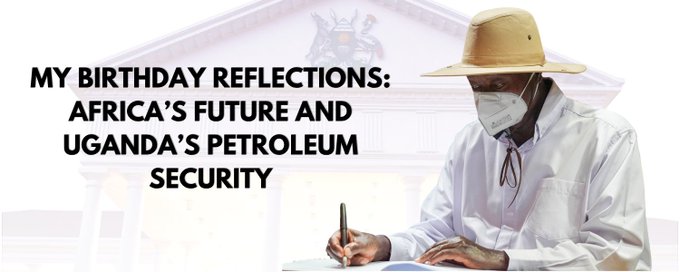
KAMPALA — President Yoweri Kaguta Museveni has used his 82nd birthday message to call for greater African economic and political integration, saying the continent must complete what he described as three “historical missions” to secure its prosperity and strategic interests.
Museveni, who turned 82 on September 15, 2026, said he received congratulations from about eight million well-wishers and expressed hope that he and his wife, Janet Museveni, would live for another 18 years.
“I want to thank the 8 million well-wishers that sent me congratulations on my 82nd birthday on the 15th of September 2026,” Museveni said.
“Those well-wishes and God’s blessings will push me and Maama for another just 18 years to reach 100 years of age and for Maama to reach 96 years.”
Looking beyond his birthday, Museveni called on Africans to pursue what he identified as three outstanding historical missions: economic prosperity through an integrated African common market, strategic security through political integration, and greater unity based on what he described as the “brotherhood” of Africa’s major linguistic groupings.
“These are: prosperity for the Africans through integrating the African common market to help the wealth creators expand; strategic security against all threats through the political integration of the continent where possible, such as is the case with the East African Federation,” he said.
Museveni also cited what he described as the “undugu” (brotherhood) of Africa’s four major linguistic groupings: Niger-Congo, including Bantu and Kwa; Nilo-Saharan, including Cushitic and Nilotic languages; Afro-Asiatic, including Arabic, Tigrinya and Amhara; and Khoisan.
“It is the fulfilment of these historical missions, that will guarantee our prosperity and strategic security,” he said.
Museveni Revisits Uganda’s Petroleum Imports
The President also used the message to clarify remarks he recently made during the commissioning of the foundation stone for a 320-million-litre oil storage facility at Buyala.
He accused sections of the Kenyan media of adding “pilipili” (red pepper) to his remarks concerning Uganda’s historical reliance on intermediaries in the procurement of petroleum products.
Museveni said that during the struggle against former President Idi Amin, his group had criticised the government for placing people without formal education in positions of responsibility.
“When we were fighting Idi Amin, among other things, we used to say that he had destroyed governance in Uganda by putting abatasoma (the ones that did not go to school) in charge of running the affairs of the Country,” he said.
However, Museveni said the government later discovered that some highly educated civil servants were also contributing to problems in the administration.
“It was much later that we discovered that those civil servants (PS, Commissioners, etc.), were ruining the Country,” he said.
He cited Uganda’s procurement of petroleum products as an example, saying he was unaware for years that the country was purchasing fuel through middlemen in Kenya.
“In the matter of purchasing Petroleum products for the country — a whole Country-Uganda — I did not know that these wonderful People were buying those products through middlemen in Kenya by tendering to those middlemen,” Museveni said.
He said Kenyan Senator Jirongo informed him of the arrangement around 2019, after which he instructed then Energy Minister Irene Muloni to address the issue.
“Nevertheless, nothing happened, until 2023 when we linked up with a group known as Vitol that has refineries in different parts of the World and are also bulk suppliers,” he said.
Museveni Details Fuel Price Changes
Museveni said Uganda subsequently entered into an initial agreement with Vitol on August 18, 2023, under which petroleum products would be purchased at lower prices per metric tonne.
According to figures provided by the President, the price of diesel fell from $118 to $83 per metric tonne, while petrol declined from $97.50 to $61.50. For aviation fuel, Museveni said the price fell from $114.25 to $79.25 per metric tonne.
Museveni also praised Kenyan President William Ruto for supporting the new arrangement, saying Uganda was subsequently allowed to transport its petroleum products through Kenya’s oil pipeline.
He said Uganda was also permitted to acquire a 20.15% shareholding in the pipeline. “I want to thank H.E Ruto because he prevailed over some actors in Kenya who were trying to resist,” Museveni said.
“That is how we got our new arrangement and the Kenya Government allows us to pump our products through the Kenya oil pipeline in which the Kenya Government allowed us to have shares of 20.15%.” “We are very happy with the Kenya Government of President Ruto on this matter,” he added.