



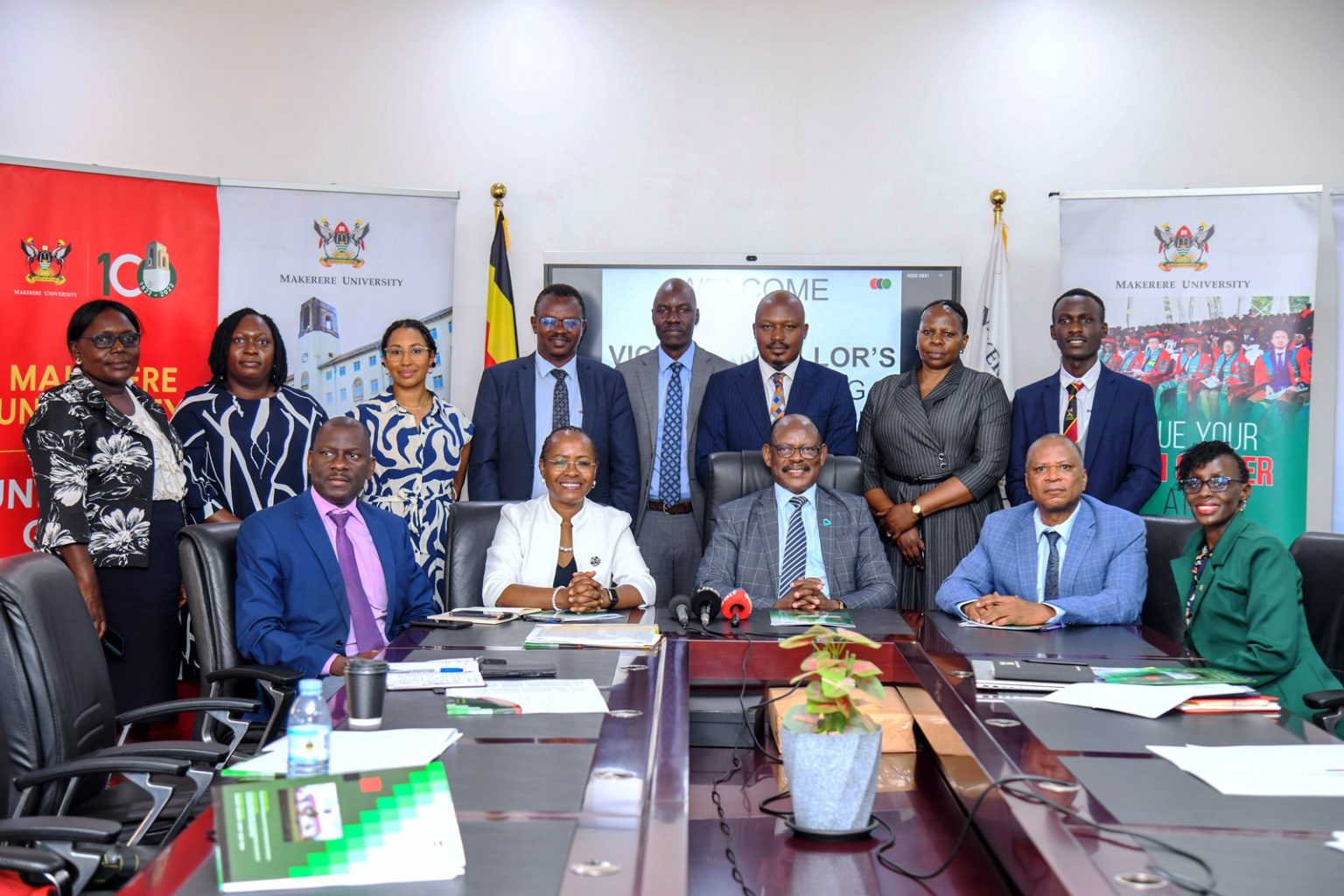
Makerere University has risen 295 places in the latest Webometrics global university rankings, while the number of postgraduate students graduating from the institution has increased steadily over the past four years, Vice Chancellor Prof. Barnabas Nawangwe has said.
Addressing journalists at a press conference on Tuesday, September 15, 2026, Nawangwe said Makerere moved from 1,071st globally in 2025 to 776th in the July 2026 Webometrics Ranking of World Universities.
The university also improved its position in Africa, moving from 13th in January 2026 to 11th in July, while retaining its position as the top-ranked university in Uganda. “Makerere remains the top-ranked university in Uganda and East Africa,” Nawangwe said.
The July ranking places Makerere among more than 32,000 universities assessed globally. Its Impact Rank improved from 1,593 to 1,185, while its Excellence Rank, which considers papers among the top 10 per cent most cited between 2019 and 2023, improved from 1,095 to 715.
Nawangwe attributed the improvement partly to increased research output and the university’s efforts to strengthen its digital and academic presence.
The university said it would continue expanding its online presence through academic journals and other research platforms.
The ranking comes as Makerere seeks to strengthen its position as a research-led university, with postgraduate training and completion emerging as a major institutional priority.
Postgraduate completions rise
According to figures presented by the university, the number of postgraduate graduands has increased from 1,588 in 2023 to 2,922 in 2026.
The figures show 1,588 postgraduate graduands at the 73rd Graduation Ceremony in 2023, 1,874 at the 74th ceremony in 2024, 2,199 at the 75th ceremony in 2025 and 2,922 at the 76th ceremony in 2026.
The increase represents an 84 per cent rise in postgraduate graduands over the four-year period.
Nawangwe, however, said the figures should not be interpreted as meaning that all postgraduate students are completing their programmes within the prescribed period.
He said the university had not yet achieved a 100 per cent on-time completion rate and was therefore introducing a digital tracking framework to monitor the progress of Master’s and PhD students from admission through completion.
“The University has not yet reached a 100 per cent on-time completion rate,” Nawangwe said, adding that the institution was converting concerns over postgraduate completion into “institutional action.”
Under the new system, student progress will be monitored continuously rather than assessed only after students have graduated.
The accountability structure will run from the student to the supervisor or graduate coordinator, college or school, Directorate of Graduate Training and University Management.
The university has adopted the framework “TRACK – SUPPORT – ACCOUNT – COMPLETE”, under which students’ progress will be tracked, barriers identified and support provided, while supervisors and university units will be held accountable for delays.
Nawangwe said the objective was to “complete more students, on time and to the required academic standard.”
The push comes as Makerere continues to expand graduate training. The university invited applications for postgraduate diplomas, Master’s and doctoral programmes for the 2026/2027 academic year, with applications covering taught PhDs, Master’s programmes, postgraduate diplomas and PhDs by research.
The university subsequently released admission lists for its 2026/2027 postgraduate intake, covering Master’s, PhD and postgraduate diploma programmes across its colleges and schools.
Makerere admits 25,832 students
The university also announced that admissions for the 2026/2027 academic year had been completed, with 25,832 students admitted.
Of these, 2,169 students were admitted under government sponsorship, while 23,663 were admitted under private sponsorship.
Makerere had opened applications for undergraduate programmes to Ugandan, East African and international applicants during the admission cycle, while its admissions system also covered different categories including government sponsorship, private sponsorship, diploma holders, mature-age applicants and international students.
The university has also released the 2026/2027 postgraduate admission lists covering programmes across colleges including Health Sciences, Humanities and Social Sciences, Natural Sciences, Engineering, Law, Public Health and Business and Management Sciences.
Nawangwe said the growth in postgraduate completions was supported by government funding and digital systems designed to monitor students’ academic progress.
First Deputy Vice Chancellor in charge of Academic Affairs, Prof. Sarah Ssali, said the university was also strengthening quality assurance mechanisms around teaching, assessment and student progression.
“Students can evaluate their courses and provide feedback that can be used to improve teaching and learning as well as the research environment,” she noted.
Ssali said the Academic Management Information System (ACMIS) enables supervisors, colleges and university management to identify delays in student progress and take corrective action.
“The system allows students to monitor their academic progress and print testimonials without having to queue at university offices, with transcripts expected to be added in future.”
Makerere’s latest ranking and postgraduate figures therefore point to two measures of the university’s performance: how it is being seen globally and how effectively it is moving students through the academic system.
The challenge, Nawangwe indicated, is no longer simply getting Makerere higher in international rankings or admitting more students; it is ensuring that those students, particularly at postgraduate level, actually complete their studies on time and produce research that contributes to the university’s standing.