


KAMPALA — Finance Minister Henry Musasizi has called for faster implementation of economic reforms as Uganda seeks to transform its economy and achieve its target of becoming a competitive upper-middle-income country by 2040.
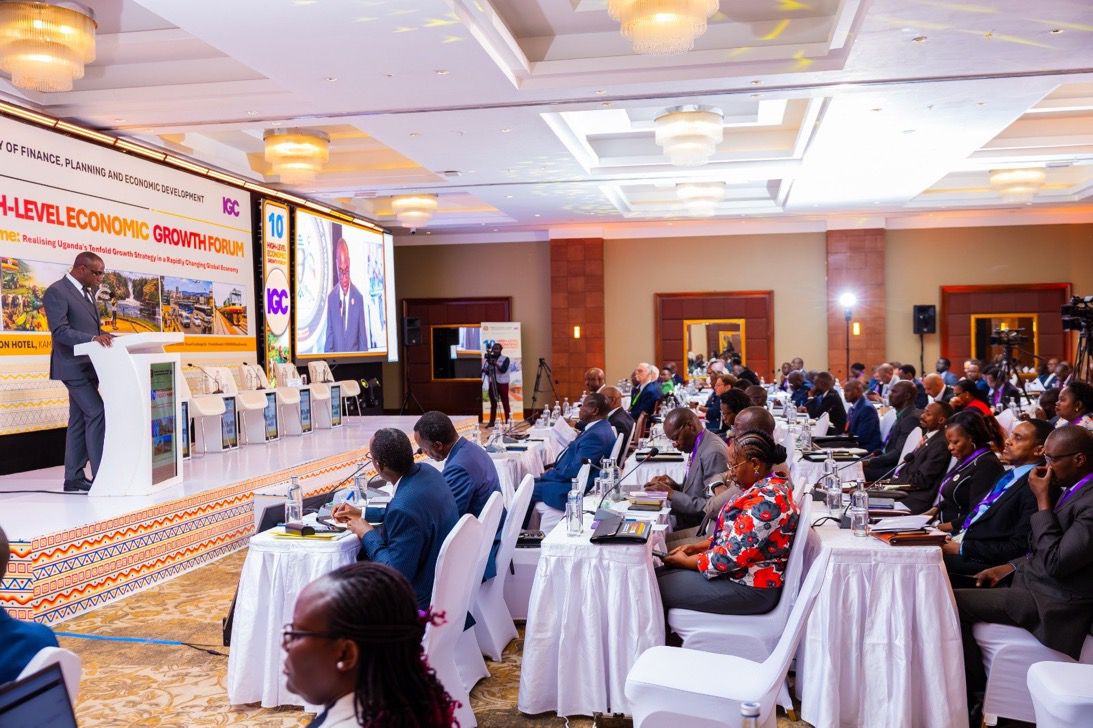
Musasizi made the remarks on Thursday while opening the 10th Economic Growth Forum at Sheraton Hotel, Kampala, saying the forum comes at a time when Uganda’s economic prospects are being shaped by rapid technological change, shifting global trade and investment patterns, geopolitical uncertainty, climate-related risks and demographic pressures.
“These developments present real challenges, but they also create significant opportunities. The task before us is to position Uganda to respond with agility, resilience and purpose,” Musasizi said.
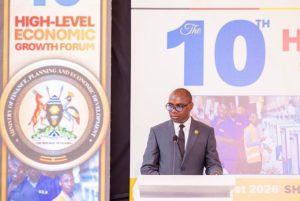
The forum, organised by the Ministry of Finance, Planning and Economic Development in collaboration with the International Growth Centre (IGC), is the tenth high-level Economic Growth Forum since the initiative began in 2017.
Musasizi said the forums have generated several policy proposals aimed at growing and transforming Uganda’s economy, arguing that the latest edition should produce practical interventions capable of addressing the country’s emerging economic challenges.
Uganda’s economy is estimated to have grown by 6.4 percent in the 2025/26 financial year, up from 6.3 percent in 2024/25.
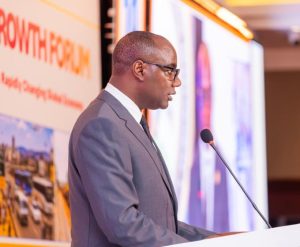
The minister said the government has now set an ambitious target of growing the economy tenfold by 2040, a goal he described as necessary if Uganda is to secure a stronger position in the global economy.
“I therefore encourage researchers and academics in the room to be bold in presenting evidence, including evidence that challenges conventional thinking,” Musasizi said.
“I also encourage policymakers to remain open to new ideas, and the private sector to provide candid feedback on the constraints that affect investment, productivity and competitiveness.”
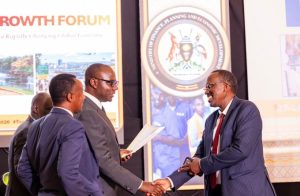
He said the forum should not end with another set of recommendations that remain on paper.
“If we can leave this Forum with some clear, evidence-based and implementable priorities, then we will have made a meaningful contribution to Uganda’s growth agenda,” he said.
The Permanent Secretary and Secretary to the Treasury, Ramathan Ggoobi, said the previous nine forums had helped Uganda identify some of the structural constraints holding back economic growth.
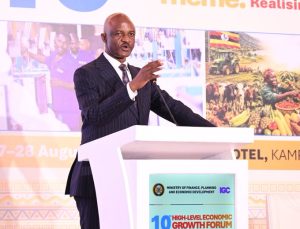
He said the challenge now was to move from diagnosis to implementation.
“The last nine economic growth forums have helped Uganda to identify what constrains economic growth,” Ggoobi said. “The next phase must be about execution, turning evidence into reforms, reforms into investment and investment into productivity, exports, jobs and incomes.”
Ggoobi said Uganda’s economy had recovered, with growth returning to above six percent, while tax reforms had made significant progress.

However, he said the next challenge would be to deepen tax compliance, broaden the tax base and ensure better value for money from public spending.
On Public Investment Management, Ggoobi said Uganda’s problem was increasingly not the absence of systems, but failure to enforce them. “Going forward, if the projects are not ready, there will be no budget and funding,” he said.
Ggoobi warned that Uganda’s ambition of achieving tenfold economic growth could not be achieved through the production of another strategy document.
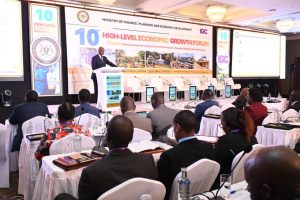
“The Economic Growth Forum has helped Uganda to understand what must be done. The next test is whether we can do it — faster, at scale and with measurable results. Tenfold Growth will not be delivered by another strategy. It will be delivered by execution,” he said.
The forum is also examining how global developments, particularly artificial intelligence, trade and climate change, are altering Uganda’s medium-term growth opportunities.
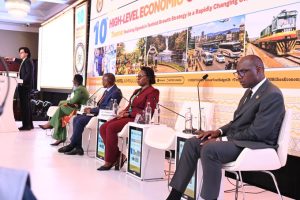
The first session, chaired by Musasizi, focused on global trends shaping Uganda’s economic prospects, including changes in global trade and investment flows, access to capital, climate finance and the potential of new technologies to raise productivity. Speakers included Shahrukh Wani of the International Growth Centre and Vicky Chemutai of the World Bank.
The second session, chaired by Minister of State for Planning Amos Lugoloobi, focused on modern industrial policy as a driver of productivity and economic growth.
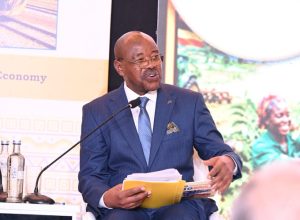
Lugoloobi said Uganda needs to rethink industrial policy if it is to accelerate productivity across key sectors and expand the country’s export base.
“Technology and innovation are central to growth in agro-industry, critical minerals, commercial agriculture, knowledge-based services and other high-value activities,” Lugoloobi said.
The session examined how Uganda can design and implement an industrial policy capable of moving the economy towards higher-value production.
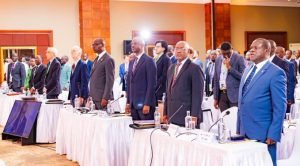
Presentations were made by Adam Collins of the IGC, Dr Anna Vittali of New York University and Dr Ezra Muhumuza of the Uganda Manufacturers Association.
Deputy Secretary to the Treasury Patrick Ocailap, who participated as a discussant, called for a comprehensive industrial policy capable of transforming production, expanding exports, creating jobs and growing the economy.
Ocailap said Uganda should assess productivity levels across the agro-industrial, tourism, minerals and science and technology sectors to identify where competitiveness can be improved.
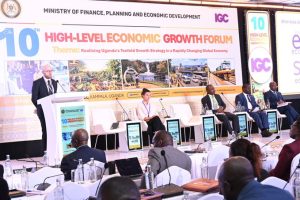
He also urged the country to concentrate on areas where it has a comparative advantage to compete more effectively in regional and international markets.