


KAMPALA — President Yoweri Kaguta Museveni has called for stronger collaboration between Government and the private sector to accelerate industrialisation, expand regional value chains and position East Africa as a competitive manufacturing bloc.
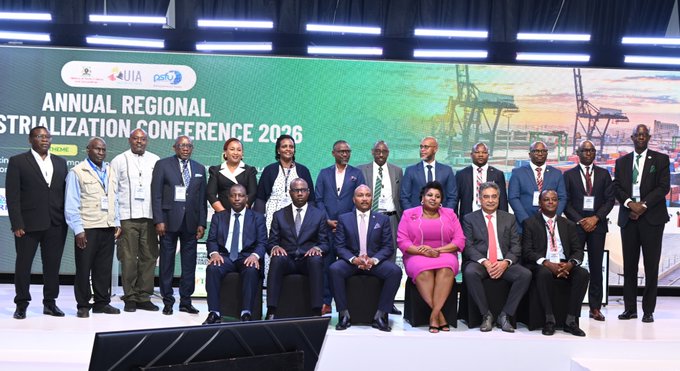
The President’s message was delivered on his behalf by Finance Minister Henry Musasizi at the 3rd Annual Regional Industrialisation Conference 2026 held at the Kampala Serena Hotel under the theme, “Unlocking Industrial Competitiveness through Innovation and Regional Value Chain Integration.”
President Museveni said industrialisation must remain at the centre of Uganda’s economic transformation because manufacturing, processing and value addition are critical to creating jobs, increasing household incomes and reducing the country’s vulnerability to external economic shocks.
“Industrialisation is not optional; it is central to building jobs, wealth, and resilience,” Musasizi said while representing the President.
The President’s message was anchored on Uganda’s Tenfold Growth Strategy, which seeks to expand the economy ten times to about US$500 billion in the long-term.
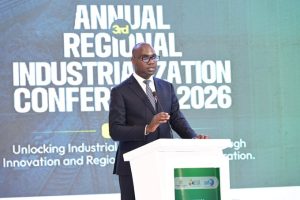
Museveni said achieving that ambition would require Government to create an environment in which manufacturers, investors and innovators can operate with confidence, highlighting policy consistency, infrastructure, energy and the ease of doing business as key priorities.
He also emphasised the importance of allowing the private sector to take the lead in production and investment, with Government focusing on removing barriers to enterprise and industrial growth.
Industrial parks at centre of strategy
Musasizi said Uganda’s industrialisation strategy is anchored in the country’s national development framework, with the development of industrial parks serving as a major pillar.
He cited the Kampala Industrial and Business Park at Namanve, which covers approximately 1,000 hectares and has attracted investments in manufacturing, logistics, food processing and agro-processing.
He also highlighted the Sino-Uganda Bio-Industrial Park, covering about 619 acres and hosting approximately 75 factories that employ more than 12,000 people.
The Government wants industrial parks to serve markets beyond Uganda, Musasizi said, with manufacturers expected to produce competitive goods for the East African and wider African markets.
Priority opportunities include agro-processing, leather, textiles, pharmaceuticals, petrochemicals, steel, construction materials and logistics.
The approach is consistent with the government’s wider industrialisation policy, which places value addition and manufacturing at the centre of Uganda’s efforts to move away from exporting mainly raw commodities.
East Africa urged to act as one market
Musasizi urged governments and businesses to stop viewing East African economies as isolated national markets and instead treat the region as a single economic space.
He said East Africa has a consumer market of more than 400 million people, while the African Continental Free Trade Area provides access to a continental market of approximately 1.4 billion people.

Uganda, he said, remains committed to deeper integration within the East African Community, including removing non-tariff barriers, operationalising one-stop border posts and improving access to regional markets.
The message comes as manufacturers across the region continue to raise concerns over barriers that make it difficult for goods to move freely between EAC member states.
For Uganda, overcoming such obstacles is particularly important if domestic manufacturers are to achieve economies of scale by selling beyond the country’s relatively small domestic market.
Private sector seeks practical solutions
Private Sector Foundation Uganda (PSFU) Board Chairman Humphrey Nzeyi said manufacturing remains below the regional industrialisation ambitions despite its importance to employment, exports and government revenues.
Nzeyi said manufacturing contributes approximately 9.7% to 11.8% of regional GDP, compared with the EAC industrialisation policy target of 25% by 2032.
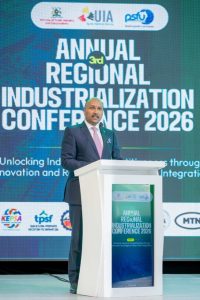
In Uganda, he said, manufacturing contributes more than 16.5% of GDP and supports approximately two million direct jobs.
He called for practical measures to address the constraints facing manufacturers, including access to long-term industrial finance, infrastructure, energy costs, standards, illicit trade and non-tariff barriers.
Nzeyi also called for stronger cross-border linkages that can enable East African manufacturers to participate in regional value chains rather than operating largely within individual national markets.
Power and infrastructure remain challenges
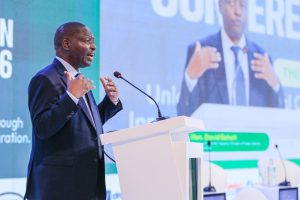
Minister of State for Trade, Industry and Cooperatives responsible for Industry David Bahati said East Africa must focus on producing more, manufacturing more and exporting more if the region is to become globally competitive.
Bahati identified power, infrastructure, irrigation, regional connectivity and non-tariff barriers among the key constraints requiring urgent attention.
Musasizi, meanwhile, pledged continued engagement between Government and the private sector to identify obstacles affecting manufacturing and develop solutions that can enable businesses to expand production.
The Finance Minister said the presence of private-sector representatives from across the region at the conference provided an opportunity for Government to listen directly to businesses and respond to their concerns.
Selling Uganda to the world
President Museveni also commended PSFU for promoting Uganda as an investment destination and maintaining coordination with the ministries responsible for trade, industry, finance and economic development.
He said such coordination would be important in achieving Uganda’s development targets towards 2040.
The President’s message also framed industrialisation as a regional rather than purely Ugandan project, arguing that East African countries can achieve greater competitiveness by combining their markets, resources and production capacities.
The conference brings together policymakers, manufacturers, financiers and private-sector leaders to discuss ways of turning regional industrialisation commitments into increased investment, production, employment and trade.