


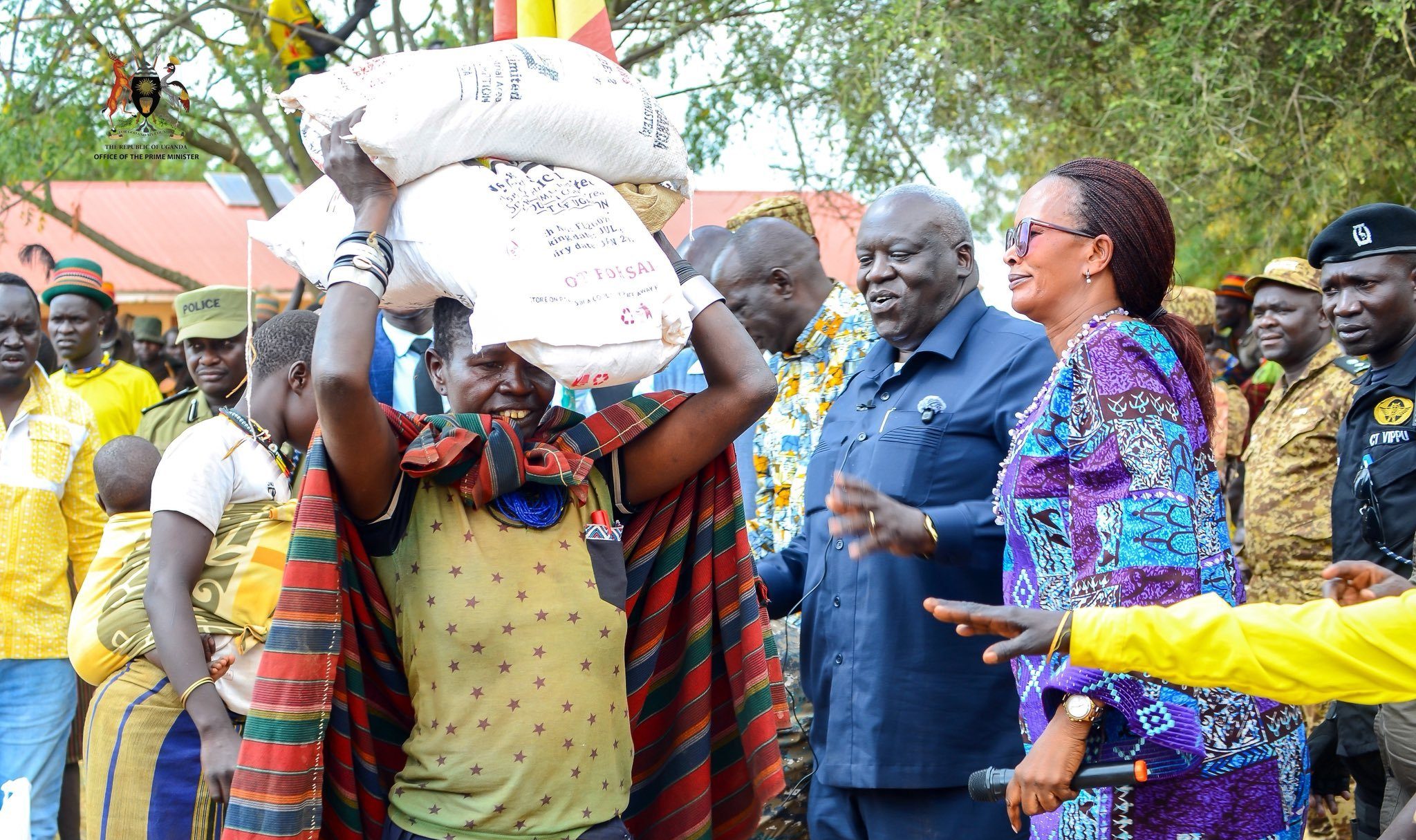
KAMPALA — The Government has delivered more than 1,400 metric tonnes of food relief to drought-affected communities in Karamoja during the first week of its emergency response, marking the beginning of a larger intervention aimed at addressing food shortages across the sub-region.
The Office of the Prime Minister (OPM) released the first weekly distribution report on Tuesday, detailing progress since Prime Minister Robinah Nabbanja flagged off a convoy of relief trucks on July 20, 2026.
According to the report, 1,403,380 kilograms of food—equivalent to about 1,403.38 metric tonnes—had been delivered to the nine districts of Karamoja by the end of the first week.
The relief package comprised 804,000 kilograms of maize flour and 599,380 kilograms of dry beans, distributed to households affected by the prolonged dry spell that has disrupted food production in the region.
“The Government intends to deliver over 9.4 million kilograms of food relief to Karamoja through this intervention,” the Office of the Prime Minister said.
The report notes that the emergency food distribution is intended to cushion vulnerable families from the immediate effects of food shortages while the government pursues longer-term measures to improve resilience against recurring droughts.
“This is only a response to the current food shortages in Karamoja. The Government is also pursuing measures to build resilience and implement long-term solutions to address the recurrent dry spells in the sub-region,” the OPM said.
Kaabong Receives Largest Share
Kaabong District received the largest allocation during the first week, with 273,700 kilograms of food comprising 168,000 kilograms of maize flour and 105,700 kilograms of dry beans.
Napak received 189,280 kilograms, followed closely by Nabilatuk with 186,690 kilograms. Moroto received 164,740 kilograms, while Kotido was allocated 164,000 kilograms.
Amudat received 140,480 kilograms, Abim 125,020 kilograms, Nakapiripirit 114,470 kilograms, while Karenga received 45,000 kilograms during the reporting period.
The government has pledged to continue dispatching food consignments until the planned 9.4 million kilograms of relief supplies have reached affected communities across the Karamoja sub-region.
Karamoja has experienced repeated food insecurity driven by prolonged dry spells, erratic rainfall and climate-related shocks that have affected crop production and livestock, leaving thousands of households in need of humanitarian assistance.