


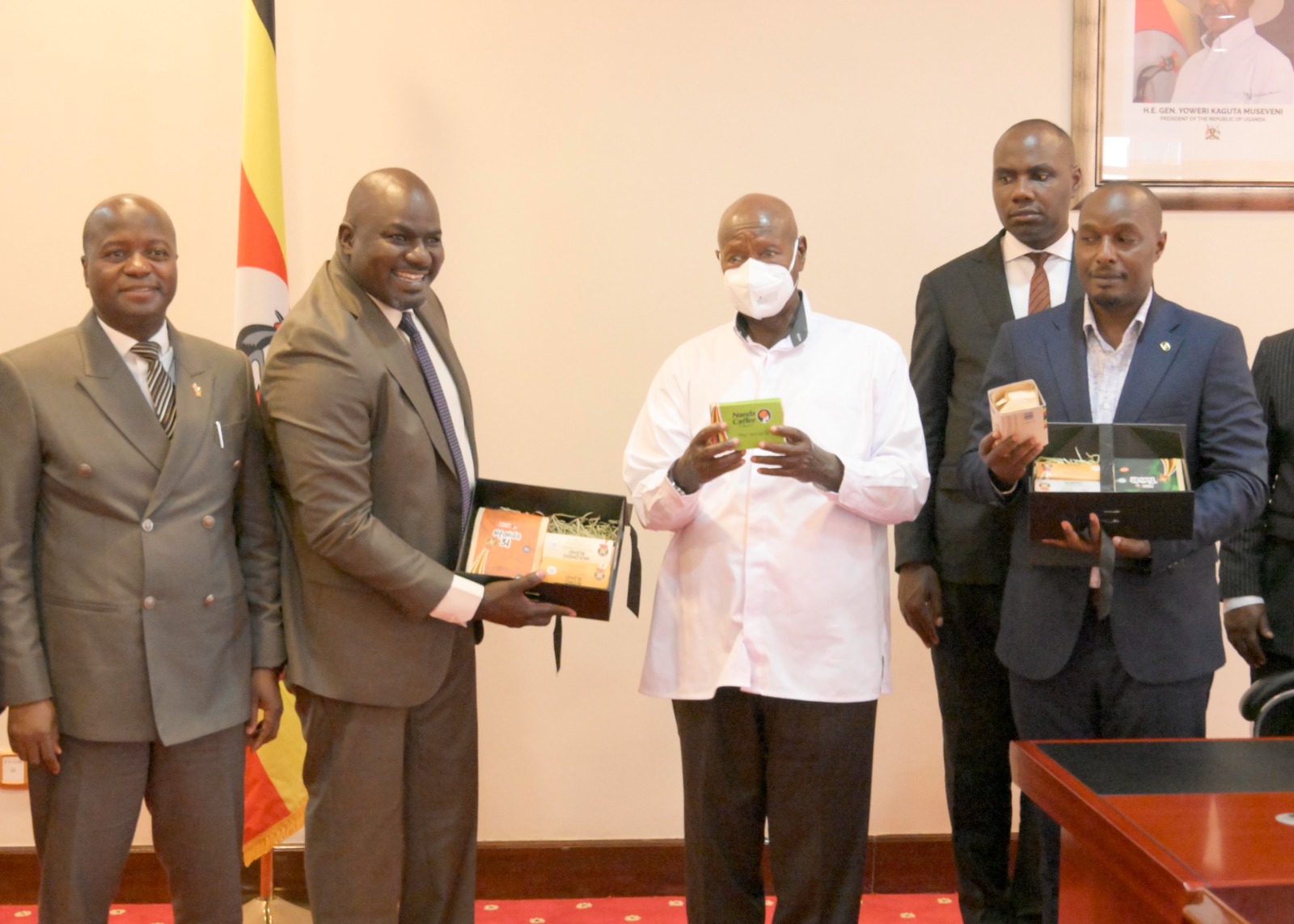
ENTEBBE — President Yoweri Kaguta Museveni has pledged government support towards the establishment of the Nonda Coffee Park in Nakaseke District, a major agro-industrial project aimed at transforming Uganda’s coffee sector through value addition, job creation and expanded access to international markets.
The President committed during a meeting at State House, Entebbe, with a delegation from Nonda Coffee Park led by Chief Executive Officer Tonny Miiro Kibuuka, who briefed him on the progress of the project and preparations for its groundbreaking ceremony scheduled for October.
President Museveni welcomed the investment, describing it as aligned with the government’s long-standing push to ensure Uganda processes its agricultural products before export to maximise earnings.
“Uganda should not continue exporting raw coffee. We must add value before export so that we create jobs, increase household incomes and earn more foreign exchange,” President Museveni said.
He pledged government support, including mobilisation of coffee farmers to increase production in preparation for the demand expected from the new facility.
The Nonda Coffee Park, to be located on a 100-acre site in Butalangu Town Council, Nakaseke District, is projected to become one of the largest single coffee processing facilities in East and Central Africa.
Upon completion, the facility will have the capacity to process 42,000 metric tonnes of coffee annually, sourcing raw coffee from Uganda’s central region and other coffee-growing areas across the country.
According to Kibuuka, the project is part of the Great Uganda-Saudi Coffee Corridor under the Value-at-Source Coffee Project, a private-sector-led industrialisation initiative designed to retain a larger share of the coffee value chain within Uganda.
“The President has committed his support to this project, particularly in mobilising coffee farming households to prepare for the increased demand for coffee that will be required by the factory,” Kibuuka said.
He explained that the project seeks to move Uganda away from the traditional model of exporting largely unprocessed coffee beans, allowing the country to benefit from processing, branding and marketing its own products.
The Nonda Coffee Park represents an estimated investment of USD200 million, with about USD160 million expected to go directly into the development of the coffee park and related infrastructure at the Nakaseke site.
The remaining financing will include support from the Government of Uganda and private investors from the Kingdom of Saudi Arabia.
Ready Saudi Market for Processed Coffee
Kibuuka said the project already has an established export market, with processed coffee from the facility expected to be supplied to Saudi Arabia under an existing commercial arrangement.
“This project is already mapped to the off-take market in the Kingdom of Saudi Arabia. There is a ready market waiting for the coffee because we are the first Ugandan company to own coffee shops in the Middle East,” he said.
He added that the company currently operates two Ugandan-branded coffee shops in Saudi Arabia, creating a direct link between Ugandan farmers, processors and international consumers.
The facility is projected to generate annual revenues exceeding USD800 million, which would significantly increase Uganda’s foreign exchange earnings from coffee.
Construction Underway
Preparatory works at the project site have already started, with construction expected to be completed within 24 months.
Kibuuka said preparations are ongoing for the official groundbreaking ceremony later this year.
“Our purpose in meeting the President was to thank him for the support he has committed to this project and also to inform him about the proposed groundbreaking ceremony later this year,” he said.
The meeting was attended by senior government officials, including Attorney General Hon. Sam Mayanja, Minister of Finance, Planning and Economic Development Hon. Henry Musasizi, Minister of Science, Technology and Innovation Eng. Jonard Asiimwe, Coordinator of Islamic Development Funds Hajji Habib Migadde, and other stakeholders involved in implementing the project.
Uganda is one of Africa’s leading coffee producers, and coffee remains the country’s top export commodity. The government has increasingly prioritised agro-processing and value addition as part of efforts to create jobs, increase farmer incomes and reduce dependence on exporting raw agricultural products.