




KAMPALA — Grain sector stakeholders have called for stronger partnerships, affordable financing and improved compliance with quality standards to make Uganda’s grain trade more competitive in regional and international markets.
The call was made during a networking reception organised by the East African Grain Council (EAGC) at Hotel Africana in Kampala on Thursday, bringing together government officials, private sector players, financial institutions, traders and other actors in the grain value chain.
Speaking at the event, Herbert Kyeyamwa, the EAGC Country Director for Uganda, said the council continues to strengthen the capacity of grain sector players through training, knowledge sharing and improved warehouse management practices.
“Over the years, the East African Grain Council has continued to build the capacity of grain sector stakeholders through training, knowledge sharing and the promotion of practical skills in warehouse management. These initiatives have helped improve professionalism, efficiency and competitiveness across the grain value chain,” Kyeyamwa said.
He said partnerships with government, development partners and the private sector have helped create a better environment for grain businesses.
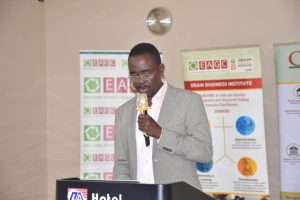
“Our competitiveness has also been strengthened through partnerships. Our collaboration with government institutions, development partners and the private sector has enhanced the policy environment, improved the business climate for trade, and expanded market opportunities for grain sector players,” he said.
Kyeyamwa described the gathering as an opportunity for stakeholders to build partnerships and develop solutions to transform Uganda’s grain sector.
“This networking reception is more than just a social gathering. It is an opportunity to strengthen partnerships, share experiences, identify new opportunities and reaffirm our collective commitment to transforming Uganda’s grain trade into one that is competitive, inclusive, efficient and affordable for all,” he said.
Representing the Ministry of East African Community Affairs, Commissioner Naboth Mugisha said regional integration under the East African Community provides Uganda’s businesses with opportunities to access wider markets.
Mugisha, who delivered remarks on behalf of the Permanent Secretary, said the government appreciates EAGC’s role in bringing together stakeholders to advance structured grain trade.
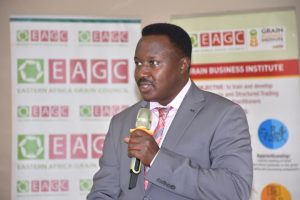
“Regional integration is not an end in itself. Rather, it is a means of facilitating trade, attracting investment and creating opportunities for enterprises to grow beyond national borders,” Mugisha said.
He, however, warned that access to regional markets must be matched with quality production, efficiency and compliance with standards.
“Access to these markets alone is not enough. Our businesses must also improve their competitiveness by complying with regional and international standards. Competitive trade requires consistency, quality assurance, efficiency and adherence to established standards,” he said.
Mugisha said government remains committed to harmonising standards, reducing trade barriers and improving the business environment.
“Compliance with sanitary and food safety measures is not simply a regulatory requirement — it is a strategic investment that opens doors to larger and more profitable markets,” he said.
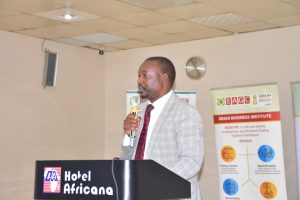
Meanwhile, Susan Namaganda from the Uganda Securities Exchange Commodities Exchange said the exchange is working to transform Uganda’s commodity trading system by moving away from informal over-the-counter transactions to a digital platform.
She said the exchange, licensed by the Capital Markets Authority in 2022, aims to improve transparency and help farmers and traders access better prices. “We are the first licensed commodities exchange in Uganda, having been licensed by the Capital Markets Authority in 2022,” Namaganda said.
“Our objective is to transform the commodities market from an over-the-counter market, where transactions are negotiated directly between buyers and sellers, to a digital trading platform,” she added.
She said the platform will allow Ugandan grain traders to connect with buyers within the East African region. “Through this platform, we enable the trading of grains while giving farmers and aggregators access to better pricing, not only from local off-takers but also from buyers across the East African region,” Namaganda said.
She noted that successful commodity trading requires quality assurance, storage facilities and structured systems. “Commodities trading is not a walk in the park. It requires standards, quality assurance, proper storage and structured trading systems,” she said.

For grain traders, Ssozi Hussein of Tariq General Suppliers, welcomed initiatives aimed at linking farmers and businesses to formal markets. He said many traders have struggled to understand commodity exchanges and their benefits.
“For a long time, we have heard about the Securities Exchange, but many of us had never really understood what it was or seen it in action. It is encouraging to finally see you on the ground engaging with businesses like ours,” Ssozi said.
He said businesses continue to recover from the effects of COVID-19 and require better market connections. “Initiatives like this provide an opportunity for businesses and farmers to connect with structured markets and hopefully improve the way we trade,” he said.
Also speaking, Justine Komugisha, a Banking Officer in the Administered Funds Department at the Bank of Uganda, highlighted financing opportunities available to grain traders and agricultural enterprises.
She said government-supported financing programmes have already provided significant support to the sector. “To date, we have financed more than 15,000 grain traders and disbursed over Shs1.5 trillion to Ugandan farmers and agribusinesses,” Komugisha said.

She said traders can access financing through programmes including the Agricultural Credit Facility (ACF) and the Small Business Recovery Fund. “Specifically for grain traders, financing of up to Shs10 billion can be provided to an individual borrower,” she said.
Komugisha added that grain trading loans are available at 15 percent per annum, while capital investments under the Agricultural Credit Facility attract financing at 4 percent per annum.
Stakeholders said strengthening Uganda’s grain sector will require continued investment in infrastructure, affordable financing, structured markets and compliance with standards to expand opportunities for farmers and traders.