



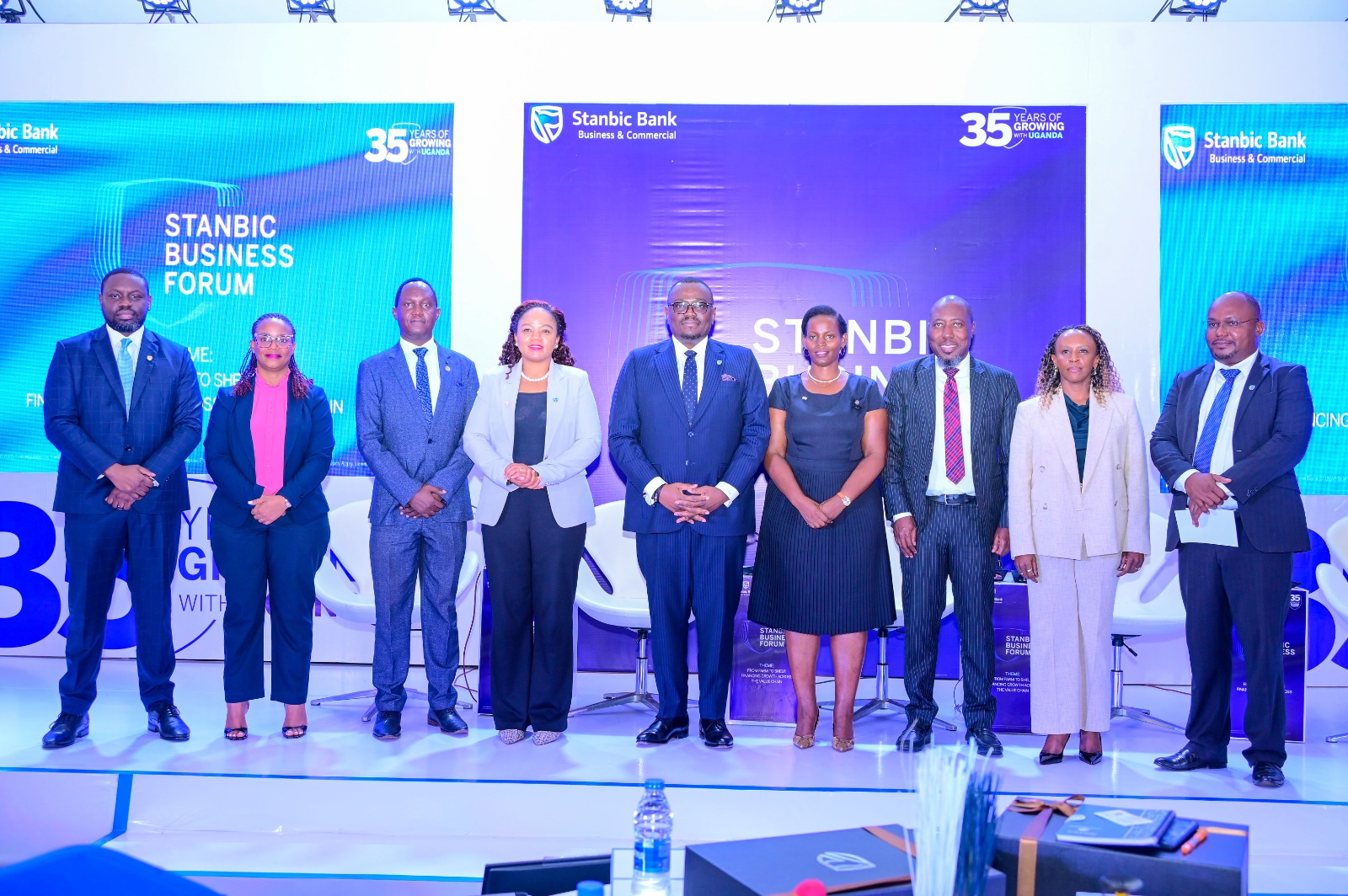
KAMPALA — Business leaders, policymakers, financiers and legal experts have called for stronger value-chain financing, industrial partnerships and succession planning to accelerate Uganda’s manufacturing sector growth and ensure long-term business sustainability.
The calls were made during the Stanbic Business Forum held at Protea Hotel Kampala under the theme “From Farm to Shelf: Financing Growth Across the Value Chain.” The forum brought together manufacturers, government officials, financial institutions and industry stakeholders to discuss challenges and opportunities within Uganda’s agro-industrial sector.
Opening the forum, Tunde Thorpe, Executive Head of Business and Commercial Banking at Stanbic Bank Uganda, said manufacturing remains central to Uganda’s economic transformation due to its contribution to GDP, employment and tax revenue.
“The theme, ‘From Farm to Shelf,’ captures a very important concept. It speaks to the journey from harvest through processing and transformation into a finished product. At its core, it is about value addition and creating value through the manufacturing process,” Thorpe said.
He noted that manufacturing contributes between 14 and 16 percent of Uganda’s Gross Domestic Product and accounts for about 30 percent of the country’s tax base.
“We believe that manufacturing is a critical sector and central to Uganda’s growth. At Stanbic Bank, we believe that Uganda is our home, and we drive her growth. One of the key vehicles for driving that growth is the manufacturing sector,” he said.
Thorpe explained that the forum was designed to bring together regulators, policymakers, industry practitioners and financiers to jointly address barriers affecting industrial growth.
“We recognise that these challenges cannot be solved by a financial institution alone. That is why it was important for us to convene a forum like this—bringing together all the key stakeholders—to have meaningful and purposeful conversations about how we can collectively drive growth in the sector and create lasting impact,” he added.

Thorpe said insights gathered from the discussions would be used to further refine the bank’s Manufacturing Customer Value Proposition. “The discussions today have provided us with fresh insights that will help us continue refining that Customer Value Proposition to ensure that it addresses the real pain points faced by our clients,” he said.
Patrick Mugisha, the Commissioner for Business Development and Quality Assurance at the Ministry of Trade, Industry and Cooperatives, focused on value-chain development as the foundation of Uganda’s industrial future.
“Uganda’s future will not be built farm by farm or factory by factory. It will be built value chain by value chain,” Mugisha said.
The statement resonated throughout the discussions, with participants emphasising the need for stronger integration between farmers, processors, manufacturers, distributors and financiers.

Closing the forum, Paul Muganwa, Executive Director and Head of Corporate and Investment Banking at Stanbic Bank Uganda, praised the quality of the discussions and urged stakeholders to ensure that conversations translate into action.
“To be entirely honest, I was initially a little skeptical. The topic was broad, and I wondered how we could meaningfully engage on an entire value chain within a few hours in one room. However, I chose to do what every leader must learn to do from time to time—remain silent and allow the team to execute. I am glad I did,” Muganwa said.
He noted that the discussions had successfully connected issues ranging from geopolitics and trade to financing and industrial development. “There is a growing appreciation that the future of industrialization in Uganda will depend on how effectively these value chains are integrated,” he said.
Muganwa also highlighted a shift in how businesses engage with financial institutions. “I remember that as a young banker, I once met with clients and spent a lot of time talking about the advice we could provide. At the end of the meeting, they told me, ‘We are not interested in your advice; we want your money.’ It was therefore interesting to hear that clients now recognize the value of advice alongside capital,” he said.

Beyond financing and manufacturing, the forum also examined business continuity and succession planning through a fireside discussion led by Ruth Sebatindira, Senior Counsel and Founding Partner of Ligomarc Advocates.
Sebatindira urged business owners to prioritize governance structures that would allow their enterprises to survive beyond their founders. “Build to endure. That phrase perfectly captures why we are here today. We are having this conversation so that we can build businesses that endure,” she said.
Drawing from her experience as a founder, Sebatindira warned that many businesses collapse when founders die without clear succession plans. “When that happens, three things usually occur: a leadership vacuum emerges, tension develops within the family, and the business freezes because there is no plan,” she said.
She emphasized the importance of aligning family governance, business governance and estate planning. “The goal is to ensure that all three systems support one another. If they are not aligned, conflicts arise. Family expectations clash with legal structures, and business continuity suffers,” she said.

Sebatindira also advocated for inclusive succession planning, urging families not to sideline daughters. “I am a passionate advocate of female succession. The Constitution provides equal rights, and families must stop excluding daughters from succession conversations. If you are preparing successors, prepare all your children,” she said.
Summing up her message to business owners, she stated: “Planning is love. If you truly love your family, plan for them. Protect your family, protect your business and protect your legacy.”