


JINJA, Uganda — President Yoweri Kaguta Museveni has called for greater political integration across East Africa and the African continent, arguing that it is the only sustainable solution to future security threats and a prerequisite for Africa’s long-term prosperity and global competitiveness.
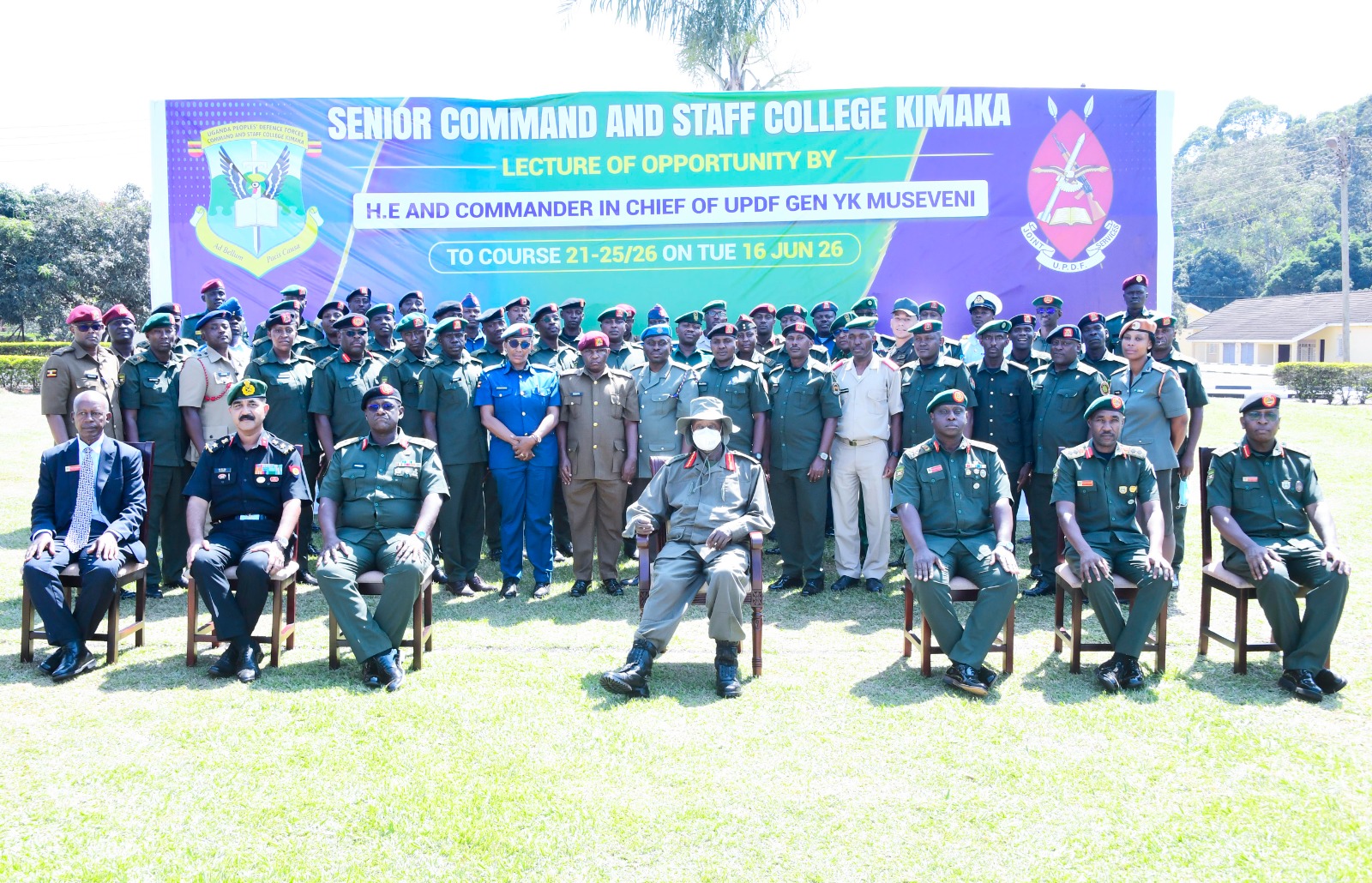
Speaking during a lecture of opportunity to army officers at the Senior Staff College-Kimaka in Jinja on Monday, President Museveni, who is also the Commander-in-Chief of the Uganda People’s Defence Forces (UPDF), urged military leaders to champion the historical mission of African unity and development.
The President criticised pre-colonial African leaders for failing to recognise and respond to the strategic dangers posed by colonial expansion, saying their focus on personal interests contributed to the continent’s subjugation.
“The chiefs and kings were here glorifying themselves when their building was falling down. This strategic danger was known but neglected by kings and chiefs,” President Museveni said.
He reminded the officers that for more than six decades, the National Resistance Movement (NRM) has consistently emphasised what it considers the key historical missions necessary for Uganda, East Africa and Africa to achieve prosperity and strategic independence.
According to President Museveni, economic integration remains central to Africa’s transformation because it creates larger markets capable of supporting industrialisation and wealth creation.
“The first historical mission is to ensure the prosperity of our people. We have told you that one of the factors to help you prosper is the economic integration of the African market. We have been struggling with it, so you, the young people, should continue with it instead of dancing pakachini and watching European football. If we don’t integrate, we shall be in problems,” he said.
The President argued that economic cooperation alone would not be enough and that Africa must eventually pursue political integration if it is to effectively address future security challenges and compete globally.
“That’s why the answer there is political integration. We have been talking about East African integration, but if Presidents want to remain big fish in small ponds, then that issue will not be addressed,” he said.
Using examples from global technological and military advancements, President Museveni noted that modern security increasingly extends beyond traditional land and maritime boundaries into areas such as space exploration and advanced defence capabilities.
“We must be able to operate on land, air, navy and in space, but can Uganda have a space programme? Or can we go to the ocean? No, we are cut off by the irrational colonial borders,” he said.
The President also addressed the challenge of land pressure in parts of Africa, attributing it largely to underdevelopment and overdependence on subsistence agriculture. “Land is only crucial for agriculture, but in a money economy, many people are in manufacturing and services. A few are in agriculture,” he observed.
On ongoing conflicts in the Middle East and their potential implications for Africa, President Museveni argued that the continent possesses sufficient resources to withstand external shocks if those resources are properly utilised.
“Africa has everything. The issue is how to use those resources properly,” he said.
The President also dismissed tribal and religious politics, describing them as signs of weak ideological grounding. “The politics of identity is the politics of parasites,” he said.
He emphasised the importance of patriotism and Pan-Africanism in promoting regional markets, economic growth and national development.
President Museveni further highlighted Uganda’s four priority wealth-creation sectors — commercial agriculture, manufacturing, services and Information and Communication Technology (ICT) — as the foundation for job creation and economic transformation.
The Commandant of the Senior Staff College-Kimaka, Brig Gen Michael Kabango, thanked President Museveni for what he described as visionary leadership that has guided Uganda toward peace, stability and economic progress.
“Your presence today is a great inspiration to both the faculty and the students who are gathered here,” Brig Gen Kabango said.
He noted that the current Senior Staff Course, Intake 21 of 2025/2026, commenced on July 8, 2025, and is expected to graduate on July 2, 2026.
The course comprises 52 officers, including 38 Ugandans and 14 participants from friendly countries such as Burundi, Egypt, Kenya, Malawi, Rwanda, South Africa, South Sudan and Tanzania, reflecting the regional character of military cooperation and professional development.
President Museveni urged the officers to remain focused on the broader historical mission of securing prosperity, stability and unity for Africa, arguing that only a politically and economically integrated continent can effectively confront future challenges.