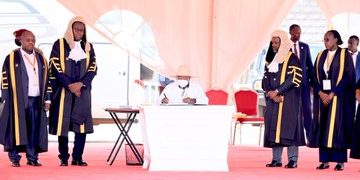



KAMPALA — President Yoweri Kaguta Museveni has hailed Uganda’s economic performance, saying the country remains on a strong growth trajectory because of its abundant natural resources and deliberate government policies aimed at transforming households from subsistence production into the money economy.
Speaking shortly after the presentation of the 2026/27 National Budget at a special sitting of Parliament held at Kololo Independence Grounds on Thursday, President Museveni said the National Resistance Movement (NRM) government’s focus goes beyond economic growth figures to achieving fundamental socioeconomic transformation.
“The aim of the NRM government is not just growth but socioeconomic transformation,” President Museveni told Parliament.
The President said Uganda’s economy continues to perform well because the country possesses significant untapped potential in agriculture, tourism, minerals and human resources. “Uganda is a rich country with a lot of potential,” he said.
Moving Households Into the Money Economy
A significant portion of the President’s address focused on the government’s long-standing effort to move Ugandan households from subsistence farming into commercial production and income-generating activities.
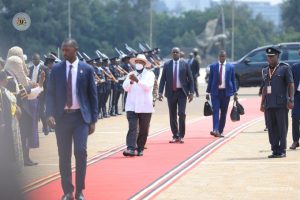
President Museveni traced the challenge back to the colonial period, noting that by the time Uganda attained independence in 1962, only a small fraction of households were participating in the money economy.
“By 1962, only 9 percent of the homesteads were in the money economy. After almost 70 years, only 9 percent were in the money economy,” he said.
The President explained that this reality heavily influenced the NRM’s Ten-Point Programme, particularly the objective of building “an economy which is integrated, independent and self-sustaining.”
According to Museveni, progress remained slow for decades, with only 32 percent of homesteads participating in the money economy by 2013.
“By 2013, only 32 percent of homesteads had joined the money economy,” he said.
He revealed that government subsequently involved the Uganda People’s Defence Forces (UPDF), under the leadership of Gen. Salim Saleh, in efforts aimed at transforming household incomes through wealth-creation initiatives.
The President said interventions such as the distribution of free seedlings, agricultural support programmes and the Parish Development Model (PDM) have significantly improved household participation in productive economic activities.
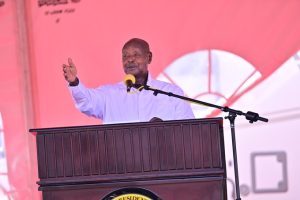
“With interventions such as free seedlings and the Parish Development Model, 67 percent of homesteads are now in the money economy,” Museveni said.
However, he noted that approximately one-third of Ugandan households remain outside the formal economy. “So this is the challenge. This is why we are saying no more. We cannot go on like this. This is the work of the leaders,” he said.
The President challenged political, cultural and community leaders to take greater responsibility in ensuring that more households engage in commercial agriculture, small businesses and other productive ventures.
Using a traditional proverb to illustrate the responsibility of leadership, Museveni remarked: “The eyes of the dead body are the eyes of the one who is carrying the dead body. If the one who is carrying the dead body falls in the pit, the body also will fall in the pit.”
Oil Revenues to Fund Infrastructure
President Museveni also outlined government’s plans for future oil revenues, saying proceeds from Uganda’s petroleum sector will be invested in strategic infrastructure projects critical to long-term economic growth.
The President said part of the oil income would be directed towards financing railways, roads and oil pipeline infrastructure. “We shall use part of the oil money for infrastructure development such as railways, roads and oil pipelines,” he said.
He argued that investments in transport and energy infrastructure are essential for lowering production costs, attracting investment and enhancing Uganda’s competitiveness.
Call for Urban Order and Trade Regulation
The President urged leaders to support the ongoing enforcement of trade order measures in towns and cities, saying proper planning and discipline are essential for sustainable urban development. “Roads are for vehicles and motorcycles, and the sidewalks are for pedestrians,” Museveni said.
He warned leaders against politicising enforcement efforts aimed at restoring order in urban areas. “Don’t go on with the cheap politics of misleading our people,” he said.
The President compared the country to a human body, saying all systems must function properly for national development to occur.
He argued that maintaining orderly urban centres is crucial for public safety, efficient transportation and economic productivity.
Ebola Prevention
President Museveni also used the occasion to reiterate his earlier warnings about Ebola and urged Ugandans to continue observing public health guidelines.
The President revealed that Uganda had recorded 19 Ebola cases, including 14 linked to a family that had travelled from the Democratic Republic of Congo.
He reported encouraging signs in the country’s containment efforts. “No new Ebola case had been reported for five days,” he said.
Museveni cautioned against practices that could facilitate transmission of the disease and cited reports from neighbouring countries. “I am told many pastors have died in DR Congo because of blessing people by laying their hands on them,” he said.
He urged religious leaders and the public to follow health standard operating procedures to prevent further spread of the disease.
Following the President’s remarks, Parliament concluded proceedings for the day.
Speaker Oboth-Oboth subsequently adjourned the House until June 30, 2026, after the successful presentation of the 2026/27 National Budget and the President’s address.
The budget outlines government’s priorities for the coming financial year, with a strong emphasis on wealth creation, industrialisation, infrastructure development, human capital growth and household income transformation.
President Museveni maintained that Uganda’s future prosperity will depend not only on economic growth but on ensuring that every household participates in productive economic activity.
“The challenge now is to move the remaining 33 percent into the money economy,” he said, adding that achieving that objective will require commitment and accountability from leaders at all levels.