


KAMPALA – The cost of construction materials and services in Uganda increased in March 2026, while prices charged by manufacturers and utility providers also rose in April 2026, according to new figures released by the Uganda Bureau of Statistics (UBOS).
The latest Construction Input Price Index (CIPI) report shows that annual construction sector inflation rose to 0.7 percent in March 2026, up from 0.1 percent in February 2026. This means that, on average, the cost of inputs used in the construction industry was higher than it was a year earlier.
UBOS said the increase was mainly driven by higher costs in specialised construction activities, particularly demolition and site preparation works, whose annual inflation climbed to 1.5 percent in March from 0.5 percent in February.
Construction of buildings also recorded higher inflation, rising to 0.8 percent from 0.1 percent the previous month. Residential building construction registered the highest increase at 1.0 percent, while non-residential buildings, such as offices and commercial structures, recorded 0.7 percent inflation.
Civil engineering works, including roads, railways and utility projects, also experienced a rise in costs. Annual inflation in the category increased to 0.6 percent in March from 0.4 percent in February.
On a monthly basis, construction sector inflation rose sharply to 0.8 percent in March 2026, compared to 0.1 percent in February.
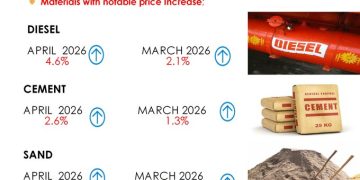
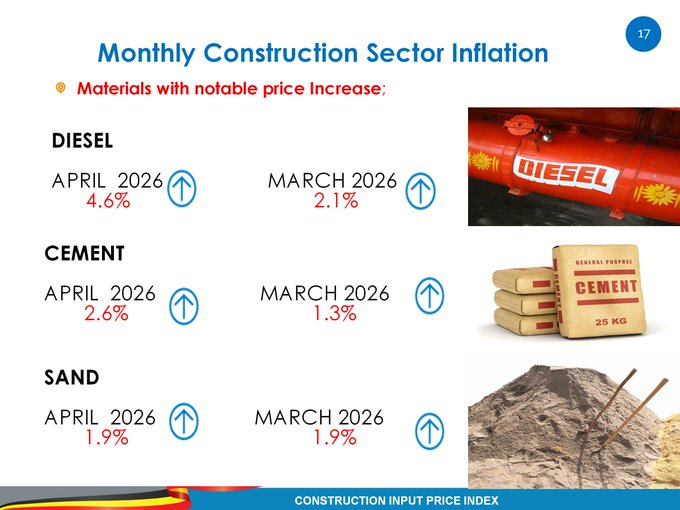
UBOS attributed the increase to higher prices of key construction materials and fuel. Diesel prices increased by 2.1 percent in March, cement prices rose by 1.3 percent, while high-tensile steel bars recorded a 2.7 percent increase.
However, some materials became cheaper. Prices of adhesives, sealants, waterproofing materials and grout fell by 0.2 percent during the month.
The overall Construction Input Price Index increased from 128.00 points in February to 128.98 points in March 2026.
Meanwhile, a separate UBOS report on the Producer Price Index for Manufacturing and Utilities (PPI-M&U) showed that annual producer inflation increased to 0.9 percent in April 2026, up from 0.5 percent in March 2026.
Producer inflation measures changes in prices received by manufacturers and utility providers before goods reach consumers.
According to UBOS, the increase was largely driven by the manufacturing sector, whose annual inflation rose to 0.8 percent in April from 0.4 percent in March.
The biggest contributor was the manufacture of non-metallic mineral products, which includes cement production. Inflation in the category jumped to 3.7 percent from 1.0 percent a month earlier. Cement manufacturing inflation alone rose to 3.8 percent in April from 1.0 percent in March.
Processing and preserving of meat also recorded higher inflation, increasing to 1.9 percent from 1.1 percent.
The utilities sector, which includes electricity and water services, registered annual inflation of 1.0 percent, slightly lower than the 1.4 percent recorded in March.
On a monthly basis, producer inflation slowed to 0.2 percent in April, down from 0.5 percent in March. UBOS said this was partly due to falling prices in some food-processing industries, including fish processing and sugar manufacturing.
According to UBOS, the figures reflect continued but modest increases in production and construction costs across the economy.
The reports indicate that while inflation in both construction and manufacturing remains relatively low, rising prices of fuel, cement and steel continue to put upward pressure on the cost of building projects and industrial production in Uganda.