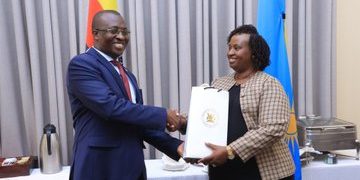



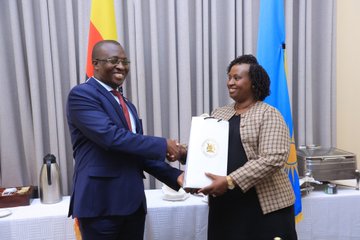
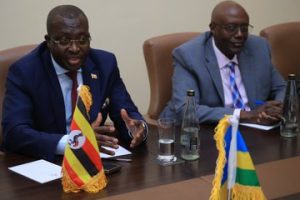
Uganda and Rwanda have signed four Memoranda of Understanding (MoUs) in key sectors, marking a major step in strengthening bilateral cooperation during the 12th Session of the Joint Permanent Commission (JPC) held at Mestil Hotel in Nsambya, Kampala.
The agreements—covering health, education, agriculture, and local government—were signed by Hon. John Mulumba, Minister of State for Foreign Affairs, who led the Uganda delegation and the Minister of State for Foreign Affairs, Dr Usta Kaitesi, who led the Rwandan delegation, reinforcing institutional collaboration between the two countries.
Officials said the signing of the MoUs demonstrates a renewed commitment to translating diplomatic engagement into practical cooperation that directly benefits citizens.
“The session has provided an opportunity to review progress, offer strategic direction, and agree on practical steps to strengthen priority areas of cooperation,” Kaitesi said, adding that the focus now shifts to implementation of agreed decisions.
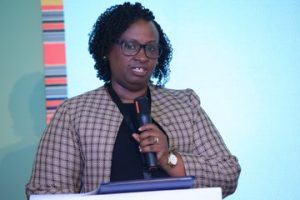
Hon. Dr Usta Kaitesi, Minister of State for Foreign Affairs, who led the Rwanda delegation.
The three-day meeting, held from April 20 to 22, 2026, brought together senior government officials and technical teams from both countries to assess progress since the previous session in Kigali in 2023 and identify new areas of partnership.
Speaking during the opening, Mulimba emphasised the significance of the JPC as a platform for resolving challenges and advancing shared interests.
“Uganda and Rwanda are partners bound by history, culture, and kinship, with linked economies and shared aspirations for peace and development,” he said. “Our citizens expect tangible results that unlock opportunities and remove barriers.”
Beyond the four signed agreements, both sides also committed to expanding cooperation into areas such as investment promotion, tourism development—including Meetings, Incentives, Conferences and Exhibitions (MICE)—as well as conservation and veteran affairs.
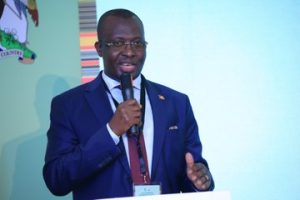
Hon. John Mulumba, Minister of State for Foreign Affairs, who led the Uganda delegation
The ministers expressed satisfaction with progress already made in sectors such as defence and security, immigration, infrastructure, and information and communication technology, noting that the momentum reflects strong political will under Yoweri Kaguta Museveni and Paul Kagame.
Kaitesi highlighted the importance of continued high-level engagement between the two leaders, saying it remains “central to strengthening trust, addressing issues of mutual interest, and advancing good neighbourliness.”
Mulimba, in his closing remarks, stressed the need to move beyond commitments to actual delivery. “Let us reaffirm that Uganda–Rwanda relations are not based on convenience, but on shared history and destiny. Our people expect us to remove barriers, not prolong them,” he said.
He added that the adoption of a results-based scorecard approach would help track implementation and ensure accountability ahead of the next session.
Both countries pledged to ensure the timely execution of the signed agreements, with a focus on delivering measurable socio-economic benefits and advancing regional integration.
The next session of the Joint Permanent Commission will be hosted by Rwanda at a date to be agreed through diplomatic channels.