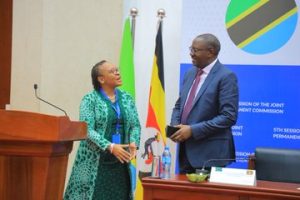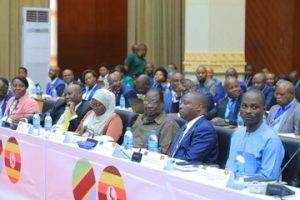



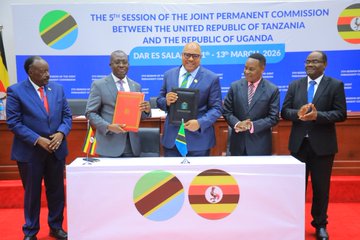
Dar es Salaam, Tanzania — Uganda and Tanzania have taken a major step in regional trade and infrastructure development by formalising the framework for the Isaka–Lusahunga–Murongo/Kikagati–Mpondwe Standard Gauge Railway (SGR) during the 5th Uganda–Tanzania Joint Permanent Commission (JPC) in Dar es Salaam.
The SGR corridor is set to connect inland Ugandan and Tanzanian markets directly to the Port of Dar es Salaam, providing faster, more efficient movement of goods, reducing transport costs, and boosting industrial growth in the region.
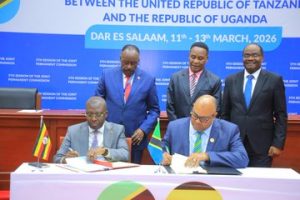
“This is a landmark development for East Africa,” said Vincent Waiswa Bagiire, Permanent Secretary at the Ministry of Foreign Affairs, Uganda. “By formalising this framework, we are laying the foundation for a railway corridor that will unlock trade, attract investment, and strengthen regional integration.”
Regional and International Support
The SGR project has attracted international attention, having been prioritised under the African Development Bank’s NEPAD Infrastructure Project Preparation Facility, which provides both technical support and funding opportunities.

“This support ensures that the project is not only ambitious but also viable, with the expertise and financing required to deliver a corridor of regional significance,” Bagiire added.
Strategic Importance
Officials highlighted that the SGR is part of a broader regional vision linking transport, energy, and trade infrastructure. The corridor complements other initiatives, including the East African Crude Oil Pipeline (EACOP) and expanded Lake Victoria connectivity through vessels such as MV New Mwanza, Africa’s largest freshwater vessel.

“The railway will revolutionise logistics for traders and investors,” said Hon. Mulimba John, Uganda’s Minister of State for Foreign Affairs (Regional Affairs). “Goods will move faster, costs will drop, and both countries will benefit from improved access to regional and global markets.”
Economic Impact
The corridor is expected to stimulate industrial activity, create jobs, and expand the reach of small and medium enterprises. By linking inland production zones to Dar Port, exporters can bypass bottlenecks and achieve faster turnaround times for goods destined for international markets.
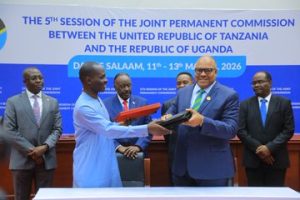
“The framework we signed is not just an agreement—it is a commitment to implementation,” emphasised Bagiire. “Our shared goal is to ensure that infrastructure investments deliver real benefits to citizens, traders, and investors across East Africa.”
The 5th JPC also reinforced cooperation in trade, energy, and border facilitation, with Uganda set to host the 6th session in 2028. Together, officials say, the partnership and the SGR corridor signal a new era of connectivity, prosperity, and regional integration.