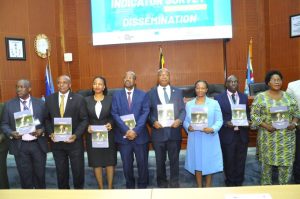



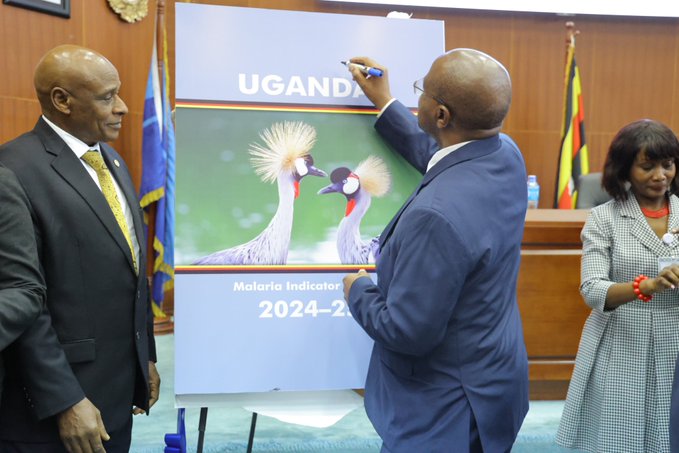
KAMPALA — The Uganda Bureau of Statistics (UBOS) has released the Uganda Malaria Indicator Survey (UMIS) Report 2024/25, revealing that only 10 percent of households in Uganda received Indoor Residual Spraying (IRS) against mosquitoes in the past year.
The report was officially launched on Thursday at Statistics House by the Minister of State for Planning, Amos Lugoloobi, who said reliable data remains critical for effective planning and decision-making.
According to the findings, IRS coverage stands at 12 percent in rural areas and 8 percent in urban centres. The report also shows that indoor spraying is most common in the West Nile sub-region, while Seasonal Malaria Chemoprevention (SMC) is widely implemented in the Karamoja sub-region.

Speaking at the launch, Lugoloobi emphasised the importance of credible data in guiding national development policies. “Reliable data plays a critical role in effective policy planning, implementation and evaluation. Without credible statistics, it becomes difficult to guide development decisions,” he said.
He commended UBOS for strengthening the availability of timely national data, noting that the findings from the malaria survey provide important insights for government and development partners.
“The Uganda Malaria Indicator Survey provides key insights that help us understand malaria trends, target high-burden areas and strengthen prevention and treatment efforts,” Lugoloobi added.
He reaffirmed the commitment of the Ministry of Finance, Planning and Economic Development to support the production of high-quality statistics that guide policy decisions, resource allocation and improved public health outcomes.
Meanwhile, UBOS Executive Director Chris N. Mukiza said the malaria survey marks the first of eight statistical reports that the agency plans to release between March and May 2026.

“The Uganda Malaria Indicator Survey is one of the key national studies examining malaria prevalence patterns, prevention measures, treatment practices and control efforts in the country,” Mukiza said.
He noted that the survey has, over the years, played a crucial role in tracking progress and shaping national malaria control strategies.
Mukiza also revealed that the survey data was collected using digital technology platforms, a move aimed at improving the accuracy, timeliness and efficiency of national statistics while reducing operational costs.
“The findings from the survey will guide the strengthening of malaria control programmes and inform national policy decisions aimed at reducing the malaria burden in Uganda,” he said.
He commended the teams of nurses, health technicians, supervisors and field staff who collected data from communities across the country, saying their work was key to the successful implementation of the study.
UBOS has called on policymakers, researchers and development partners to actively use the survey findings to support evidence-based planning and targeted malaria control interventions across Uganda.