



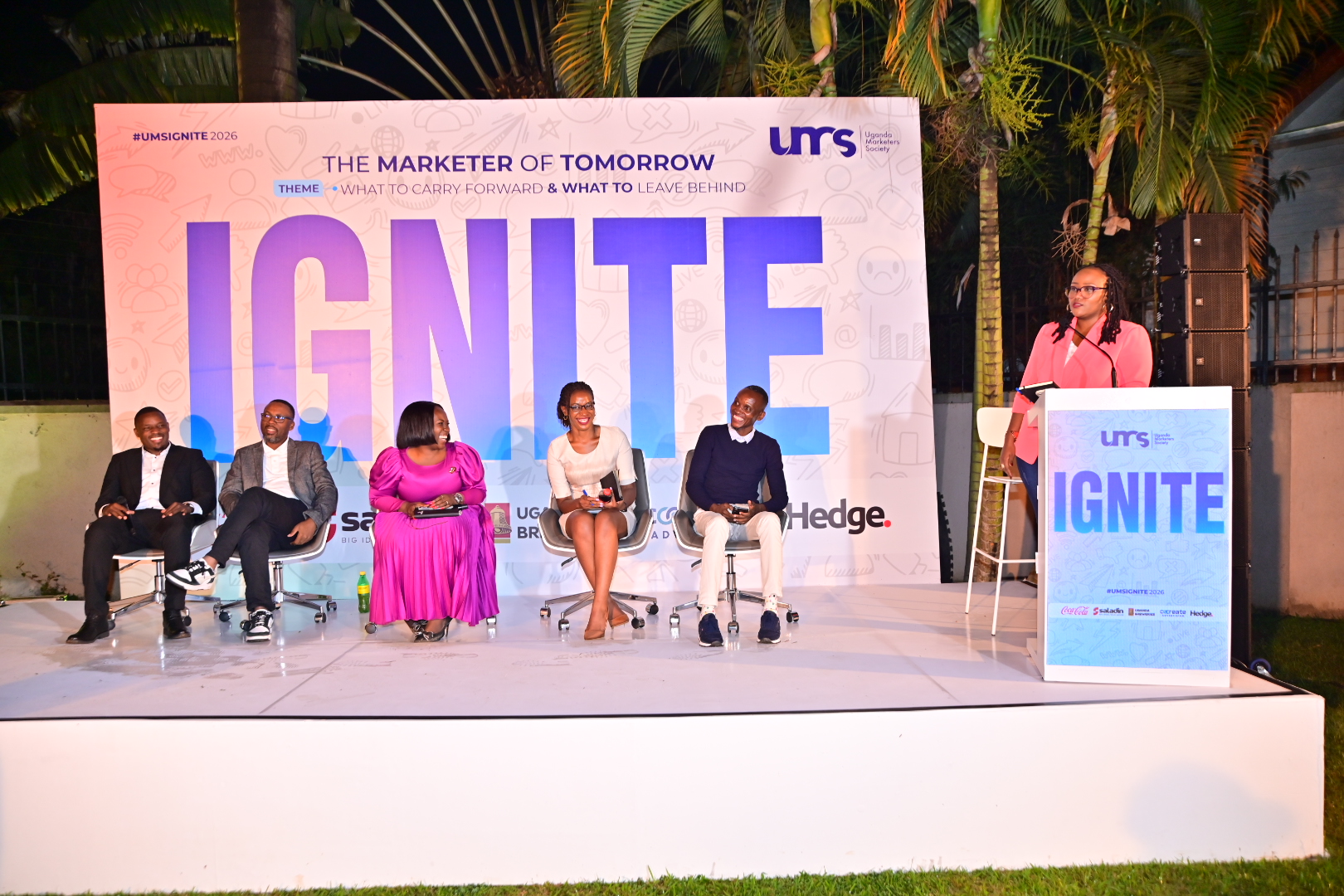
Uganda Marketers Society (UMS) opened its 2026 calendar with a bold challenge to the profession: marketing must move beyond activity and reclaim its place at the centre of commercial decision-making.
Held at the Saladin Media Offices, the first #UMSIgniteSession of the year brought together senior marketing and business leaders to examine what marketers must leave behind, and what they must now embrace, if they are to remain credible and effective in an increasingly demanding marketplace.
The session, themed around recalibrating modern marketing, focused less on trends and more on judgement, discipline and measurable business contribution.
Leaving Behind Campaign-Only Thinking
Responding to the moderator’s opening question on what marketers must abandon, panellists were united in their view that the era of short-term, campaign-only thinking must end.
Rommel Jasi, General Manager at Saladin Media Uganda, argued that tomorrow’s marketer must carry a commercial leadership mindset. “You must be comfortable in conversations with the CFO and CEO,” he said, urging marketers to shift from short-term campaign cycles to long-term value creation.
Macklean Kukundakwe, Trade and Marketing Manager at Coca-Cola Beverages Uganda, called for an end to siloed working. Marketing, she noted, one cannot operate as an isolated function. Cross-functional engagement is no longer optional; it is essential.
John Earnest Ssekisonge, Managing Director at Kasi Insight, challenged the profession’s long-standing obsession with differentiation for its own sake. “Whatever you do must be backed by budget and data,” he said, emphasising the need to build brands deliberately over the long term rather than chase surface-level distinction.
For Racheal Musiima Senyondo, Head of HNI Business Unit at Prudential Uganda, customer intimacy remains non-negotiable. As markets become more competitive, she stressed that meaningful connection with customers will define the marketer of tomorrow.
From Vanity Metrics to Commercial Accountability
A recurring theme throughout the session was accountability.
Jasi outlined three critical shifts Ugandan brands must adopt. First, the move away from vanity metrics. If a metric cannot be linked to revenue or margin impact, he argued, it is a distraction. Second, brands must move beyond last-click thinking and rigorously test what truly drives performance. Third, reporting must shift from fragmented channel updates to unified measurement aligned to the organisation’s profit and loss account.
“Marketing must prove it is an investment,” he stated, urging practitioners to understand the wider commercial architecture of their businesses.
The panel reinforced that reporting alone is not impact. Data must inform decisions and influence outcomes.
Learning from Costly Mistakes
In a candid reflection on missteps, David Okayan, CEO of Colorsy Coatings Ltd, shared lessons from his entrepreneurial journey. One of his most significant errors, he admitted, was prioritising brand building before establishing sufficient substance in the business.
“First ensure the fundamentals are right,” he advised. “Understand the market properly. Build with clarity, not hype.” He also underscored the importance of relevant partnerships, noting that some journeys cannot be undertaken alone.
Effectiveness as the Ultimate Differentiator
When asked what distinguishes effective marketing approaches today, Kukundakwe pointed to one word: effectiveness.
“What sets a marketer apart is delivering value consistently,” he said. “Whatever the sector, you must deliver on business outcomes and key performance indicators.”
He added that integrating brands into consumers’ everyday lives, educating the market and building trust are critical in a competitive environment. Agencies, he noted, must equally carry the same commercial KPIs as their clients.

Musiima Senyondo echoed the commercial imperative, summarising it plainly as “money in the bank”. She emphasised that return on investment cannot be discussed in abstraction. Conversion, she noted, is not built in isolation but through collaboration across departments. Relatability and customer experience remain central to sustainable growth.
The Data Question: From Reports to Real-Time Relevance
Earnest Ssekisonge challenged brands to rethink how they use consumer data. Too often, he argued, organisations rely on recycled reports while consumer behaviour shifts within weeks.
“Move from recycled data to real-time understanding,” he urged, encouraging brands to examine share of wallet and real consumer prospects more closely. Beyond producing reports, marketers must ask what additional value they are contributing to the business.
Jasi added a caution: data without proper interpretation can mislead. “Your ability to tell a story from the data is critical,” he said. He called for stronger collaboration with data scientists and clearer governance frameworks to ensure commercial value is extracted responsibly.
He warned against confusing activity with impact. “Opportunities do not respond to desperation; they respond to value,” he remarked, encouraging marketers to adopt a disciplined commercial lens.
Marketing as the Ignition Point of Growth
In her closing remarks, UMS President Charity Winnie Kamusiime Asiimwe (MCIM) reinforced the session’s central message: marketing must reclaim its strategic authority.
“We affirmed that marketing is not an accessory to strategy; it is the ignition point of growth,” she said. “It drives revenue, protects margins, shapes culture and anchors the voice of the customer.”
She reminded attendees of several hard truths: if a metric cannot demonstrate commercial value, it is a distraction; reporting must be advisory, not merely descriptive; and data without interpretation is noise.
Her call was clear, marketing must move from activity to commercialisation, from channel updates to unified performance, and from cost centre to investment engine.
Industry Support
The session was made possible with the support of Saladin Marketing, which hosted the event, alongside Coca-Cola Beverages Uganda, Uganda Breweries Limited, Bavaria, CoCREATE Advertising (creative partner), and Hedge Marketing.