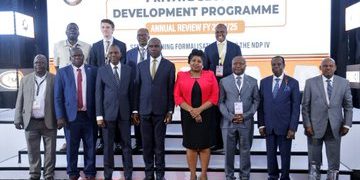



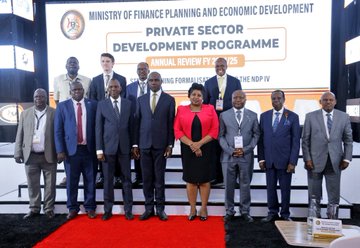
The government has said Uganda’s economy has registered a strong rebound and is now ranked among the fastest-growing economies globally, as officials met in Kampala for the annual review of the Private Sector Development (PSD) Programme.
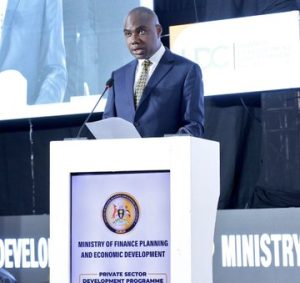
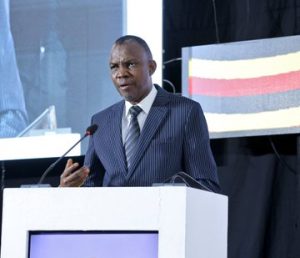
Speaking at the official opening of the PSD programme annual review at Mestil Hotel on Thursday, the Minister of State for General Duties at the Ministry of Finance, Planning and Economic Development, Henry Musasizi, said Uganda’s improved performance is a result of stable leadership and sound policy direction under the National Resistance Movement (NRM) government.
“Uganda’s economy has rebounded strongly under the able leadership of the NRM Government,” Musasizi said, adding that the country is now “recognised internationally as one of the fastest-growing economies in the world, with projections placing Uganda among the very top by 2031.”
Musasizi noted that Uganda’s macroeconomic environment remains resilient, describing it as a key driver of investor confidence. “Macroeconomic indicators also reflect resilience and stability, making Uganda increasingly attractive to investors,” he said.
Private Sector Financing Expanded
Musasizi highlighted major government interventions aimed at increasing private sector financing, saying the Uganda Development Bank (UDB) has played a critical role in expanding access to affordable credit.
He said financing to the private sector has grown significantly through government capitalisation of UDB. “Financing to the private sector has expanded through the Uganda Development Bank capitalization which exceeded UGX 1.5 trillion over the past five years,” Musasizi said.
He also pointed to other government wealth-creation initiatives, including Emyooga and the Parish Development Model (PDM), which he said have broadened financial inclusion.
He said financing has been boosted “through Emyooga (worth over UGX 500 billion) and UGX 3.26 trillion through the Parish Development Model (PDM), reaching millions of beneficiaries, deepening financial inclusion and wealth creation.”
Tenfold Growth Strategy Raises New Demands
Musasizi said the PSD programme is expected to play an even bigger role under the government’s long-term economic ambition to expand Uganda’s economy ten times over the next 15 years.
He said that although the Tenfold Growth Strategy has already been incorporated into the Fourth National Development Plan (NDP IV), the strategy comes with increased pressure on institutions implementing the PSD programme.
He noted that the goal is to grow Uganda’s economy to USD 500 billion by 2040, which will require stronger implementation capacity and more deliberate reforms.
“Although the Tenfold Growth Strategy is already integrated into the NDP IV, it introduces new challenges and demands a major leap in the delivery capacity under the PSD programme to achieve the ambitious goal of growing the economy 10 times to USD 500 billion by 2040,” he said.
Musasizi said the annual review meeting was critical for aligning priorities ahead of the next phase of national planning. “This annual review is timely, as it allows us to prepare for the road ahead. Our focus will be intentional and results-driven,” he said.
He listed key priorities the government will focus on, including “cheaper and accessible credit, financial inclusion, managing arrears, private sector capacity and formalisation.”
Implementation Action Plan Launched
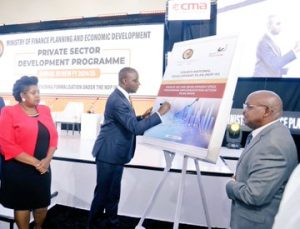
During the same meeting, Musasizi officially launched the Private Sector Development Programme Implementation Action Plan, which is expected to guide reforms and execution of PSD interventions under NDP IV.
Ggoobi Calls for Reflection on NDP III Performance
The Director of Economic Affairs, Moses Kaggwa, represented the Permanent Secretary and Secretary to the Treasury, Dr Ramathan Ggoobi, at the annual review meeting. Dr Ggoobi said the review provides an opportunity for stakeholders to assess implementation of the PSD programme over the last five years and identify areas that need adjustment as Uganda transitions into NDP IV.
“This review gives an opportunity to jointly reflect on the implementation of the PSD programme over the past 5 years, and to consider changes and improvements as we embark on the implementation of NDP IV,” Ggoobi said.
Ggoobi said the PSD programme brought together government institutions and private sector-related agencies under one framework aimed at strengthening private sector competitiveness.
“The PSST said government institutions with associated private sector responsibilities worked jointly under one programme with a specific goal of increasing private sector competitiveness to drive sustainable inclusive growth,” the Ministry said.
He outlined the five main objectives of the PSD programme, including lowering the cost of doing business, strengthening private sector capacity, promoting local content, unlocking investment in strategic sectors, and improving the enabling environment through standards enforcement.
Mixed Results in PSD Programme
Ggoobi acknowledged that while the programme registered progress in some areas, there were also weaknesses that need urgent attention. “As you will see in the PSD Annual report, there are areas where we have made good progress, but there are also areas where our performance has been weak,” he said.
He cited improved lending to growth sectors as a positive achievement, but warned that informality remains a major concern. “For example, while non-commercial lending to key growth sectors reached 4% of GDP from 1.5% in 2018/19, the share of the informal sector in the economy increased to 54.75% from 51% over the same period,” he said.
Ggoobi urged stakeholders to use the review to identify lessons and propose reforms to strengthen implementation going forward.
He implored participants “to reflect on the programme experiences and lessons under NDP III and carefully consider the adjustments needed to improve effectiveness and ensure better performance of the PSD programme under the NDP IV.”
“We will continue to work with all MDAs and other stakeholders to effectively tackle the key factors that have continued to inhibit private sector growth,” Ggoobi said.
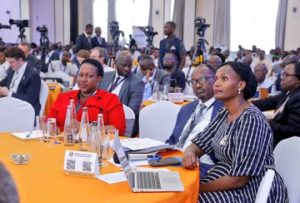
The annual review meeting brings together senior government officials, private sector leaders and development partners to assess progress and chart a path for accelerating private sector competitiveness as Uganda enters a new national development planning cycle.