



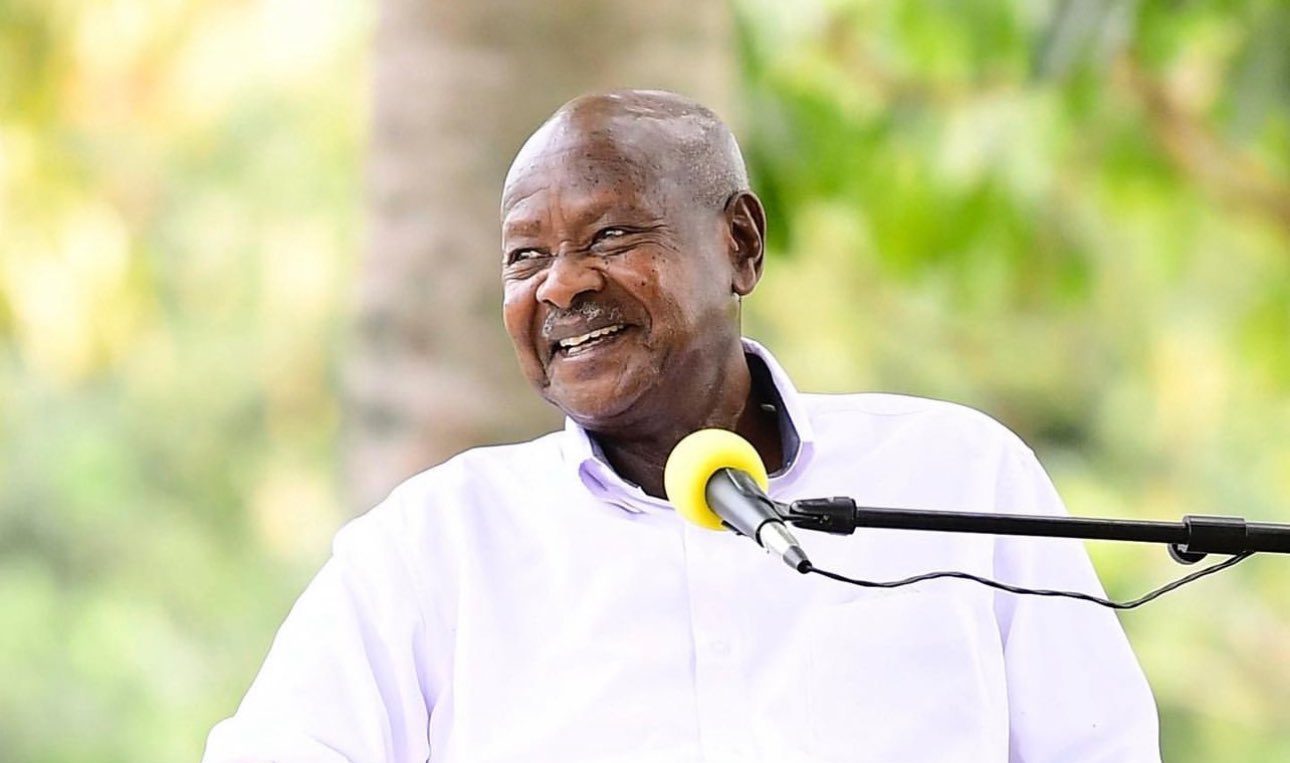
President Yoweri Kaguta Museveni has credited the use of Biometric Voter Verification (BVV) machines and what he called the National Resistance Movement’s “pro-people record” for what he described as the near completion of Uganda’s election cycle, saying the country now has “practically no opposition” capable of defeating the ruling party through legitimate means.
In a lengthy post-election statement addressed to Ugandans and particularly the “Bazzukulu,” Museveni congratulated the country for the “nearly ending elections—Presidential, Parliamentary, Local Govts and, eventually, LC1s,” while offering a sweeping reflection on Uganda’s political history, security threats, poverty, corruption, and what he called persistent sabotage by opposition forces.
Museveni said the atmosphere at his rallies was “celebratory and consultative,” with crowds spanning all age groups. “The atmosphere at these massive gatherings, was celebratory and consultative, with whole community turn-ups—the elderly, the youth and the children. It was always so beautiful for me to behold,” he said.
He likened the mood to the 1996 election season when, he said, the country largely rejected opposition politics, describing the then challenger Paul Ssemwogerere’s candidacy as being viewed as an attempt by “trouble makers.”
“It reminded me of the elections of 1996 when Ssemwogerere’s candidature was perceived by the majority as efforts of trouble makers,” Museveni said, quoting a Luganda expression: “Tubadde Bulungyi, kati Ssemwogerere aze kutabula”—meaning the country had been moving well but someone had come to disturb it.
“Politics of Megwa” and Sectarian Divisions
Museveni argued that sectarian politics based on tribe and religion had previously fueled division, especially in parts of Northern Uganda and the north-west, where he said some leaders promoted the idea of “megwa” (ours).
“It was only in the North and a bit of the North-West, where some of the usual opportunists had been pushing the politics of ‘megwa’ (ours),” he said.
He also accused earlier political actors, particularly the Kabaka Yekka movement in the early 1960s, of encouraging violence and economic sabotage against political opponents.
“Some neighbours even torching the houses of their area-mates… ‘Okwokya enyumba or okusawa emwanyi’ (cutting down somebody’s coffee plantation),” Museveni stated.
NRM Politics of “Okukyenuura”
Museveni attributed the NRM’s popularity to what he called the “NRA/NRA politics of Okukyenuura,” which he described as eliminating society’s “emikyeno”—needs that can be solved if leaders take action.
“Okukyenuura means to remove emikyeno of society. Emikyeno mean the needs of society that could be solved if some-body bothered to do the needful,” he said.
He listed what he called major achievements by the NRM by 1996, including ending extra-judicial killings through the creation of a disciplined army. “By creating a disciplined Army of soldiers ‘abalinga Ababiikira’ (as well behaved and polite as nuns),” he said.
He further said the NRM ended the politics of identity and tribal conflict, and restored industrial production by “quickly privatising the economy,” allowing goods such as sugar, cement, beer, soap and salt to return to the market. “We had ended ebura ry’ebintu (shortage of consumer and capital goods),” Museveni said.
He also credited his government with rebuilding roads such as Kampala-Kabale, Kampala-Mbale and Kampala-Gulu, and defeating insurgencies including those led by Alice Lakwena, Joseph Kony and the Allied Democratic Forces (ADF).
Universal Immunisation and “Opposing What?”
Museveni also pointed to public health achievements, recalling that in 1987, he and Dr Ruhakana Rugunda launched immunisation campaigns against six killer diseases. “The people were very happy and did not want to hear of Opposition. ‘Opposing what?’, they would often ask,” he said.
Poverty, School Fees, Corruption and Land Grabbing
However, Museveni acknowledged that by the late 1990s, new “mikyeno” began emerging, including poverty, the cost of education, corruption, and injustice in courts. “Some People were beginning to say: ‘Tulya ddembe?’ ‘Do we eat peace?’” he said.
He responded by introducing three policy measures: Entandikwa, Universal Primary Education (UPE) and a new land policy, embedded in the Constitution and the Land Act of 1998.
But Museveni blamed “careerist leaders” for failing to implement these initiatives effectively, arguing that self-interested politicians focused on salaries and allowances instead of pro-masses policies.
“Many of the careerist leaders (nnonya-kulya) that were thrown up by the elections, were busy with salaries, allowances for themselves and never bothered with the implementation of those pro-masses policies,” he said.
He claimed poor implementation contributed to later problems including school drop-outs, ghetto children, and land grabbing.
Load Shedding and Attack on Muntu
Museveni blamed the electricity crisis and load shedding experienced in the mid-2000s on Parliament, directly naming former army commander and politician Maj. Gen. Mugyisha Muntu.
“Shortage of electricity caused by whom and by what? Caused by the Parliament of that time including Major-General Mugyisha Muntu who in the recent elections has been expending so much energy, telling lies,” Museveni charged.
He said that Parliament blocked a proposed deal to build Bujagali power dam that would have produced electricity at “US cents 4.9 per kilowatt hour.”
“Secret Ballot” and Claims of Electoral Cheating
Museveni revisited Uganda’s electoral history, arguing that election rigging returned with the reintroduction of secret ballot voting during the 1994 Constituent Assembly elections. “Ever since the introduction of the secret ballot in 1994 vote for the CA, ballot cheating had started again,” he claimed.
He recalled a story about a “young man” who allegedly exposed Electoral Commission officials involved in ballot stuffing, multiple voting and altering results. “They offered that they could cheat for NRM like they had been cheating for the opposition. I told them that I did not want anybody to cheat for me,” Museveni said.
Instead, he claimed he asked them to use their “privileged position of being Electoral Commission cheaters, to stop cheating.
He said this contributed to his improved results in the 2011 elections. “That is why the results showed higher scores for the NRM in 2011. It was 68%,” he stated.
Museveni says NUP “Infiltrated 2.7 Million Votes”
Museveni claimed that in the 2021 elections, the National Unity Platform (NUP) fraudulently inserted 2.7 million votes into ballot boxes in Buganda and Busoga. “However, in the 2021 elections, NUP infiltrated 2.7million votes in the ballot boxes of Buganda and Busoga,” he said.
He argued that the ruling party’s performance has been affected by both “fractured political landscape” and “massive election cheating” by the opposition.
Government Programs and “Radar on the Ground”
Museveni defended government poverty alleviation programmes, listing NAADS, Operation Wealth Creation (OWC), Youth Fund, Women Fund and Emyooga as key interventions. “My political radar is always on the ground,” Museveni said, adding that despite weaknesses, the programmes had boosted national production.
He listed key agricultural output figures, including: Coffee: 9 million bags (up from 3 million in 1986), Milk: 5.3 billion litres (up from 200 million litres in 1986), Maize: 5 million tonnes (up from 500,000 tonnes in 1986), Cattle: 16 million heads (up from 3 million in 1986), Bananas: 12 million tonnes (up from 6 million tonnes in 1986), Cassava: 5 million tonnes (up from 1.9 million tonnes in 1986) and Egg production: 49.6 million trays.
However, Museveni admitted that prosperity was not evenly spread, claiming that by 2019, only 61% of homesteads were in the money economy while 39% remained subsistence.
Parish Development Model and “Sikwatanga ku Kakadde”
Museveni said complaints that government programmes benefited only elites led him to insist on the Parish Development Model (PDM), which relies on parish SACCOs to decide beneficiaries. “I started hearing my people saying: ‘Begabila bokka’—‘they only give to their friends or relatives’,” he said.
He praised PDM success stories, saying many Ugandans were reporting that they had never physically held a million shillings before. “The stories of ‘sikwatanga ku kakadde’ (I have never held a million shillings in my hands), are everywhere,” Museveni said.
He said PDM, combined with peace, infrastructure and government support in northern Uganda and Karamoja, helped create the positive campaign atmosphere he witnessed.
“The Death-Knell to the Opposition Were the BVV Machines”
Museveni credited biometric technology for limiting electoral fraud, saying the BVV machines cut off the opposition’s “life-line of cheating.” “The death-knell to the opposition were the BVV machines. With the BVV machines, the Opposition’s life-line of cheating, was gone,” he said.
However, he acknowledged that poor training of some BVV operators created loopholes. “It was, therefore, a rescue that many BVV machine operators did not learn how to use them properly. They got a chance to cheat here and there,” he said.
“There Is Practically No Opposition in Uganda”
Museveni said the NRM’s political strength is overwhelming, citing party membership statistics. “Our registered members as of the 6th of May, 2025, were 21 million where those old enough to vote were 18.5 million,” he said.
He claimed that since Uganda has about 21 million registered voters, if all NRM supporters voted, the party would win by a massive margin. “This means 88% support for the NRM. That is the real balance of forces in the country as per now,” he stated.
Blames Low Turnout on “Najja-kulya” Leaders
Museveni admitted that many NRM supporters do not vote, blaming “Najja-kulya” leaders—self-seeking politicians—both within NRM and the opposition. “The NRM side, do not interact closely with our members, during Primaries they use violence and unfair practices,” he said, suggesting such actions disgust supporters and drive them away from voting.
He also suggested opposition intimidation discourages voters.
Fresh Accusations of Violence and “Mercenaries”
Museveni accused NUP of orchestrating violence in Masaka in 2021, where 28 people were attacked with machetes. “You remember the 28 elders that were cut by machete (panga) wielders in Masaka in 2021? That was the work of NUP,” he alleged.
He said the opposition had planned “big insurrection” to disrupt voting, but that security forces and citizens prevented it. “They still have schemes they are still hatching, working with some criminal foreigners (mercenaries). We shall crush them,” Museveni warned.
He said some cases will be prosecuted in court.
Museveni Rejects Shelter at Rallies
Museveni also spoke about his campaign schedule, noting it started in Luwero on September 30, 2025 and ended at Kololo on January 13, 2026.
He described midday rallies under the sun and rain as physically demanding, but said he refused special treatment. “I rejected a proposal from my staff where they wanted to erect a shelter against the sun for me… I had to be in the sun and the rain with the tens of thousands of my supporters,” he said.
He criticised local leaders for spending money on tents for elites while ordinary supporters, including children and elderly people, endure harsh weather.
“We need to review the practice of the local elite wasting NRM money or Govt money, hiring tents for young leaders while the masses of the people are in the sun or the rain,” Museveni said.
Cites Nebbi, Bulambuli and Namisindwa as Proof BVV Works
Museveni offered district-by-district examples to show the BVV system can deliver clear results when properly used, highlighting Nebbi where he said BVV worked in all 362 polling stations. “In Nebbi, they worked in all the 362 polling stations and NRM got 81%, NUP 15.4%,” he said.
He cited Bulambuli and Namisindwa results, mentioning NRM and Mafabi performance. “In Bulambuli’s 257 polling stations, NRM got 60.80%, Mafabi got 30.12%. Namisindwa had 302 polling stations and NRM got 65.47%, Mafabi 26.46%,” he stated.
Calls for Reconciliation, Even with Opposition
Despite his harsh tone toward opposition groups, Museveni ended by calling for fairness and reconciliation, urging Ugandans not to mistreat political rivals. “All said and done, I call upon Ugandans to abandon any bad behaviour and act fairly to all, even opposition,” he said.
However, he insisted reconciliation must be “principled,” not opportunistic. “You should work for principled reconciliation—not just opportunistic patching up,” he said.
Museveni Recalls 1979 Kagera River Crossing
In a historical reflection, Museveni reminded Ugandans that February 11 marked the anniversary of his 1979 entry into Uganda alongside Tanzanian forces during the war that removed Idi Amin.
“I crossed the Kagyera River with 200 FRONASA fighters at Murongo-Kyikagate alongside the Task Force Batallion of Major Kessy of the TPDF’S 206 Brigade under Brigadier Silas Mayunga,” he said.
He recalled sleeping on the road in Nshungyezi and camping at Ngarama Sub-county headquarters, claiming that within two months his force grew to 9,000 fighters. “Between the 12th of February and the 15th of April, 1979, we built a force of 9,000 fighters of FRONASA,” Museveni said.