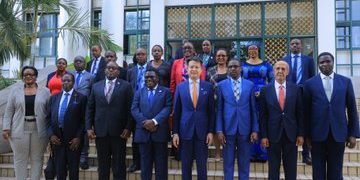




The Director General of the World Intellectual Property Organisation (WIPO), Mr Daren Tang, on Thursday held high-level discussions with senior Ugandan government officials as part of his second day of engagements in the country, reaffirming WIPO’s commitment to supporting Uganda’s ambitious intellectual property (IP) reforms.
Mr Tang and his delegation met the Minister of Justice and Constitutional Affairs, Hon. Norbert Mao, alongside the Solicitor General and Deputy Solicitor General, for a strategic dialogue on Uganda’s modernisation of its IP ecosystem.

Hon. Mao said Uganda had entered a new phase of innovation-driven development. “Uganda is taking bold steps to reform laws that support creativity, innovation and a modern IP ecosystem,” he said.
WIPO’s Director General praised Uganda’s momentum and outlined the organisation’s vision for inclusive IP development. “IP must be accessible and meaningful for every country, especially emerging economies where creativity and entrepreneurship are rising fastest,” Mr Tang said.
He stressed that Uganda’s small businesses, researchers, rural innovators, and young people should be at the centre of these reforms.

Mr Tang pointed to Ugandan success stories as proof that IP can transform livelihoods. “IP tools help create jobs, build businesses and strengthen communities. Uganda shows what is possible when innovation is supported at all levels,” he noted.
Later, the WIPO chief held an in-depth engagement with the Science, Technology and Innovation (STI) Secretariat under the Office of the President. Representing the Secretariat, Minister of General Duties Rt. Hon. Justine Lumumba said Uganda’s innovation capacity was growing rapidly.
“Nearly all our work is tied to IP. Building this ecosystem has been a privilege — our innovation capacity is rising because we are intentional, consistent and learning every day,” she said.

Mr Tang highlighted Uganda’s strong youth demographics, expanding university research base and active Technology and Innovation Support Centre (TISC) network as key strengths.
“IP must empower communities — from professors to young innovators working outside formal systems,” he said.
He added, “With 78% of your population under 35, Uganda’s innovative potential is immense. We are ready to work with your GII Task Force, strengthen IP training, and support your innovation parks and tech-transfer systems.”

Hon. Mao expressed gratitude to WIPO for its longstanding support. “Uganda is honoured to host you. The Attorney General remains the anchor for reforms that protect and commercialise creativity,” he said.
He added: “WIPO has helped us move from merely protecting IP to commercialising it. Uganda does not forget its friends.”
Attorney General Kiryowa Kiwanuka reiterated Uganda’s commitment to using IP as a driver of national transformation.

“We have moved from merely protecting IP to commercialising it. Our national principles — patriotism, Pan-Africanism and socio-economic transformation — align fully with WIPO’s mission. Uganda does not forget its friends,” he emphasised.
Mr Tang reaffirmed WIPO’s readiness to expand cooperation, noting progress in geographical indications (GIs), youth IP programmes, TISCs, and upcoming initiatives such as “IP in the Hubs.”

“IP must work for SMEs, rural communities and young innovators — unlocking the country’s intellectual and ancestral knowledge for national development,” he said.
Mr Tang’s visit marks one of the most comprehensive engagements between Uganda and WIPO in recent years, spotlighting the country’s determination to build a modern innovation economy backed by strong, inclusive IP systems.