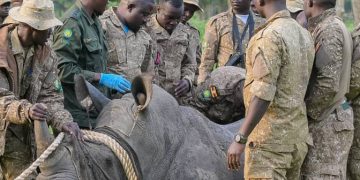



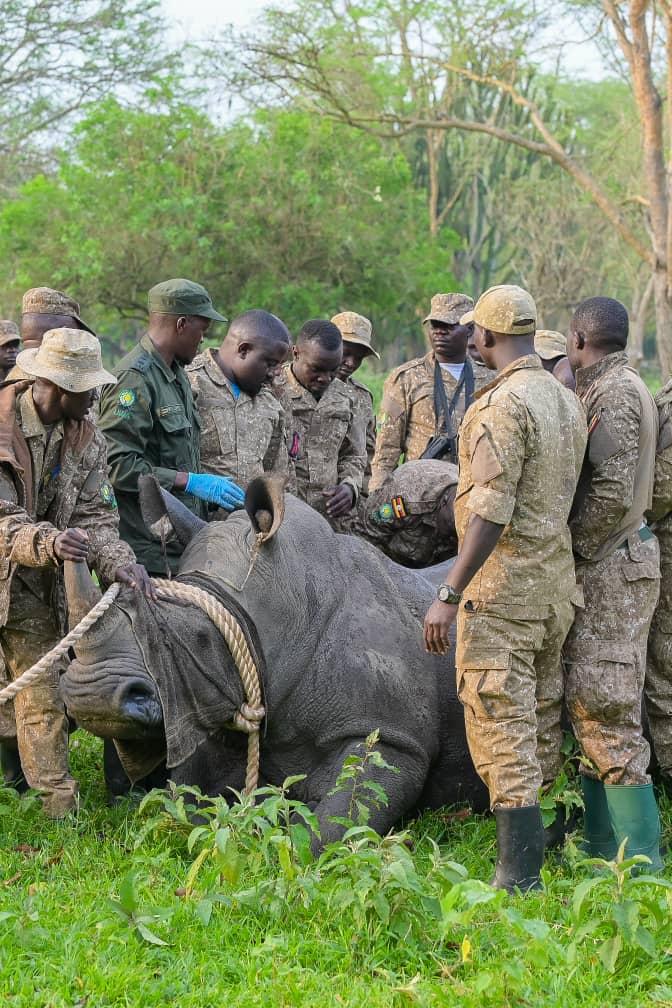
Uganda has marked a major conservation milestone following the successful translocation of rhinos from Ziwa Rhino Sanctuary to Ajai Wildlife Reserve for the first time in the country’s history.
The relocation of four southern white rhinos officially kick-started a national programme that will see 20 rhinos reintroduced to Ajai in Madi-Okollo.
The move is part of the National Rhino Conservation Strategy, which aims to rebuild Uganda’s rhino population and restore the species to parts of its historical range. Ajai Wildlife Reserve was once home to the northern white rhino, a subspecies that is now functionally extinct due to decades of poaching and habitat loss.
Although the southern white rhino is not indigenous to Uganda, UWA says the principle of conservation equivalence guides its reintroduction.
Historically, both northern and southern white rhinos belonged to the same species before their eventual separation, making the move an ecologically sound alternative for restoring rhinos to Uganda’s landscapes.
According to Hangi Bashir, Assistant Commissioner Communications, UWA, the four rhinos are currently under intensive monitoring as they adapt to their new habitat.
A second phase involving the relocation of the remaining 16 rhinos will be undertaken after successful stabilisation of the first group.
UWA Executive Director Dr. James Musinguzi described the translocation as a defining moment for wildlife conservation in Uganda.
“The return of rhinos to Ajai is a proud and emotional moment for Uganda. It reflects years of dedicated conservation work and a highly successful breeding programme at Ziwa Rhino Sanctuary, where our rhino population has steadily grown under careful protection.
This next step strengthens species recovery and restores an important part of our natural heritage for future generations,” Dr Musinguzi said.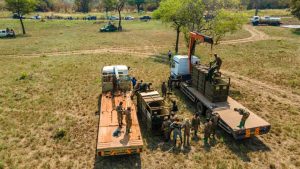
Uganda previously hosted both the northern white rhino and the eastern black rhino. The northern white rhinos occupied areas west of the Albert Nile, particularly in the former West Nile district, with Ajai as their stronghold. The eastern black rhinos were found east of the Albert Nile and north of the Victoria Nile, spanning the former Acholi, Lango and Karamoja regions.
However, widespread poaching and prolonged insecurity led to their extinction in the wild, with the last rhino killed in the Narus Valley of Kidepo Valley National Park in 1983.
Efforts to reintroduce rhinos began in 1997 with the establishment of Rhino Fund Uganda, followed by public awareness initiatives in 2001 and the importation of two rhinos from Kenya.
In 2005/2006, the breeding programme at Ziwa Rhino Sanctuary was strengthened through the importation of six rhinos from Kenya and the United States, forming the foundation of a population that has since grown to over 45.
In December 2025, an additional eight southern white rhinos were imported from South Africa to further bolster the breeding population in line with national conservation goals.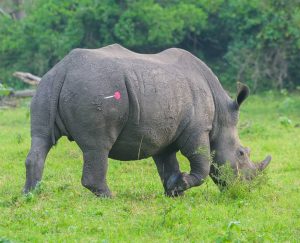
He noted that a number of measures are being taken to ensure the safety of the rhinos, as well as develop the west Nile tourism circuit.
Hangi called upon neighbouring communities and the general public to actively support the initiative by reporting any suspicious activity that may threaten the rhinos’ safety.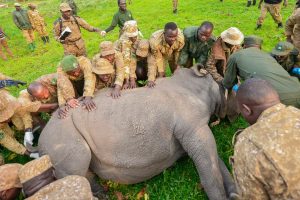
“The success of this programme depends on our shared responsibility and national pride in protecting Uganda’s wildlife heritage,” he noted.