



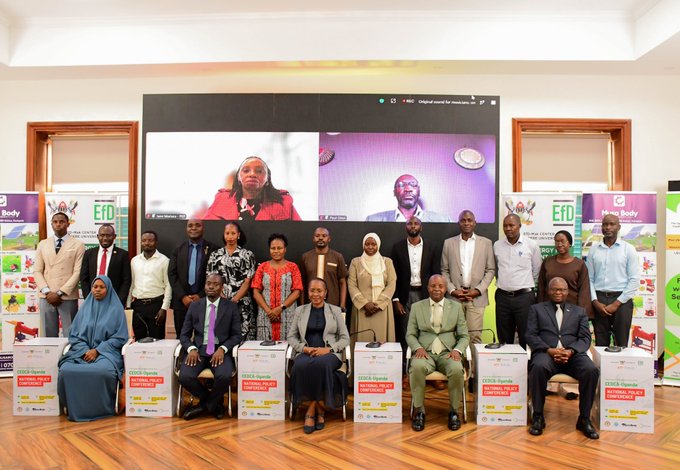
KAMPALA — Uganda’s transition to clean energy will remain incomplete unless renewable technologies become affordable, accessible and genuinely useful to smallholder farmers, researchers, government officials and private-sector actors have warned.
The call was made at the Clean Energy for Development: A Call to Action (CEDCA) Uganda National Policy Conference held at Makerere University, where researchers presented findings on the barriers preventing farmers and agricultural businesses from adopting low-carbon technologies.
Prof. Edward Bbaale, Principal of Makerere University’s College of Business and Management Sciences and Principal Investigator of the CEDCA project, said the research had examined two critical policy gaps: how information reaches farmers and whether government incentives are effectively targeted and sequenced.

He said the study was particularly concerned with “the appropriateness of information dissemination mechanisms and the effectiveness, targeting and sequencing of programme incentive structures.”
That distinction matters. A solar pump can exist; a subsidy can exist; a farmer can even know that clean technology exists. Yet adoption can still fail if the three do not meet at the farm.
Representing Makerere University Vice Chancellor Prof. Barnabas Nawangwe, Deputy Vice Chancellor for Academic Affairs Prof. Sarah Ssali said climate change was already altering the conditions under which Ugandan farmers operate.

“Uganda, like much of sub-Saharan Africa, is experiencing profound climate challenges. Erratic rainfall, prolonged droughts and heat waves have become increasingly common,” she said.
Ssali said annual temperatures had been rising while precipitation had declined, creating an urgent need for irrigation and agricultural value addition. “In this context, irrigation and value addition are no longer optional but essential,” she said.
But the technologies remain out of reach for many farmers. “Interesting evidence shows that only 2 percent of farmers apply sustainable irrigation, and very few use modern agricultural technologies,” Ssali said.
She stressed that low adoption should not be interpreted as a lack of interest among farmers. “This is not because they lack interest, but because they face barriers arising from high costs, limited access to financing and inadequate information about available technologies and government-supported programmes,” she said.
Ssali said Makerere had worked with Ugandan engineering company Musabe Machinery Uganda Limited and Sun Culture Uganda Limited to connect farmers with technologies including irrigation, milling, harvesting and food-processing equipment.
She argued that the clean-energy transition should ultimately be judged by what happens to people’s livelihoods. “It’s about empowering farmers, strengthening livelihoods and securing Uganda’s food sovereignty and climate resilience.”
Representing the Ministry of Energy and Mineral Development, energy officer Hatimu Muyanja said Uganda’s energy transition must be built on evidence and inclusive policymaking.

“We recognise that a sustainable energy transition must be grounded in credible evidence and inclusive policy dialogue,” Muyanja said.
He noted that more than 70 percent of Uganda’s population depends on agriculture, while rural businesses and agricultural value chains continue to face high energy costs and unreliable electricity.
“Fossil fuels also limit productive use and local value addition,” he said.
Muyanja gave the example of farmers who may have water nearby but lack the energy infrastructure to access it. “You may find someone who has a source of water about 100 metres away, but is unable to access it because of the energy required to pump the water,” he said.
Technologies such as solar water pumps, solar dryers and tillers, he said, could improve agricultural productivity, reduce post-harvest losses and strengthen resilience to climate shocks.
The ministry is also looking beyond household electrification towards productive energy use. “We are moving beyond, as a Ministry, simply providing household electrification. We are looking towards developing clean energy for productive agriculture, processing and value addition in rural areas,” Muyanja said.
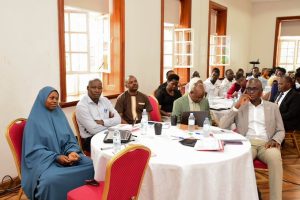
He said the government-backed Electricity Access Scale-Up Project, financed by the World Bank, is being implemented to expand electricity access, while community service centres could help farmers access technology and technical knowledge.
Evidence must lead to policy
Joining the conference virtually, Prof. Jane Kabubo-Mariara, Executive Director of the Partnership for Economic Policy (PEP), said the project demonstrated the importance of generating evidence locally rather than importing solutions designed elsewhere.
PEP, she said, is a 1,000-member organisation built around the belief that “in-country development challenges require local and diverse solutions.” “Our vision is for a world in which every country, including Uganda, has local evidence and expertise to help make decisions about its own future,” she said.
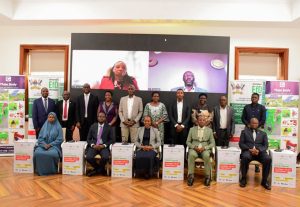
Kabubo-Mariara said PEP uses mentorship, peer review and co-production between researchers and policymakers to ensure research can actually influence decisions. “This approach works,” she said.
She cited PEP data showing that 55 percent of projects supported since 2016 had contributed to informing or influencing relevant policy processes.
The CEDCA project, she said, uses randomised controlled trials to test interventions designed to accelerate adoption of low-carbon agricultural technologies in Burkina Faso, Kenya, Uganda and Vietnam.

Clean energy must improve incomes
Dr Florence Lwiza, an Environment for Development research fellow, warned against assuming that simply providing information would automatically produce adoption.
“Information alone is not enough to drive adoption,” Lwiza said, calling for financing, targeted communication and reliable access to clean-energy technology providers.
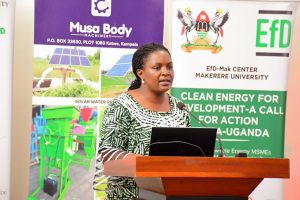
Dr Nicholas Kilimani, a Makerere University faculty member, similarly argued that clean energy should be judged by its impact on farmers’ incomes. “Clean-energy interventions must be connected to agricultural activities and realities of smallholder farmers,” he said.
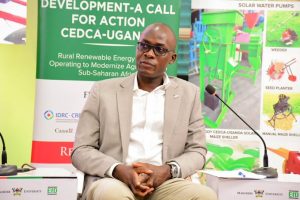
Delivering a keynote address on “Productive Use of Energy in Uganda,” Associate Professor Fred Matovu urged researchers, farmers, technology developers and government to work together to develop agricultural technologies that are accessible, affordable, reliable and sustainable.
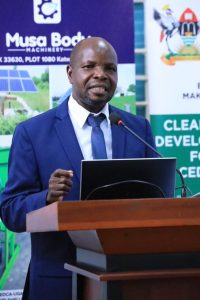
Research seeks practical solutions
Project Manager and Engineer Gyaviira Ssewankambo presented a co-created hybrid maize sheller developed through collaboration between Makerere researchers, Musa Body fabricators and farmers.
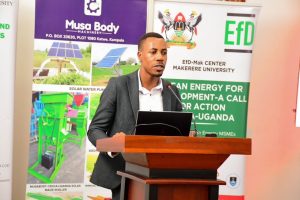
Dr Aisha Nanyiti, who presented the research findings and policy implications, urged policymakers to pay close attention to Uganda’s rising food imports.
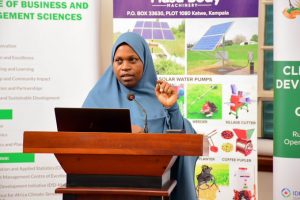
She warned that growing dependence on imported food exposes the country to external shocks, strengthening the case for technologies that can raise domestic agricultural productivity and value addition.
Dr Peter Babyenda, Policy Engagement Coordinator at Makerere University’s College of Business, said the panel discussion reached agreement that productive energy technologies must be climate-smart, affordable, feasible, reliable and culturally acceptable.
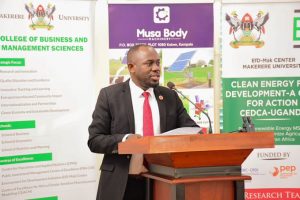
A high-level panel on scaling clean-energy adoption brought together Ms Babirye Habeeba, farmer Ausi Sembatya, Dr Nicholas Kilimani and Alfred Kizza of the Uganda Energy Credit Capitalisation Company.