


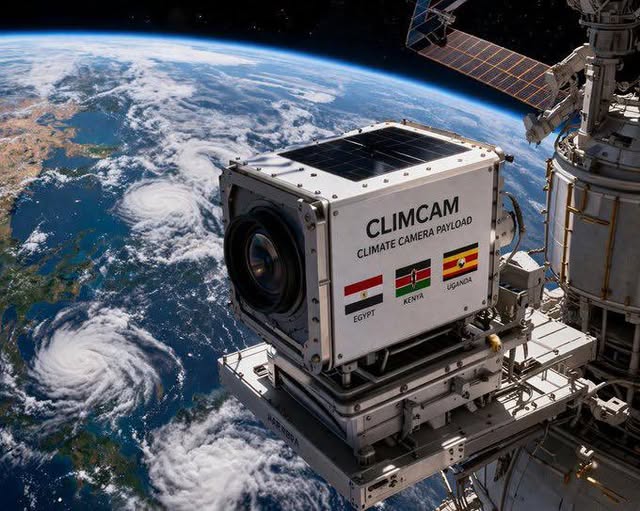
Uganda has marked a major milestone in science and innovation with the launch of its first space-based climate monitoring system, the ClimCam, aboard a SpaceX Falcon 9 rocket on Friday, April 11, 2026.
The project, announced by the Government of Uganda through the Science, Technology and Innovation Secretariat, forms part of a joint Earth-observation mission developed under the United Nations Office for Outer Space Affairs (UNOOSA) “Access to Space for All” programme in partnership with Airbus.
According to officials, ClimCam was launched aboard the Falcon 9 Cygnus NG-24 mission bound for the International Space Station (ISS), where it will be deployed on the Airbus Bartolomeo external platform using the ArgUS carrier system.
The government said the innovation is designed to revolutionise climate monitoring in Eastern Africa by providing high-resolution environmental data to support disaster response, agriculture, and climate resilience.
“CLIMCAM is set to revolutionise climate monitoring across Eastern Africa,” the Science, Technology and Innovation Secretariat said in a statement. “It enables real-time, on-orbit climate-impact detection using machine-learning algorithms.”
The system is expected to deliver imagery with a spatial resolution of about 10 metres and provide up to four imaging passes daily over the region, offering enhanced monitoring of floods, droughts, and environmental changes.
The mission is a collaboration between Uganda, Kenya, and Egypt and represents one of Africa’s most advanced participatory space technology initiatives to date.
Ugandan engineers played a central role in the project’s development, including Gerald Kisangala (Soroti University), Kalyankolo Zaina (Mbarara University of Science and Technology), Nalwanga Rosemary (Busitema University), and Ongom Christopher Adoko (Kyambogo University).

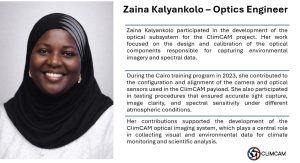


Their work focused on embedded systems, firmware development, and printed circuit board design.
The government noted that four engineers were also sponsored for specialised training at the Egyptian Space Agency, strengthening national capacity in space science and engineering.
Officials said the project offers Uganda strategic benefits in environmental monitoring, technological advancement, and data sovereignty, positioning the country as an emerging player in space-enabled climate intelligence.
Once operational, ClimCam is expected to complement existing ground-based weather systems and machine-learning early warning tools, improving preparedness and response to climate-related disasters across the region.