




Washington, D.C. — The White House on Thursday hosted what it called a “historic moment for peace” as U.S. President Donald J. Trump presided over the signing of the Washington Accords, a new peace deal between Rwandan President Paul Kagame and Democratic Republic of Congo (DRC) President Félix Tshisekedi.
The ceremony, held at the newly unveiled Donald J. Trump Institute for Peace, was marked by soaring rhetoric, sweeping promises, and praise from regional leaders — even as conflict continues to rage on the ground in eastern DRC.
President Trump hailed the agreement as a diplomatic triumph.
“For more than 30 years, one of the worst conflicts on earth has been raging in Eastern Congo,” Trump said. “Millions and millions of people have been tragically killed… many administrations have tried… today, we’re succeeding where so many others have failed.”
He outlined the core pillars of the Washington Accords: “A permanent ceasefire, the disarmament of non-state forces, provisions for refugees to return to their homes, and justice and accountability for those who have committed illegal atrocities.”
The United States also signed bilateral agreements with both Rwanda and the DRC, a move Trump said would open new opportunities for U.S. access to critical minerals. “These agreements will unlock economic benefits for everybody,” he added.
Regional Leaders Praise U.S. Role
President Kagame called the initiative unprecedented. “The biggest word of thanks goes to President Donald Trump,” he said. “No one was asking President Trump to take up this task. Our region is far from the headlines, but when he saw the opportunity to contribute to peace, he immediately took it.”
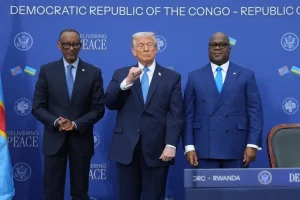
DRC President Tshisekedi also expressed deep appreciation. “I would like to express, quite solemnly, our deep thanks to the President of the United States of America, Mr Donald Trump… and the American people,” he said.
Kenyan President William Ruto, who attended the ceremony, praised the agreement as a turning point. “Mr President, what you have achieved is not only transformative — it is consequential, and historic,” Ruto said.
A Ceremonial Boost to a Fragile Agreement
The Washington ceremony supports a peace agreement initially negotiated in June, but which has failed to produce a cessation of hostilities. Fighting between the Congolese army and the Rwanda-backed M23 rebel group has intensified in recent weeks.
Experts warn that the ceremony’s symbolism must now translate into action.
What Could the Deal Change on the Ground?
Under the terms of the accord: Rwanda agrees to end its military and logistical support for M23. DRC commits to confronting Hutu militias on its territory, including remnants of groups associated with the 1994 genocide. Both countries vow to open new economic corridors, particularly for rare earth mineral exports, with the U.S. positioned as a key strategic partner.
But the reality in eastern DRC tells a more complicated story. Violent clashes continue, and M23 has captured significant territory even after the June agreement.
Analysts note that Rwanda’s long-standing security concerns — especially regarding Hutu rebel factions — and the DRC’s internal political dynamics remain major obstacles.
“What was signed in Washington is significant diplomatically,” one regional expert said, “but it does not change the security calculations on the ground overnight.”
As celebrations continued in Washington, residents of North Kivu, South Kivu and Ituri provinces faced another night of shelling and displacement.
The Washington Accords mark the highest-profile international intervention in the Rwanda-DRC conflict in years. Whether it will deliver the promised peace — or become another stalled agreement — will depend on actions far from the ceremony’s bright lights.