


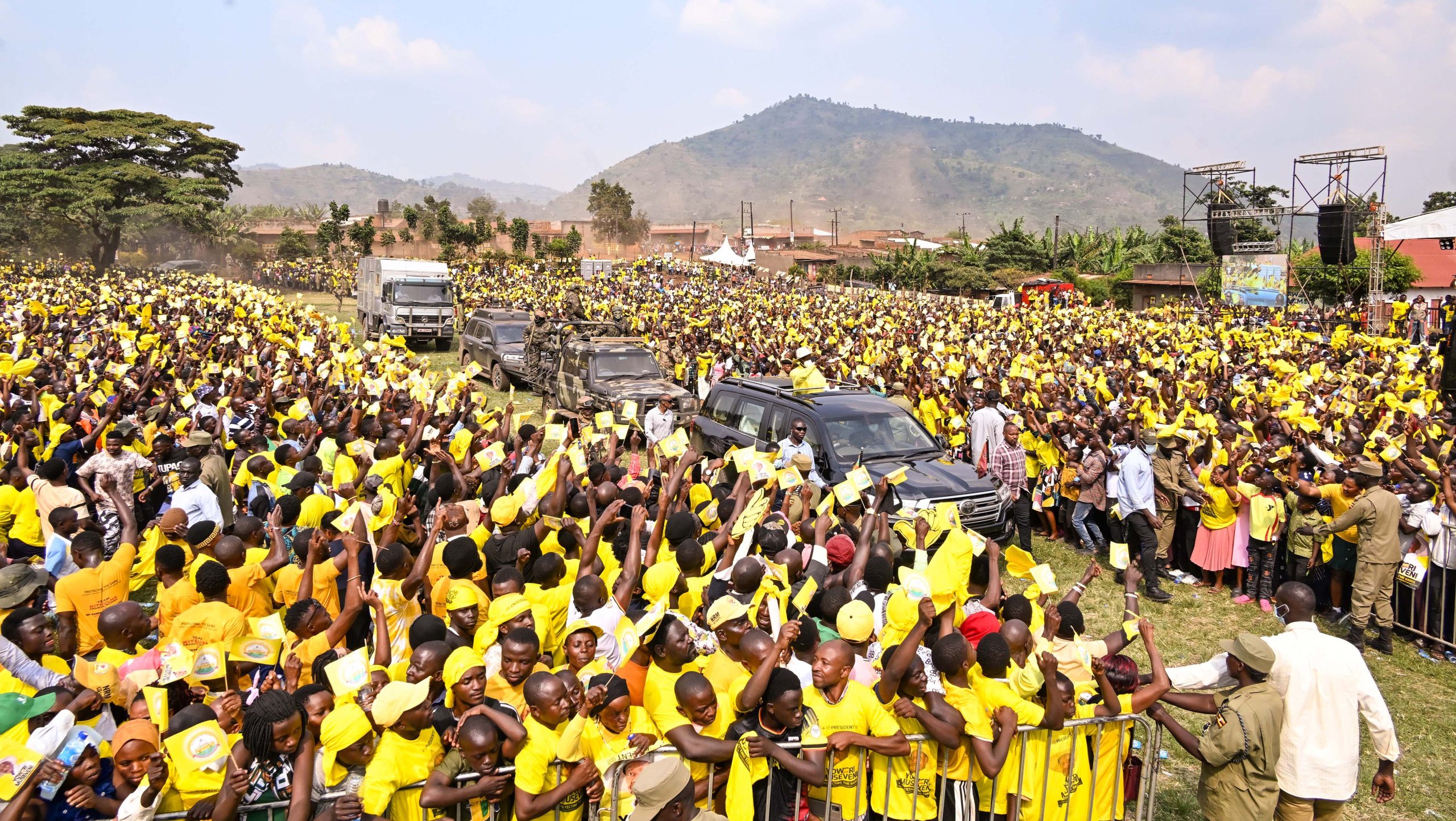
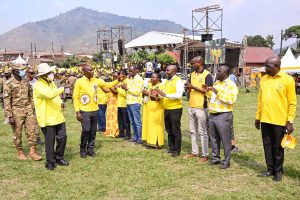
President Yoweri Kaguta Museveni on Monday, January 12, 2026, returned to the Rwenzori region with a campaign stop in Busongora North Constituency, Kasese District, using the rally to outline what he described as the National Resistance Movement’s (NRM) historic and future contributions to Uganda as the country heads toward the 2026 general elections.
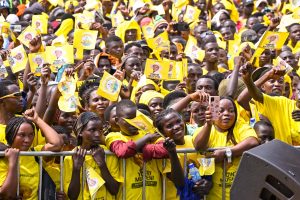
Addressing supporters at Nkaiga Primary School in Maliba Sub-county, President Museveni, who is the NRM national chairman and the party’s presidential flag bearer, highlighted the seven key contributions of the NRM to Uganda, focusing particularly on peace, development, wealth creation, and job creation.
President Museveni identified peace as the first and most fundamental contribution of the NRM. He argued that Uganda’s post-independence instability was largely caused by what he termed as “bad politics” rooted in sectarianism along religious and tribal lines.
According to the President, such politics made it impossible to build stable national parties and institutions. “Instability had eluded Uganda because politics was based on religion and tribe. With that kind of politics, you cannot build strong national institutions.”
He cited the political landscape at independence in 1962, when the Democratic Party (DP) largely attracted Catholics, the Uganda People’s Congress (UPC) drew support mainly from Protestants and some Muslims, while Kabaka Yekka was rooted in Buganda. The lack of a national outlook, he said, led to fragile coalitions, their collapse, and eventually conflict.
President Museveni told supporters that the NRM deliberately rejected sectarian politics, opting instead for a national, inclusive approach. This, he said, enabled the NRM to build strong national institutions, including a professional army, which he credited for the relative peace Uganda enjoys today.
“That is how we got peace—through clean politics and strong national institutions,” he said, describing peace as the foundation upon which all other progress is built.
Turning to development, President Museveni listed infrastructure such as electricity, roads, schools, clean water, health centres, and bridges as the second major contribution of the NRM. However, he cautioned that development alone does not automatically lift households out of poverty.
“You may have a good tarmac road, but you don’t sleep on that road at night,” he said. “You sleep in your house, and when you return, poverty welcomes you back.”
It was this distinction, he explained, that led the NRM to separate development, which benefits everyone collectively, from wealth, which must be created at the household level.
This thinking, President Museveni said, informed the party’s long-standing emphasis on wealth creation alongside infrastructure development.
Using Kasese as an example, he pointed to the district’s economic potential, citing coffee production and tourism around the Rwenzori Mountains and national parks.
He illustrated Uganda’s economic interdependence by noting that coffee from Kasese passes through Kampala, while milk, beef, and bananas produced in one region are consumed in another.
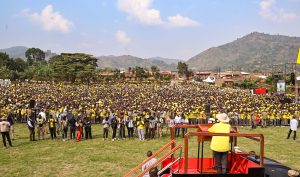
“Somebody who does not appreciate Uganda as one country is an enemy of Uganda,” he said.
Regarding wealth creation, the President described it as the third major contribution of the NRM. He said that in the 1996 NRM manifesto, the government introduced the four-acre model aimed at helping smallholder farmers both feed their families and earn income.
Under the model, one acre is planted with coffee, another with food crops, a third one with fruits, and a fourth with pasture for dairy cows, complemented by poultry, piggery, or fish farming in the backyard.
To demonstrate the viability of this approach, President Museveni highlighted several successful demonstration farmers across the country. One of the most prominent examples was the state Minister for Transport, Hon. Fred Byamukama, of the Kamanyire Demonstration Farm in Kakumiro District.
His four-acre model farm integrates coffee, bananas, pineapples, poultry, dairy and piggery enterprises. According to Hon. Byamukama, the farm keeps more than 200 pigs and over 25,000 layers, producing about 302 trays of eggs daily. It also has dairy cows producing approximately 120 litres of milk per day.
Quoting figures from the farm, President Museveni said the egg enterprise alone generates about Shs.108 million per month, with net profits of around Shs. 55 million after costs, translating to roughly Shs700 million annually.
“That is from eggs alone, without counting coffee, bananas, milk, and pigs,” he said, describing the farm as living proof of the ideas the NRM has promoted since the 1990s.
The President also cited examples from regions often associated with poverty to argue that wealth creation depends more on enterprise selection and management than on infrastructure. He referred to Korea Dick Ogira, a farmer from Abim District in Karamoja, who received 200 mango seedlings under Operation Wealth Creation (OWC) and Shs1 million through the Parish Development Model (PDM).
Ogira planted mangoes alongside two acres of cassava and, according to President Museveni, earned about Shs12 million in his first year by selling mangoes at Shs1,000 each.
“That man is in Abim, Karamoja, very far from here, with no tarmac road and no electricity, but wealth is there.”
He clarified that while crops such as maize, cocoa, and tobacco are viable, they require large-scale production and are not suitable for the four-acre model.
President Museveni reviewed the evolution of government interventions aimed at boosting household incomes, starting with Entandikwa, followed by the National Agricultural Advisory Services (NAADS), Operation Wealth Creation, and now the Parish Development Model.
Under OWC, he noted, Kasese District received significant agricultural inputs, including about 17 million coffee seedlings, 7,770 mango seedlings, and 640,000 apple seedlings.
However, complaints about mismanagement of earlier programs led the government to design the PDM, which sends funds directly to parish-level savings and credit cooperatives (SACCOs).
Under the PDM, President Museveni said, every Ugandan aged 18 and above is encouraged to join the parish SACCO, whose leaders are elected by members. Each parish receives Shs100 million per year, with beneficiaries expected to repay loans with modest interest, allowing the fund to grow over time.
“In the third year, the money starts coming back, and in five years, the parish will have over Shs500 million,” President Museveni said, expressing satisfaction with Kasese’s reported performance under the program.
He also revealed plans to introduce additional targeted funds, including support for parish leaders, unemployed university graduates, ghetto youth, boda boda riders, religious leaders, Islamic districts, and cultural institutions such as Obusinga bwa Rwenzururu.
“The idea is that everyone must be involved in wealth creation. We do not want spectators.”
The fourth contribution President Museveni highlighted was job creation. He challenged the belief that jobs can only come from the government, noting that the public service employs only about 480,000 people in a country of more than 50 million.
“Where do jobs come from?” he asked. “They come from commercial agriculture, manufacturing, services, and artisanship.”
To illustrate, President Museveni cited Johnson Basangwa of Jeka Poultry Farm in Kamuli District. Basangwa, he said, was once competing for a political post but took advice to invest in poultry instead. Today, his farm reportedly sells about 2,000 trays of eggs daily, earning about Shs20 million per day and creating jobs for roughly 300 Ugandans.
“He had no job himself, but now he has created wealth and jobs for others,” President Museveni said.
The President also pointed to manufacturing growth, citing the Sino-Uganda Mbale Industrial Park, which he said now hosts about 75 factories and employs thousands, transforming what was once undeveloped land into a new industrial town.
For Kasese, President Museveni identified commercial agriculture, tourism linked to the Rwenzori Mountains and national parks, and services such as transport and hospitality as key drivers of future wealth and employment.
The NRM candidate urged voters in Busongora North and across Kasese District to support the NRM in the 2026 elections, arguing that continued peace, development, wealth creation, and job creation are rooted in the party’s principles of patriotism, Pan-Africanism, socio-economic transformation, and democracy.
The Busongora North rally was among the final regional engagements in President Museveni’s campaign schedule, ahead of a planned climax at Kololo Ceremonial Grounds today.
The event was also attended by ministers, members of the NRM Central Executive Committee, Members of Parliament, and party flag bearers from Kasese and neighbouring areas.
Uganda is scheduled to go to the polls on Thursday, January 15, 2026.