


KAMPALA — At least 13 percent of children in Uganda are orphans, representing about 2.9 million who have lost one or both parents, according to the latest findings released by the Uganda Bureau of Statistics (UBOS).
The figures are contained in the Orphans and Other Vulnerable Children (OVC) Census Monograph 2024 – Volume 4, which paints a stark picture of child vulnerability across the country.
According to UBOS, orphanhood remains more prevalent in rural areas, where 13.5 percent of children are affected, compared to 11.9 percent in urban centres. The data further indicates that children who have lost only their fathers outnumber those who have lost only their mothers.
“The numbers tell a deeper story about Uganda’s children,” UBOS noted in its release, highlighting growing concerns around orphanhood and the rise of youth-headed households.
Education disparities also stand out sharply in the report. A significant number of orphaned children aged between three and five years have never attended school. Among older children aged 6 to 17, 28.6 percent of male orphans and 26.7 percent of female orphans have never been to school.
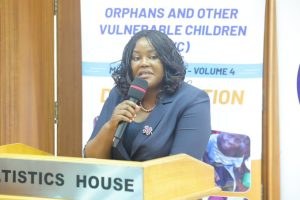
Ms Sharon Uwamahoro, a Senior Statistician at UBOS, emphasised the gap in school participation between orphans and non-orphans. “Only 53.7 percent of male orphans and 54.4 percent of female orphans are attending school, compared to 71.5 percent and 71.8 percent among non-orphans, respectively,” she said.
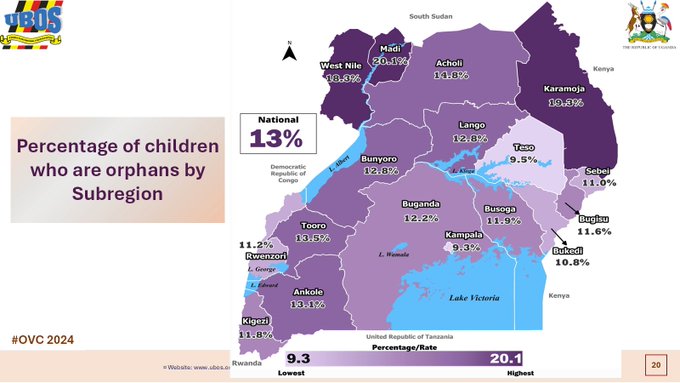
Regionally, the burden of orphanhood varies widely. The highest proportions were recorded in Madi sub-region at 20.1 percent, followed by Karamoja at 19.3 percent and West Nile at 18.3 percent. In contrast, Kampala registered the lowest level at 9.3 percent. At the district level, Yumbe recorded the highest rate nationally at 27.3 percent.
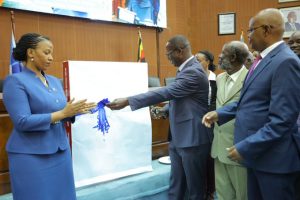
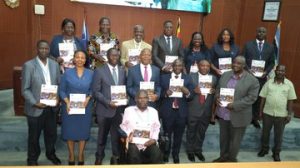
The monograph was officially launched at Statistics House in Kampala last week by Aggrey Kibenge, Permanent Secretary at the Ministry of Gender, Labour and Social Development, who underscored the importance of the data in shaping government interventions.
“The findings provide detailed, disaggregated data to guide targeted and equitable service delivery across children’s rights, including survival, development, protection and participation,” Kibenge said.
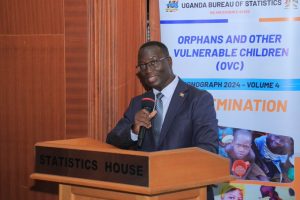
He added that the government is committed to translating the data into action. “The Ministry reaffirms its commitment to utilising this evidence to strengthen planning, improve service delivery, and enhance outcomes for vulnerable children,” he said.
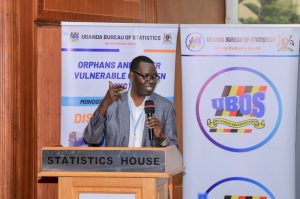
Representing UNICEF, Chief of Social Policy Moses Sichei commended UBOS for producing what he described as critical data for policy and programming.
“This monograph provides essential information on who vulnerable children are, how many they are, and where they are located,” Sichei said. “Without such data, evidence-based policy and interventions for children cannot be achieved.”
The report also aligns with Uganda’s commitments under international frameworks such as the United Nations Convention on the Rights of the Child and the African Charter on the Rights and Welfare of the Child.
UBOS Executive Director Chris N. Mukiza and other officials present at the launch were applauded for their role in delivering what stakeholders described as a vital tool for planning and addressing child vulnerability.
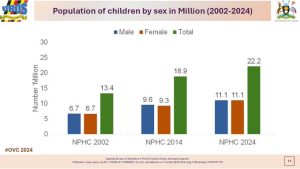
According to the 2024 National Population and Housing Census, children under 18 make up 22.2 million of Uganda’s population, underscoring the scale at which orphanhood and vulnerability could impact the country’s future if left unaddressed.