




The National Social Security Fund Uganda (NSSF) has officially launched the 16th edition of its annual Career Expo at Makerere University, bringing together thousands of students to explore the impact of artificial intelligence on future careers.
The three-day event is themed “Man or Machine: Exploring AI’s Impact on Careers” and aims to prepare young people for a rapidly evolving job market.
While opening the career expo on Wednesday, Hon. Dr Monica Musenero Masanza, Minister for Science, Technology and Innovation Information, encouraged students to embrace technological change as a tool for value creation.
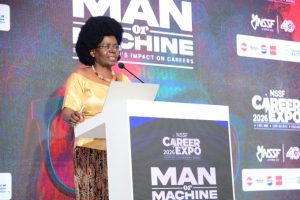
“AI is part of what we call digital transformation. Every industrial revolution starts small, grows, takes over, and eventually becomes unavoidable. The real goal of technological change is to accelerate productivity, expand market access, foster innovation, and improve service delivery.”
She said the industrial revolutions are not simply about gadgets and that they are about increasing the speed and scale at which value is created. “If AI helps you finish your assignment quickly, what do you do with the rest of your time? Social media? Endless chatting? Or something productive? The purpose of saving time is not idleness—it is to create more value.”

Speaking at the launch, NSSF Deputy Managing Director Gerald Paul Kasaato said this year’s Career Expo will take place across 14 universities and campuses countrywide. “I am delighted to officiate at the launch of the 16th edition of the Career Expo 2026. We are honoured to begin with Makerere University, one of Africa’s most prestigious centres of learning.”
Kasaato explained that the theme reflects students’ concerns about the rise of AI and automation: “Many students worry that machines will replace human beings. But the future is not about humans competing with machines. It is about humans learning how to work with machines. AI, automation, and digital technologies will transform industries, yes, but they will also create new careers, new businesses, and new opportunities. The real challenge is ensuring that young people are equipped with the right skills, mindset, and adaptability to thrive in this new world.”

He also highlighted the Expo’s role in promoting financial literacy and long-term social security planning: “The students in this room are our future members. For us, this Expo is an opportunity to sensitise them about the importance of saving, especially saving for retirement. In fact, after this session, we will also have an opportunity to register students who do not yet have NSSF numbers. Since the Expo began, we have registered over 120,000 students, and together they have saved UGX 235 billion to date. That is a significant contribution to their social security and long-term financial wellbeing.”
Lameck Kavuma, the Chief Operating Officer at AI Studio Uganda, spoke about the collaborative potential of humans and machines: “For the very first time in history, we have access to a form of technology that gives us virtually any information we want in this world. Imagine what you can do with that.”
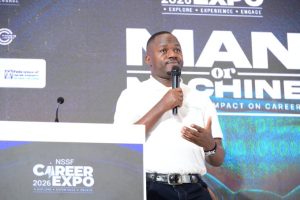
He added,”The machine can do many things that humans are limited in doing. But that also means a lot can change when we learn to interact and work together like this, human and machine.”
Prof. Moses Musinguzi, the Principal of the College of Engineering, Design, Art and Technology (CEDAT), delivering remarks on behalf of the Vice Chancellor, discussed AI integration in education.

“AI has the potential to make many things much better. It can significantly increase our productivity. At the university level, we are developing policies to guide the use of AI.”
He added: “Some staff are sceptical, while others are more open to embracing it. The general consensus worldwide is that AI cannot simply be rejected. Instead, the question we must ask is how we can use AI in ways that are responsible, effective, and productive.”

The Career Expo 2026, held in partnership with Makerere University and NSSF, is designed to connect students with professional networks, internship and job opportunities, and insights into workplace preparedness and long-term social security planning. Students attending the first day actively engaged in discussions around AI’s impact on careers and the skills required to remain relevant in a digital economy.
The event continues over the next two days, with sessions planned at multiple universities across Uganda, reinforcing the message that collaboration between humans and machines is key to thriving in the Fourth Industrial Revolution.