



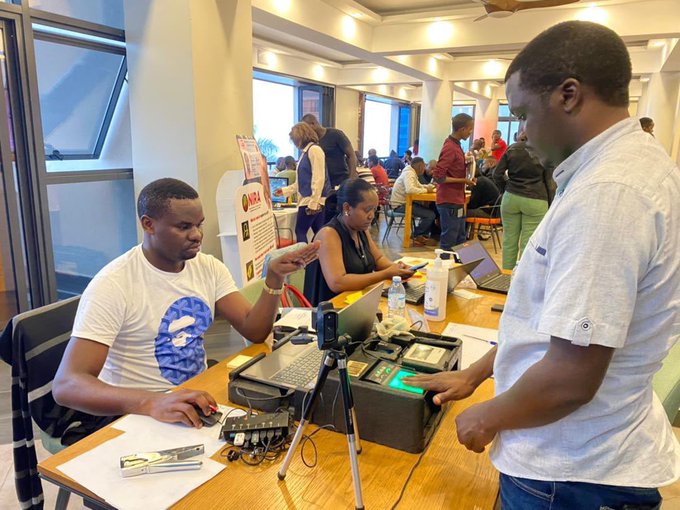
The National Identification and Registration Authority (NIRA) has announced that more than 35 million Ugandans are now registered in the country’s new national ID system following the completion of the parish-level mass enrollment and renewal exercise.
Speaking to the media, Claire Ollama, NIRA Registrar, said the nationwide exercise, which began on May 27, 2025, officially ended on February 8, 2026, after a three-month extension. She confirmed that all data from the old system has been successfully migrated to the new national register.
“We have successfully migrated all data from the old system into the new, and I wish to inform you this morning that 28,571,893 records are now migrated into the new system,” Ollama said. “Every record that we had in the old system is now present in the new system.”
During the exercise, NIRA registered 14 million people, printing 10 million ID cards. As of now, 2.5 million ID cards have been issued out of the seven million dispatched to citizens. Authorities are urging those who have not yet collected their IDs to do so promptly.
“Ugandans who are 16 years and above qualify to receive national IDs. However, those who are already 18 years and above do not need to return for re-registration — they only need to collect their national IDs,” said Osborn Mushabe, Public Relations Officer at NIRA.
Mushabe explained that while the registration process uses modern technology, delays have occurred due to the high number of applicants.
“National ID renewal isn’t supposed to take long. The delay is only due to the high number of applicants. The process is faster for those whose data is already on record,” Mushabe said.
The mass enrollment exercise included the planned registration of 17.2 million Ugandans at the parish level. With the parish-based services now closed, NIRA has returned to normal operations at its district offices, while emphasising the need to improve child registration due to low turnout.
“The parish-level national ID enrollment exercise officially closed on February 8, 2026, marking the end of parish-based services and the completion of data migration from the old system,” said Ollama.
The exercise is a key step in ensuring that all eligible Ugandans can be uniquely identified, access government services, and use the national ID as proof of citizenship.
“Not everyone living in Uganda is a Ugandan. When we register you and assign you a unique NIN, you are then able to access services as a citizen and use it as proof of Ugandan citizenship,” Mushabe added.
NIRA continues to encourage Ugandans who have not yet collected their ID cards, as well as parents, to register their children, to ensure full coverage nationwide.