


Gomba – President Yoweri Kaguta Museveni has called on youth leaders to lead a mindset shift among Uganda’s young people, encouraging them to focus on wealth creation rather than waiting for limited government employment opportunities.
He emphasised that Uganda’s long-term prosperity depends on youth engagement in productive sectors of the economy.
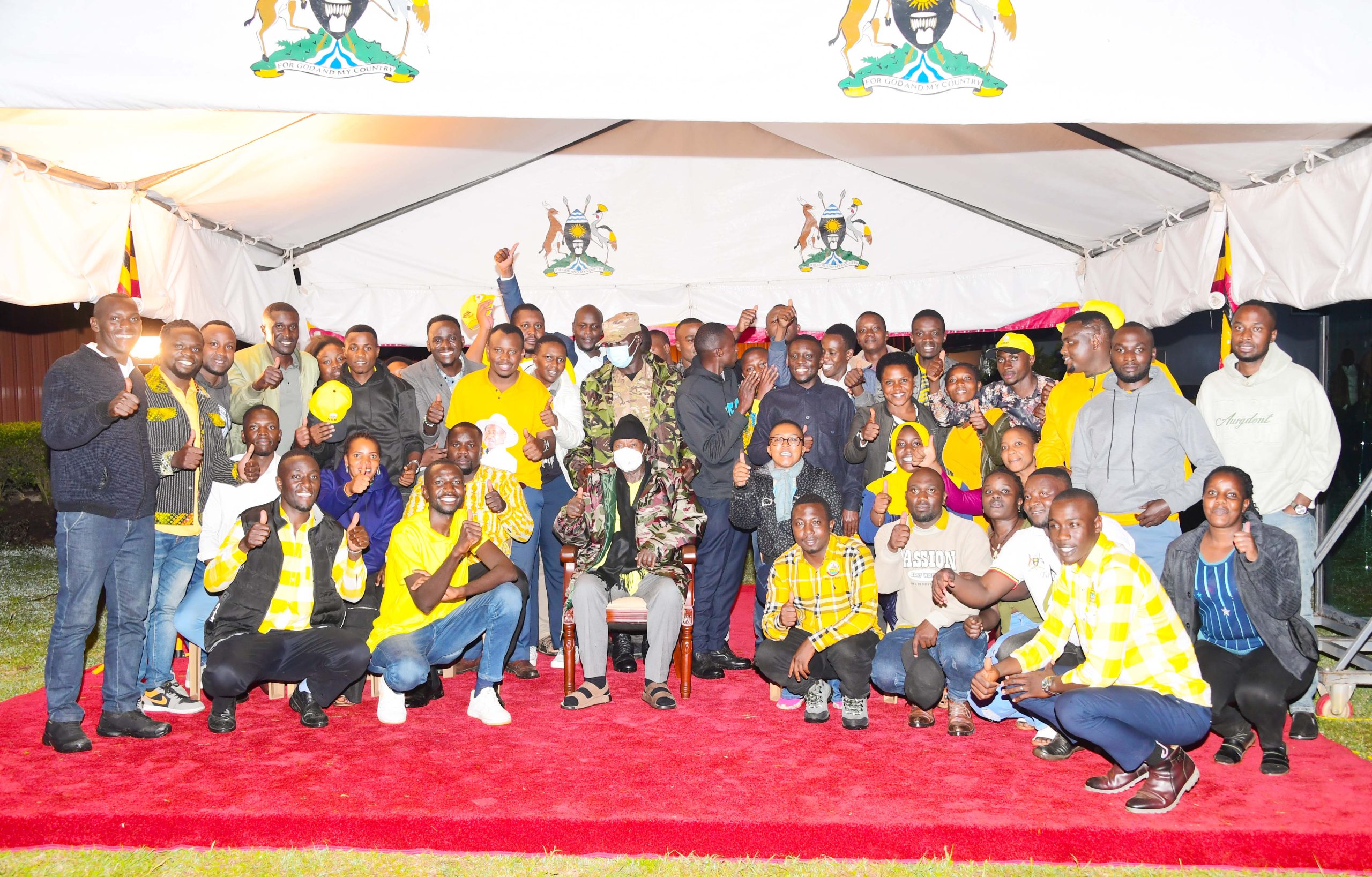
Addressing youth leaders from Western Uganda at his Kisozi farm in Gomba District, President Museveni highlighted four key sectors for youth involvement: commercial agriculture, manufacturing and artisanship, services, and Information and Communication Technology (ICT).
“The issue of empowerment at the individual level is very important. The idea of distributing heifers or revolving support is good. But when it comes to jobs, we must look for methods that cover many people,” President Museveni said. “The answer is wealth creation. All of you should be involved in wealth creation.”
The meeting brought together youth leaders from Kigezi, Ankole, Rwenzori, and Bunyoro sub-regions, and focused on youth empowerment, access to Parish Development Model (PDM) funds, leadership inclusion, and skilling opportunities.
The President cautioned against unrealistic expectations of public sector employment, noting that Uganda’s public service employs only about 480,000 people, many of whom are already in service. “Even if all those retired at once, it would not solve the youth unemployment problem. The solution is what I have been telling you—the four sectors,” he said.
President Museveni also shared that most of his children are engaged in private wealth creation rather than government work, except Gen. Muhoozi Kainerugaba, who serves in the army. “All the others are engaged in wealth creation, and they started when they were young,” he said.
He cited real-life examples, such as Johnson Basangwa of Kamuli, who began poultry farming on a small scale and has grown a successful enterprise. “People start small, and they grow,” the President said.
The President emphasised the value of manufacturing and artisanship, including maize milling, animal feed production, and coffee processing. “Value addition is where the money is. If you produce a good or a service, there is always demand,” he said.
He also highlighted ICT as a gateway for Ugandan youth to access global markets. “You can be an auditor here in Uganda, and a company in Canada sends you its books over the internet. You audit them and get paid online,” he explained. Professionals can also provide online services in medical, technical, and other fields.
President Museveni praised the Parish Development Model (PDM) as the most effective framework for grassroots wealth creation, noting that proximity to communities reduces bureaucracy and corruption. Under the PDM, each parish receives Shs100 million annually, with 30% earmarked for youth, 30% for women, 10% for the elderly, and the remainder for other priority groups.
He stressed that youth in households where funds have already been used should allow those in underserved households to benefit first. He also warned against officials demanding bribes to access PDM funds, saying such individuals will face discipline.
Eng. Asiimwe Jonard, NRM Vice Chairperson for Western Region, revealed that the party had approved an additional Shs15 million specifically for local leaders to support youth initiatives, to be included in future PDM disbursements.
Ahead of the 2026 elections, youth leaders from Western Uganda formally pledged support for President Museveni. Mr Kato Mathias, National Vice Chairman of the Western Uganda Youth League, delivered a memorandum stating: “We overwhelmingly second you as our party flag bearer for President in 2026 and 2031.”
He praised the President’s leadership for peace, stability, and youth-focused programs in education, health, and entrepreneurship. “Let us build a nation where innovation flourishes, where every citizen can thrive, and where our diversity is our strength,” he said.
Youth leaders also commended government achievements in public health, including immunisation programs, and discussed expanding Presidential skilling hubs to train more youths per district, as well as strengthening youth ideological training and cadre identification.