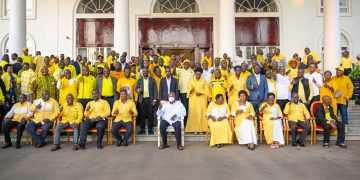




President Yoweri Kaguta Museveni on Thursday evening met National Resistance Movement (NRM) chairpersons from districts, cities, municipalities and divisions at State House Entebbe, where he congratulated them on their victory in the recently concluded party elections.
During the engagement, Museveni, who is also the NRM National Chairman, said he observed increased national cohesion during the latest elections compared to previous cycles, describing it as similar to the unity witnessed in the 1996 elections, when Ugandans strongly rallied behind the NRM due to its problem-solving leadership.
The President attributed the cohesion to what he termed “okukyenura”, meaning leadership that responds to people’s needs. He cited early achievements of the NRM government, including the restoration of security through a disciplined army and the stabilisation of essential commodities such as sugar.
Museveni noted that after 1996, challenges such as household poverty became more evident, prompting the introduction of revolving funds at the sub-county level in 1997 to support wealth creation. He said later interventions like NAADS were introduced to distribute seedlings and boost agricultural productivity, although many Ugandans remained outside the money economy.

This, he said, informed the introduction of the Parish Development Model (PDM), which channels funds directly to beneficiaries while empowering parish committees to allocate resources transparently. Museveni said PDM is performing well in some districts and pledged that additional funding would be added to enhance its impact, urging party leaders to closely monitor implementation.
On education, the President said the NRM introduced free education to expand access after foreseeing a looming crisis, but expressed concern over what he described as sabotage by some teachers and poor supervision by leaders.
Museveni also raised concerns about corruption, citing allegations of District Service Commissions selling jobs, land grabbing, and theft of medicines from government health facilities. He called on NRM leaders to intensify supervision and enforce accountability.
The President further criticised poor road maintenance and substandard works, partly blaming weak budgeting priorities, including the creation of new districts and municipalities at the expense of services that directly benefit the population.
On job creation, Museveni emphasised agriculture as the largest source of employment, while manufacturing and services offer higher-value jobs. He pledged that in the coming term, he would produce more literature focused on addressing the needs of the masses and consolidating socio-economic transformation.
He stressed the need to strengthen the private sector through affordable financing, particularly via the Uganda Development Bank (UDB), to enable enterprises to expand beyond government programs such as PDM and Emyooga.

Museveni added that once production challenges are addressed, focus should shift to markets, noting that local consumers are the first buyers. He said increasing household incomes will stimulate demand for products such as milk, cement and steel, eventually requiring expansion into regional markets.
Meanwhile, the NRM Deputy Secretary General, Hon. Rose Namayanja, congratulated Museveni on what she described as a landslide presidential victory, saying it reflects the party’s commitment to visionary leadership and service delivery.
The NRM Chairperson for Gulu District, Mr Christopher Ochen, thanked the President for empowering party structures during the elections and requested that district chairpersons be incorporated into District Executive Committees to enhance their ability to supervise government programs.
Mr JB Wamala Ssalongo, the NRM Chairperson for Mukono Municipality, appealed for municipality and city chairpersons to be represented on the party’s National Executive Committee, similar to their district counterparts, to ensure inclusive decision-making.
