



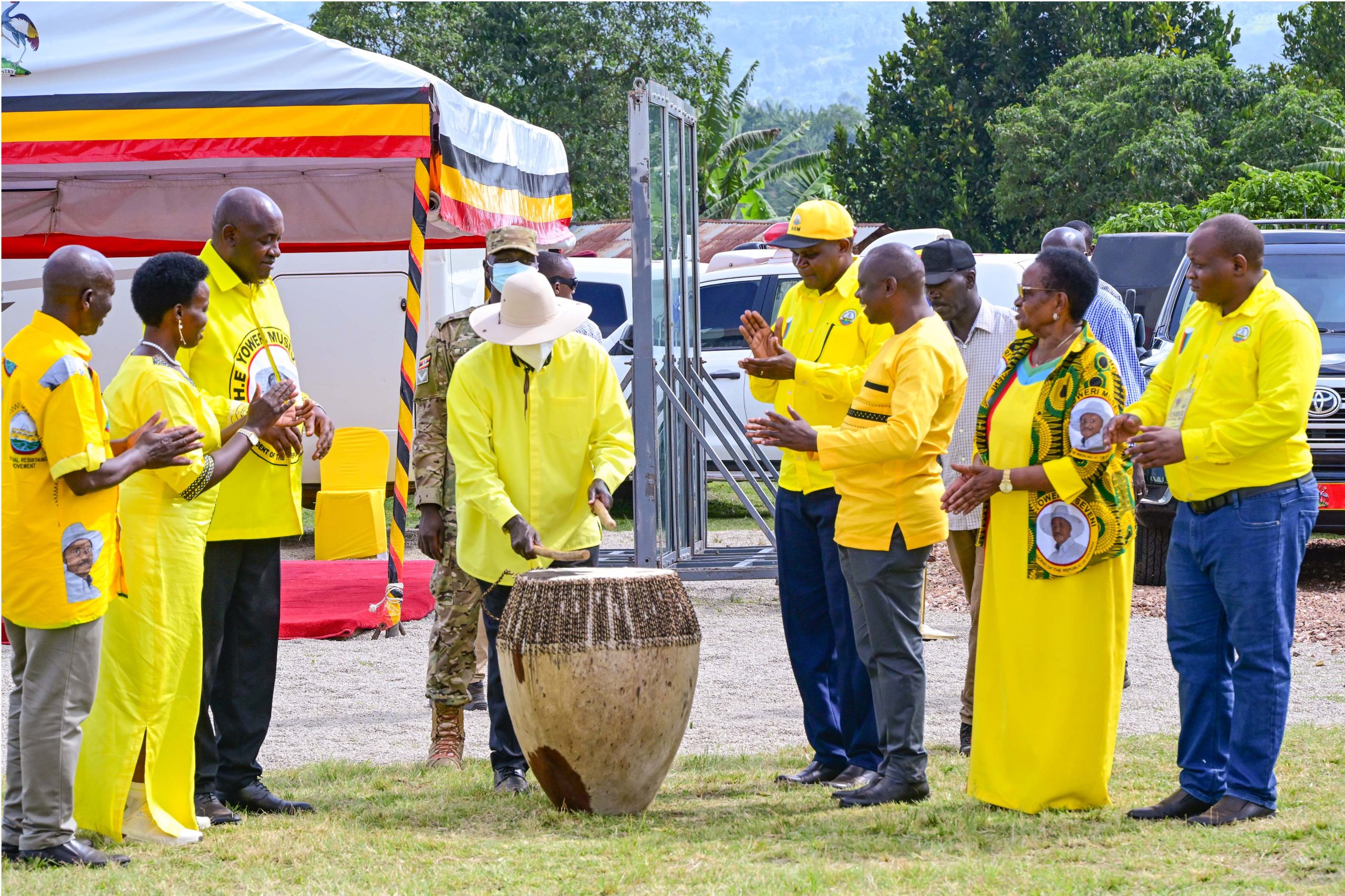
President Yoweri Kaguta Museveni has pledged a dedicated government fund to help tea farmers in Kanungu District access affordable fertilisers, saying the intervention will boost productivity and strengthen one of Kigezi’s most important agricultural sectors.
Addressing thousands of supporters at Rwere Playground on Wednesday, 26th November 2025, President Museveni—also the NRM Presidential flag bearer—said the high cost of fertilisers had become a major constraint for growers, especially those operating large estates.
“My people – the tea growers – are saying that the cost of fertilisers is too high and it is becoming unaffordable for large-scale growers. We are going to start a special fund for them so that they can easily access these fertilisers,” President Museveni said.
He explained that the financing will be managed through farmers’ SACCOs, using a model similar to the scheme being developed for sugarcane farmers and fishermen. Tea remains the backbone of Kanungu’s economy, supported by large factories processing leaf from both estates and out-growers. President Museveni noted that the crop is best suited for people with substantial acreage—like maize, cotton, and sugarcane—because such enterprises require significant land to generate meaningful returns.
For smallholders, he underscored the importance of the 4-Acre Model, first introduced in the 1996 NRM manifesto, which guides farmers on how to use limited land to create a stable household income.
At the rally, President Museveni placed peace at the top of what he termed the “seven contributions of NRM,” reminding residents that Kanungu’s position near the Democratic Republic of Congo makes them particularly aware of the importance of stability.
“You, the people of Kanungu who are near the Congo border, know better what peace means,” he said, contrasting Uganda’s long-standing stability with the insecurity that continues across the border.
He added that Uganda achieved peace without depending on international forces: “Uganda – we don’t need the United Nations to protect us. We do it ourselves because we emphasise prioritisation of what is essential in defence and not high salaries or good houses.”
The President credited the NRM government with transforming Uganda’s infrastructure, especially roads linking border districts to major economic corridors. He assured residents that more upgrades are coming, including the 149-kilometre Hamurwa–Kerere–Kanungu–Butogota–Hamayanza–Ifasha–Ikunza road stretch.
“We are going to work on that road,” he pledged.
Leaders from the district earlier thanked him for the Rukungiri–Kanungu road, which they said had eased transportation and boosted trade.
Turning to wealth creation, President Museveni warned residents not to confuse public investments with personal prosperity. Using a Busoga proverb, “Akange kakira akaife,” he reminded them that while development benefits everyone, wealth is an individual responsibility.
“The tarmac road is ours, but wealth and poverty are yours personally,” he said. “You may leave a rally like this one and find poverty waiting for you at home.”
President Museveni pointed out that even long-established roads, such as the Kabale–Mbarara–Masaka–Tororo highway, have not automatically lifted everyone out of poverty. Development, he stressed, enables opportunity—but does not replace personal effort.
He shared several examples of wealth creation, including Nakaseke farmer George Matongo, who produces 900 litres of milk per day and earns Shs 21 million monthly, despite living far from a tarmac road. “This man is far away from the tarmac road. Development is not there, but wealth is there,” he said.
He also highlighted the story of Joseph Basangwa from Kamuli, who built JEKA Farm on a 50×100 ft plot after embracing NRM’s wealth strategy. Basangwa now produces 200 trays of eggs daily, earns Shs 20 million per day, and employs more than 300 people. Another example was Dickson from Abim, who benefited from Operation Wealth Creation mango seedlings and PDM funds. He earned Shs 12 million from his mangoes in 2023 and now anticipates Shs 36 million annually after securing a contract with Soroti Fruit Factory.
“That man is in Karamoja—no tarmac road, but electricity is there. OWC was for the whole country, but some of you never minded about it,” President Museveni noted.

He reiterated that real job creation stems from agriculture, manufacturing, services, and ICT—not government. With only 480,000 government jobs available for a population of 50 million, he highlighted the contribution of factories, especially in industrial parks like Sino-Mbale, Kapeeka, and Mukono, which collectively employ over 1.3 million Ugandans.
On education, President Museveni criticised those who continue undermining free government schooling by imposing illegal fees. While UPE and USE were introduced to keep children in school, he said some parents still struggle to afford extra charges. To support youths who drop out, he established 19 Presidential Skilling Hubs across Uganda. The Kigezi regional hub—located in Kabale—offers training in tailoring, welding, baking, carpentry, and automotive mechanics.
At the rally, beneficiaries shared testimonies, including welding graduate Kushemererwa Bosco, now employing four people, and Flavia Akankunda, who took up tailoring after dropping out due to fees.
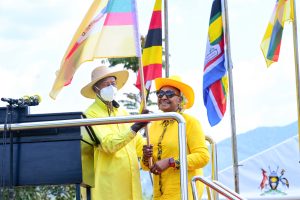
Kanungu District, with a population of 310,062, has made notable strides under programs like PDM and Emyooga. The district has received Shs 30.05 billion in PDM funds, with 98.89% already disbursed to 29,726 households. Through Emyooga, 36 SACCOs with 29,545 members have benefited from Shs 2.42 billion.
Rt. Hon. Anita Among praised Kanungu residents for consistently supporting President Museveni and credited him for restoring peace in Kigezi. Former Prime Minister Rt. Hon. Amama Mbabazi told voters that the President “understands Uganda more than everyone else,” urging them to renew his mandate.
Kanungu NRM Chairperson Caleb Kipande thanked the President for peace, improved roads, and the Matanda Irrigation Scheme, noting its potential to boost agricultural resilience.
The event was attended by senior NRM leaders, cabinet ministers, MPs, and historicals—further underscoring Kanungu’s significance in the 2026 campaign trail.