



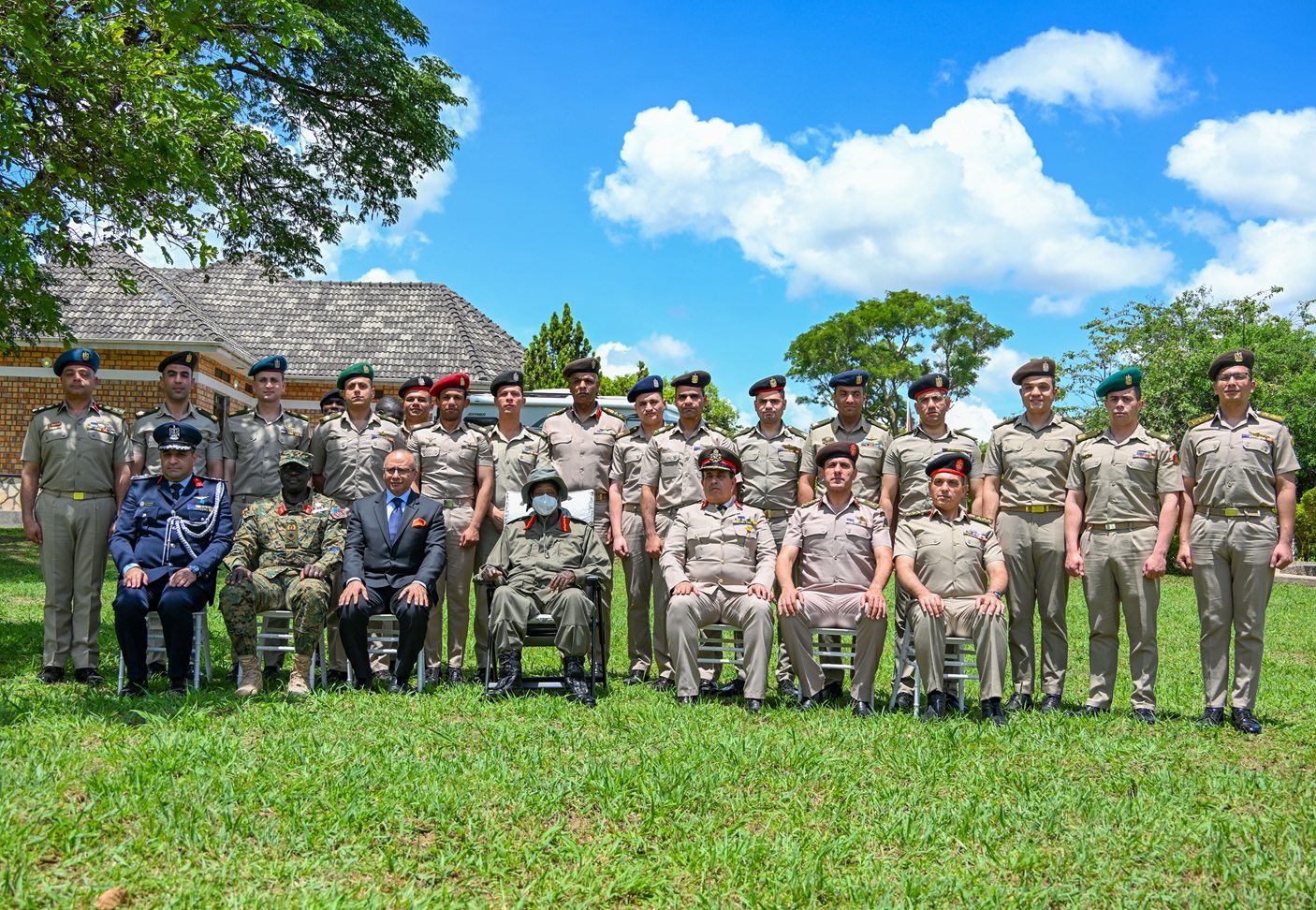
KAMPALA — President Yoweri Kaguta Museveni has called for a strategic and ideological shift in how Africa addresses challenges facing the Nile Basin, emphasising that the continent’s long-term stability depends on electrification, industrialisation, and regional integration.
The President made the remarks while delivering a lecture on opportunity to a delegation from the Egyptian Armed Forces Staff and Command College (War and National Defence College) at the National Leadership Institute (NALI), Kyankwanzi. The delegation was led by Egypt’s Ambassador to Uganda, H.E Monzer Selim, and Maj. Gen. Khaled Elnahraway.
President Museveni said discussions on the Nile have for decades been shaped by outdated colonial-era arrangements, rather than focusing on Africa’s current development realities.
“I have been discussing this with Egyptian leaders for a long time. They always talk about the old agreements with the British, but I tell them that the problem of the Nile is not those agreements,” he said.
He argued that the real pressures on the Nile stem from underdevelopment in tropical countries, particularly limited access to electricity and industrialisation. “The problem of the Nile, number one, is the lack of electricity in the tropics. When people don’t have electricity, they depend on biomass, and that is the real danger,” President Museveni said.
He warned that environmental degradation is being driven by subsistence dependence on natural resources. “When you have a big population that is not industrialised, people encroach on forests and wetlands for agriculture. That is why the answer is industrialisation, so that people do not depend on agriculture alone,” he noted.
The President also pointed to climate change as a contributing factor, citing global emissions from industrialised economies.
He called for a comprehensive regional development framework for the Nile Basin anchored in energy expansion and industrial transformation. “I always tell them, let us have a master plan for transforming the Nile Valley through electrification and industrialisation,” he said.
President Museveni revealed that water flow from Uganda towards South Sudan has declined over time due to changing rainfall patterns. “In the 1960s, the water flow was about 60 billion cubic meters, but now it has reduced to about 40 billion cubic meters,” he said.
He also highlighted the broader hydrological potential of Africa, comparing the Nile Basin with the Congo River system. “The Nile has about 85 billion cubic meters of water at Khartoum, but the Congo River has about 3,000 billion cubic meters. The Congo can provide the equivalent of about 30 Niles if there is peace and cooperation,” he explained.
The President underscored what he described as Africa’s three historical missions: prosperity, strategic security, and brotherhood.
“Prosperity does not come from begging. If aid created prosperity, Latin America would be very rich, but they are still struggling. Prosperity comes from producing goods and services with calculation, selling them, and accessing markets,” he said.
He stressed that patriotism and Pan-Africanism are essential drivers of economic transformation. “You need patriotism because you need Uganda for your own prosperity. But when you produce more, Uganda alone is not enough; that is why we talk about Pan-Africanism,” he added.
On security, President Museveni said African states must integrate to remain globally competitive. “Some global actors are talking about superiority on land, at sea, in the air, and in space. For us, even if Uganda becomes a first-class country, it is too small. Integration gives us size and strength,” he said.
Reflecting on Uganda’s liberation history, he credited regional support from African leaders such as Julius Nyerere and Samora Machel for strengthening the Uganda People’s Defence Forces (UPDF).
President Museveni further emphasised the need for socio-economic transformation in tropical regions to safeguard the environment. “The tropics must move from primitive agriculture to industry and services. Only a few people should remain in agriculture, and they should be skilled,” he said.
He warned that continued reliance on biomass energy poses a serious threat to ecological systems in the Nile Basin. “We must protect the Nile from two dangers — primitive agriculture and lack of electricity. If we continue destroying biomass, the impact will be severe,” he cautioned.
The President also highlighted the importance of natural water towers such as the Rwenzori Mountains, Mount Kenya, and Mount Elgon in sustaining regional rainfall systems. “The problem is not water in Africa; it is ideological. Africa’s solutions are known, but people are not focusing on the right issues,” President Museveni said.
Speaking on behalf of the visiting delegation, Maj. Gen. Khaled Elnahraway expressed appreciation for Uganda’s hospitality and the insights gained during the visit. “We are honoured to meet Your Excellency and to visit one of the leading training institutions in Uganda. What we have seen is far beyond what we knew from the media,” he said.
He noted that the delegation had visited Jinja, where they saw the source of the Nile, describing it as a critical shared resource for both Uganda and Egypt.
The delegation also received briefings on Uganda’s role in regional peace and cooperation, including its engagement within COMESA, with Maj. Gen. Elnahraway expressing optimism about deeper collaboration. “We look forward to strengthening cooperation and building stronger ties with Uganda and the African continent,” he added.