


MTN Uganda CEO Sylvia Mulinge has challenged Uganda to bridge the digital gap, stating, “Productivity is the next frontier,” if the nation is to realise its ambition of achieving a $500 billion economy.
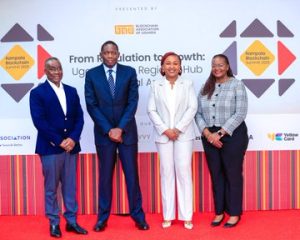
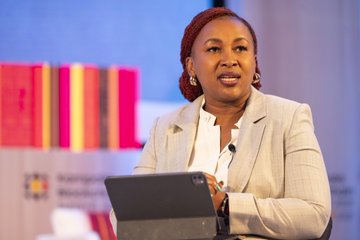
She was speaking during a Fireside Chat at the Kampala Blockchain Summit 2025 alongside Dr Tumubweinee Twinemanzi, Executive Director of Supervision at the Bank of Uganda, and Reginald Tumusiime, President of the Blockchain Association of Uganda (BAU) at Four Points by Sheraton on Tuesday.
Their discussion underscored a unifying message: Uganda’s digital transformation must be driven by access, productivity, innovation, and smart regulation. Mulinge set the tone with a pointed challenge: “Productivity is the next frontier. Without it, the demographic dividend becomes a missed opportunity,” she told attendees.

With Africa soon to hold the world’s largest working-age population, she emphasised that access to technology will determine whether the region reaps economic benefits. “Our first task is access. We must get our youth online and give them the skills to turn technology into opportunity,” she said.
Uganda’s ambition to grow from a USD 50 billion to USD 500 billion economy by 2040, Mulinge noted, will only hold if digital inclusion becomes a national priority.
She cited the GSMA’s fresh data showing that although 87% of Ugandans are covered by mobile broadband, only 29% actively use the internet. “We cannot speak of innovation without confronting that gap,” she said. “Otherwise, digital energy turns into commentary instead of transformation.”

Regulation as an Enabler, Not an Obstacle
Echoing Mulinge, Dr Twinemanzi argued that innovation and regulation must move in tandem. “Innovation will always run faster,” he said, “but regulation does not have to slow it down.”
Drawing from his experience overseeing Uganda’s banking sector, he warned against central banks drifting into commercial activities — particularly in emerging areas like gold-backed products.
“A central bank is meant to create a conducive environment for people to acquire and hold assets — not to manage natural resources,” he noted. While countries such as Ghana have involved central banks directly in gold markets, Twinemanzi called for caution: “Who authenticates the gold? Who certifies purity? That is not a trivial responsibility.”
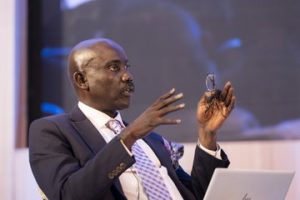
He issued a broader warning about the rise of USD-backed stablecoins like USDT. “If everyone begins trading in digital dollars, the shilling becomes sidelined. That undermines monetary sovereignty,” he said.
On regional financial systems, Twinemanzi highlighted the potential of the Pan-African Payment and Settlement System (PAPSS): “If mobile money across Africa were tokenised and interoperable, cross-border payments would be transformed.”
“We Win by Solving Local Problems”
Focusing on blockchain applications, Mulinge insisted that technology must address real needs. “Mobile money succeeded because it solved a real problem. Blockchain and stablecoins must do the same — whether in remittances, trade settlement, or transparency in public finance.”

She called for regulators and innovators to collaborate closely, recalling lessons from Africa’s early mobile money era. “Stablecoins today sit where mobile money sat fifteen years ago. Progress accelerates when both sides commit to collaboration.”
Mulinge also stressed the role of leadership in building digital ecosystems. “The biggest responsibilities of leadership are capital allocation and human capital decisions,” she said, emphasising MTN’s investments in Ugandan talent. “The environment regulators have created is why MTN is now the third most valuable company in East Africa.”
“From Conversation to Action”
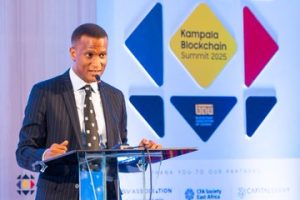
Opening the summit, BAU President Reginald Tumusiime described the event as a historic turning point.

“This is not just another summit. This is the moment Uganda moves from conversation to implementation,” he said. He hailed the six-year journey of BAU and its partnership with regulators, including pivotal engagements with the Central Bank beginning in 2019.
Tumusiime thanked Governor Michael Atingi-Ego for his leadership. “Your courage and vision have helped push this country into a new technological frontier,” he said.
Highlighting blockchain’s practical power, Tumusiime noted: “Cross-border payments that used to take days can now clear in seconds. Remittance costs can fall drastically. Millions of unbanked people can access financial services through their phones. This is not theory — it is happening now.”
A Vision for Uganda’s Competitiveness
Participants also reflected on the Governor’s keynote challenge: What will be Uganda’s competitive advantage as countries like Kenya move ahead with comprehensive virtual asset regulation?
Mulinge offered a straightforward answer: “We win by solving everyday local problems.”

For Twinemanzi, Uganda’s edge must come from sound regulatory design: “The central bank must provide stability, not become a commercial operator. Our strength will lie in creating clear boundaries that protect consumers and enable innovation.”
Tumusiime added that Uganda must act swiftly: “We have the talent, the energy, and the demographic advantage. What we need now is coordinated action.”

The event also featured a performance by King David Ayo-Loto, whose energy and warmth left the audience in high spirits.