



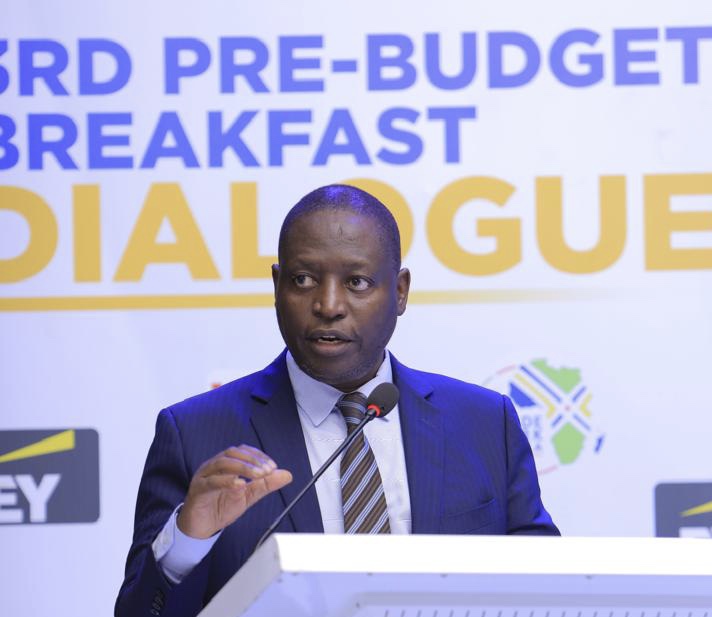
The State Minister for Trade, David Bahati, has challenged Ugandan manufacturers to improve the quality and standards of locally produced goods to remain competitive in regional and global markets.
Bahati made the call while addressing industry players at the 3rd Annual Pre-Budget Breakfast Dialogue 2026, organised by the Uganda Manufacturers Association. The dialogue brought together government officials, manufacturers, development partners and policymakers to discuss key issues affecting Uganda’s industrial sector ahead of the national budget.
Speaking at the forum, Bahati emphasised that improving product quality and strengthening manufacturing standards will enable Ugandan industries to compete effectively within the region and take advantage of emerging international market opportunities.
“Manufacturers must continue investing in quality improvement, innovation and technology adoption so that Uganda’s products can compete favourably within the region and beyond,” Bahati said.
The minister noted that the manufacturing sector remains central to Uganda’s economic transformation agenda and the country’s Ten-Fold Growth Strategy, which aims to expand the economy from about $50 billion to $500 billion by 2040.
According to Bahati, this growth will require sustained annual expansion of about 12–15 per cent, driven by value addition to Uganda’s natural resources, development of industrial parks, expansion of export-oriented industries and stronger integration into regional and global value chains.
Government, he said, is implementing several interventions aimed at strengthening Uganda’s industrial ecosystem. These include expanding industrial infrastructure through the development of industrial parks across the country, improving trade facilitation to boost cross-border trade, and strengthening standards enforcement to combat counterfeit and substandard goods.
Uganda is also actively participating in the African Continental Free Trade Area, which offers manufacturers access to a market of more than one billion consumers across Africa.
Bahati added that the government, through the Ministry of Finance, the Uganda Revenue Authority and the Uganda National Bureau of Standards to simplify regulatory procedures, reduce compliance costs and promote digital systems that improve efficiency in the business environment.
However, manufacturers continue to face several challenges, including high taxation, regulatory bureaucracy, inconsistent power supply and difficulties accessing government procurement opportunities.
Speaking at the same dialogue, Aga Sekalala said the engagement aims to identify practical solutions that will enhance competitiveness and sustainability within Uganda’s manufacturing sector.
“This dialogue provides a platform for industry and government to explore better approaches to ensure manufacturers remain competitive in an increasingly challenging market environment,” Sekalala said.
Meanwhile, Ezra Muhumuza noted that the forum is examining several key issues affecting the sector, including taxation concerns, delays in product certification by the Uganda National Bureau of Standards, and the need for reforms in the Public Procurement and Disposal of Public Assets Authority to ensure local manufacturers can effectively compete for government supply contracts.
He also highlighted the need for a consistent power supply and a more streamlined regulatory environment to support industrial growth.
Bahati reaffirmed the government’s commitment to addressing these concerns, noting that continued collaboration between the government and the private sector will be critical in building a strong and competitive manufacturing industry capable of driving Uganda’s long-term economic transformation.