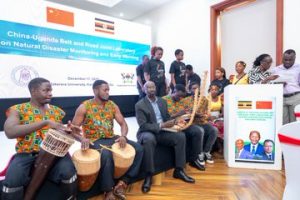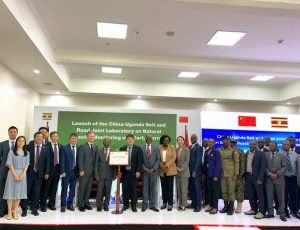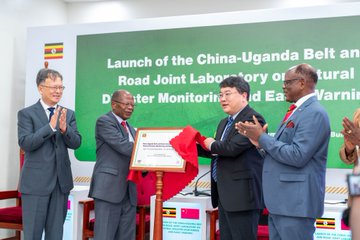
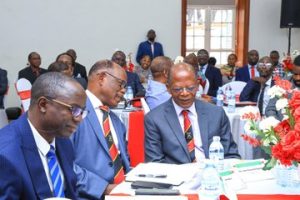
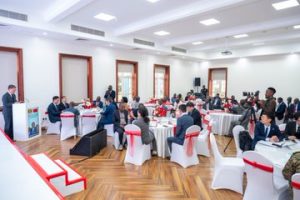
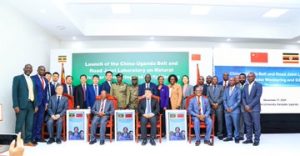
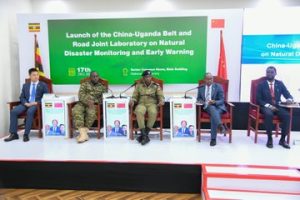
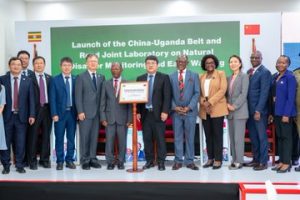
Kampala — Makerere University and China’s Tsinghua University have officially launched the China–Uganda Belt and Road Joint Laboratory on Natural Disaster Monitoring and Early Warning, a major milestone aimed at strengthening Uganda’s capacity to anticipate, monitor and respond to natural and man-made disasters.
The laboratory was inaugurated on December 17, 2025, by the Minister of State for Higher Education, Hon. John Chrysostom Muyingo, during a Symposium on Public Safety and Natural Disaster Management held at Makerere University.
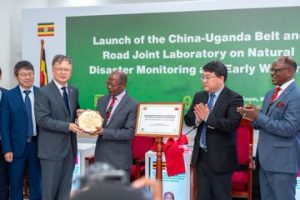
“This symposium on public safety and natural disaster management is not only timely, but long overdue,” Muyingo said. “Uganda has experienced numerous disasters—earthquakes, landslides, floods, epidemics and pandemics—and we still face challenges, particularly the lack of adequate monitoring systems and early warning mechanisms.”
Muyingo, who represented the First Lady and Minister of Education and Sports, Hon Janet Kataaha Museveni, reaffirmed government support for the initiative. “The Government of Uganda will provide all necessary and possible support to this project. We will support you fully—and we shall do even more,” he said.
Strengthening Uganda–China Cooperation
The joint laboratory is a flagship collaboration under the Belt and Road Initiative, focusing on disaster risk reduction, climate-related hazards, public health emergency preparedness, urban and infrastructure safety, and academic exchange and capacity building. It will be co-directed by Prof. Yuan Hongyong of Tsinghua University and Makerere University Vice Chancellor Prof. Barnabas Nawangwe.
Representing the Chinese Ambassador to Uganda, H.E. Zhang Lizhong, the Commercial Counsellor Wang Jianxun said the laboratory symbolises deepening scientific and academic cooperation between the two countries.
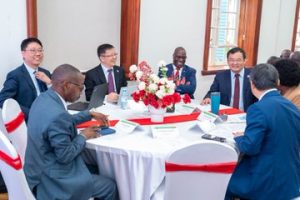
“Natural disasters know no borders,” Wang said. “By combining China’s advanced technology and expertise in disaster monitoring with Uganda’s regional experience, this joint laboratory provides a platform for innovation and practical solutions to enhance public safety.”
He added that the partnership reflects broader China–Africa cooperation under the Belt and Road Initiative and the Forum on China–Africa Cooperation (FOCAC). “This is not just the launch of a research facility, but a strong demonstration of the enduring friendship between China and Uganda,” he said.
Makerere at the Centre of Regional Resilience
Vice Chancellor Prof. Barnabas Nawangwe described the laboratory as a strategic investment in Uganda’s future safety and preparedness.
“If a major earthquake were to hit Kampala today, the consequences would be severe,” Nawangwe warned. “This underscores the importance of monitoring, preparedness and early warning systems. Our partnership with Tsinghua University gives us confidence that together we can do much more.”
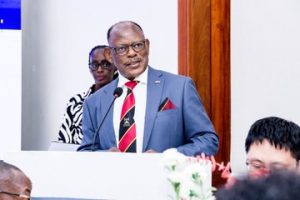
He praised Minister Muyingo, a Makerere alumnus, for championing higher education and recently defending funding proposals to improve the university’s infrastructure in Parliament.
Earlier on, Muyingo had presented a proposal to parliament for a loan to boost Makerere University’s Science, Technology and Innovation Education (STIE), which is expected to progress into modernity. Parliament gave its approval for a US$162 million loan to finance the project.
Turning Research into Real-World Impact
Industry partner G-Safety, represented by Dr Zhang Maolei, highlighted the importance of linking academic research to real-world applications.
“Uganda has strong researchers and excellent hazard maps, but there is still a gap between research and practice,” Zhang said. “Industry participation is essential to turn research into solutions that save lives and generate sustainable impact.”
The laboratory will support early warning systems, disaster simulations, artificial intelligence–driven risk mapping, and integrated emergency response platforms.
Broad Institutional Support
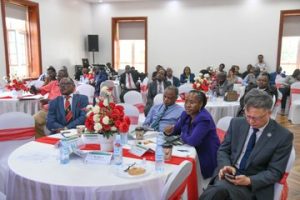
The launch attracted officials from the Office of the Prime Minister, Ministry of Health, Uganda People’s Defence Forces, Uganda Police Force, and leaders from climate-vulnerable regions, including Mt. Elgon and the Rwenzori sub-region.
The Infectious Diseases Institute (IDI) at Makerere welcomed the initiative, noting that it complements Uganda’s efforts in epidemic preparedness and climate resilience.
“For a climate-vulnerable country like Uganda, the Joint Lab will enable faster early warnings, improved risk mapping, and stronger resilience against floods and landslides—ultimately saving lives and protecting livelihoods,” IDI said in a statement.
As Uganda faces increasing climate and disaster risks, stakeholders say the new joint laboratory positions Makerere University as a regional hub for disaster preparedness and public safety research, while reinforcing long-term China–Uganda scientific cooperation.
“This laboratory will become a driver of innovation,” Wang said. “It will deliver sustainable benefits to communities most vulnerable to natural disasters.”