


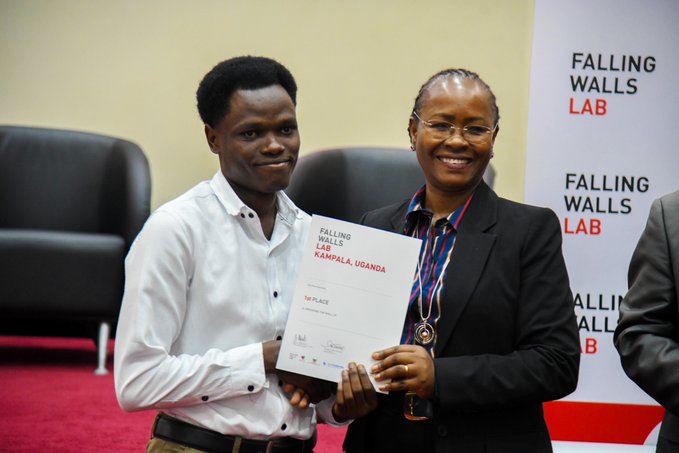
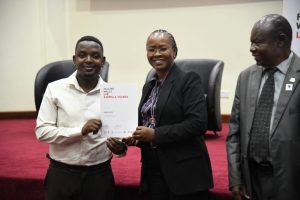
Makerere University innovator Andrew Mudhasi has won the inaugural Falling Walls Lab Kampala with a low-cost device designed to improve screening for newborn jaundice across different skin tones.
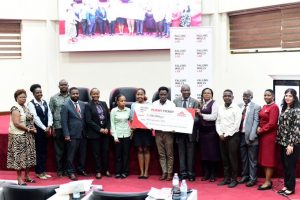
Mudhasi scored 90 per cent to emerge as the winner ahead of 11 other innovators who pitched solutions to challenges in healthcare, agriculture, clean energy, waste management and community resilience at the competition held at Makerere University’s School of Public Health Auditorium on September 14.
The Kampala event was organised by the Alliance for African Partnership Africa Office in partnership with Makerere University and other institutions. It followed the Falling Walls format, in which participants have three minutes to identify a problem or “wall” and present an innovation aimed at breaking it down.
Mudhasi’s device uses optical sensor technology and a skin-tone targeting algorithm to provide a rapid reading for jaundice screening.
During the judging session, Mudhasi said the device had not yet been tested on newborn babies but had undergone laboratory testing using simulated skin tones.
He reported that the device achieved 94 per cent accuracy when compared with laboratory spectrophotometers.
The innovation is initially intended for use in clinics and hospitals, although Mudhasi said the team is considering developing a version that could eventually enable mothers to screen babies at home.
His win means Mudhasi will represent Uganda at the Falling Walls Lab Global Finale in Berlin on November 6, 2026.
University of Nairobi innovation takes second place
Rhoda John of the University of Nairobi finished second with 89.6 per cent for an innovation aimed at addressing used-diaper waste while improving soil moisture retention.
John’s team extracts sodium polyacrylate, the absorbent polymer used in diapers, and replaces the sodium with potassium to produce a potassium-based superabsorbent material.

The material is designed to absorb and retain water in soil during dry periods. John reported a 99 per cent increase in germination and a 23 per cent increase in drought resistance during testing.
She also said the team was working with environmental officials in Nairobi on a pilot collection system for used diapers.
Makerere researcher takes third place
Stuart Mahera of Makerere University came third with 86.2 per cent for a herbal formulation targeting peptic ulcers.
Presenting under the theme “Breaking the wall of Nature and Modern Medicine,” Mahera proposed MARAC capsules as a single-drug approach to peptic-ulcer treatment.
He told the jury that the team had undertaken quality-control work, including characterisation and dose quantification, and had conducted preclinical trials on laboratory mice.
Mahera also said an application had been submitted to the National Drug Authority as the team awaits the next stage of regulatory assessment.
According to his presentation, the proposed seven-day treatment would cost about Shs21,000, compared with the existing 14-day treatment approach.
Twelve innovations presented
The competition featured 12 presentations covering healthcare, agriculture, energy, waste management and community resilience.
Among the other innovations were a digital farm-record management platform, a solar photovoltaic cooker with heat storage, a mobile application for reporting fish diseases, and a herbal cream targeting antibiotic-resistant biofilms associated with diabetic foot ulcers.
Other participants presented proposals involving brain-bleed detection using near-infrared technology, poultry disease alerts using satellite weather information and computer vision, a solar-powered mobile diagnostic van, and a blockchain-based platform for incentivising and verifying plastic-waste collection.
Another proposal sought to use artificial intelligence to translate agricultural research publications into local Ugandan languages and generate voice notes for radio-based agricultural extension.
The final presentation focused on digital resilience in Kampala’s informal settlements, using community knowledge and geographical information systems to map risks including flooding, fire, poor sanitation, waste management and inadequate infrastructure.
Prof Nawangwe calls for stronger investment in innovation
Makerere University Vice Chancellor Prof. Barnabas Nawangwe congratulated the participants and called for continued investment in innovation.

Nawangwe, who said he had attended the Falling Walls conference in Berlin, urged innovators to make their pitches more precise by clearly identifying the problem, explaining the proposed solution and demonstrating what they had already achieved.
He also welcomed participation from researchers and students outside Makerere, saying the Kampala event had created a platform for collaboration beyond the university.
The Falling Walls Lab Kampala was organised with the Alliance for African Partnership Africa Office, Makerere University, Astria Learning, Makerere University Research and Innovation Fund, the Makerere University Writing Centre, the Institute of Gender and Development Studies and the Makerere University Technology and Innovations Centre.
The global Falling Walls Lab programme is designed to give emerging researchers and innovators three minutes to present breakthroughs that address scientific and societal challenges. The Kampala edition was officially scheduled for September 14, 2026, at Makerere University.