


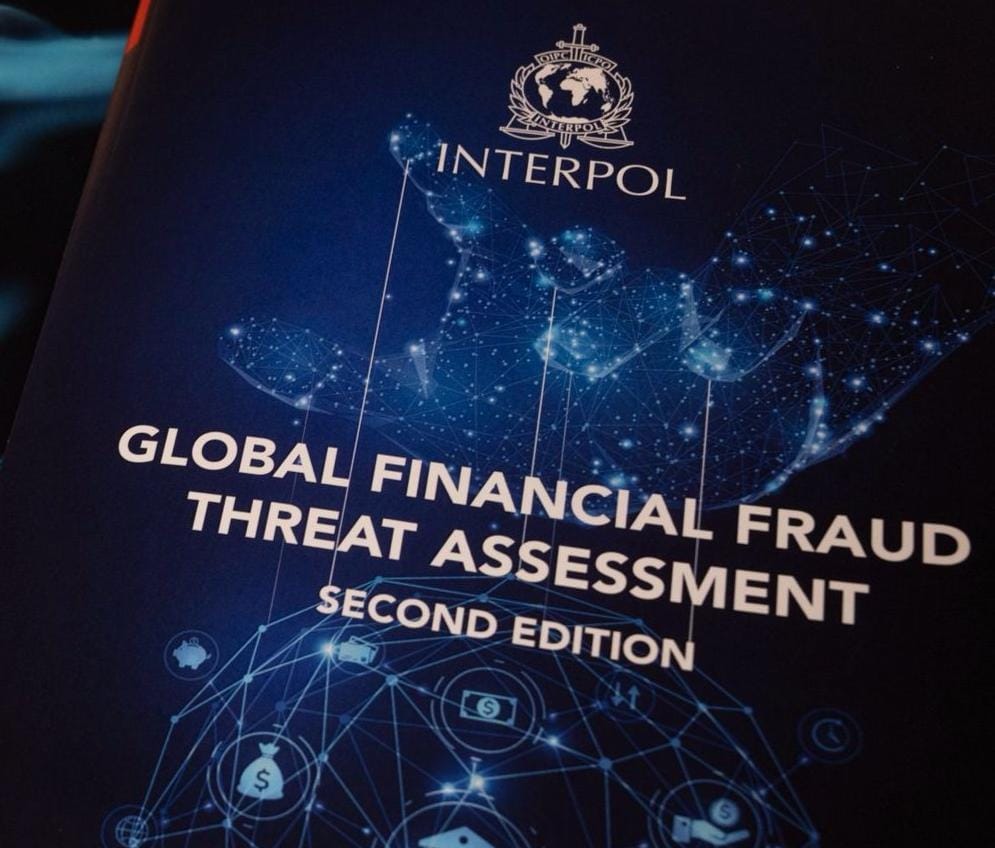
A new report by INTERPOL has raised alarm over the rapid growth and increasing sophistication of financial fraud worldwide, describing it as one of the most serious transnational crime threats today.
Released on March 16, 2026, the Global Financial Fraud Threat Assessment highlights how fraud is evolving into a central pillar of organised crime, intersecting with cybercrime, human trafficking and terrorism financing.
“Enabled by artificial intelligence, low-cost digital tools and increased global criminal collaboration, we are witnessing the industrialisation of fraud,” said Valdecy Urquiza.
AI Driving a New Era of Fraud
The report notes that artificial intelligence is significantly amplifying the scale and profitability of fraud. AI-powered scams are now estimated to be 4.5 times more profitable than traditional methods.
Criminals are increasingly using advanced systems, including so-called “agentic AI,” to independently plan and execute fraud schemes—from identifying victims to issuing ransom demands.
In addition, crimes such as sextortion are being embedded into other scams, including romance and investment fraud, often using AI-generated content and scripted manipulation.
Global Networks and Emerging Threats
INTERPOL warns that criminal groups are becoming more interconnected, sharing expertise and working with specialised money laundering networks to expand operations across borders.
The report also highlights emerging risks in regions including Africa, where some terrorist groups are reportedly using fraud—particularly cryptocurrency scams—as a source of funding.
Meanwhile, scam centres, once concentrated in specific regions, have now spread globally. These operations often involve trafficked individuals who are forced to carry out online fraud under coercion.
Law Enforcement Stepping Up Response
Despite the growing threat, the report points to improved international cooperation in tackling financial crime.
Since 2024, fraud-related INTERPOL alerts have increased by 54 percent, over 1,500 transnational fraud cases have been supported, and authorities have helped recover or track USD 1.1 billion in assets.
Urquiza emphasised the human cost behind the statistics: “The cost of financial crime is not just money—it is people’s life savings, their dignity, and in the worst case, their life.”
New Global Crackdown Initiative
To strengthen the fight against organised fraud networks, INTERPOL has launched Operation Shadow Storm, a new international task force supported by the United Kingdom.
The initiative will target: financial fraud linked to scam centres, connections to cybercrime and human trafficking and criminal networks using complex financial systems to evade detection.
It will leverage tools such as I-GRIP, INTERPOL’s stop-payment mechanism designed to intercept illicit financial flows.
Guidelines and Global Collaboration
INTERPOL is also rolling out new guidelines to help countries establish National Anti-Scam Centres, aimed at improving detection, coordination and disruption of fraud networks.
These efforts were unveiled during the Global Fraud Summit, co-hosted with the United Nations Office on Drugs and Crime (UNODC).
The summit brings together more than 1,300 participants—including government officials, law enforcement agencies, private sector leaders and civil society—to strengthen global cooperation against fraud.
A Growing Global Security Threat
The report concludes that financial fraud is no longer a peripheral crime but a core global security threat, requiring coordinated action across governments, law enforcement and the private sector.
“Strengthening cooperation between law enforcement, the private sector and raising public awareness is key in tackling this global security threat,” Urquiza said.