



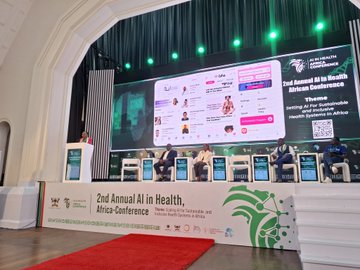
Scientists, innovators, and policymakers from across Africa converged at Makerere University for the 2nd Annual AI in Health Africa Conference 2025, showcasing groundbreaking tools and solutions designed to make healthcare more sustainable, inclusive, and accessible across the continent.
Under the theme “Scaling AI for Sustainable and Inclusive Health Systems in Africa,” the conference has brought to light a wave of homegrown AI innovations — many developed at Makerere University’s AI Health Lab — that are already redefining healthcare delivery in low-resource settings.
Among the AI-powered tools showcased are: Briskbot Assistant, an intelligent medical support platform; BriskMed, a diagnostic and patient-management system; Dawa Assist, a digital tool for medicine management and adherence; Sam Photo App, an ethical and scalable AI solution for child nutritional monitoring; AI-Augmented Monitoring and Evaluation Systems, which use data-driven insights to strengthen public health systems; ICUConnect, a web-based dashboard coordinating ICU bed referrals and forecasting bed demand in Kenyan public hospitals; and GeoAI and Spatial Machine Learning for Malaria Prediction in Uganda, integrating environmental data to anticipate outbreaks.
“Scientists have made significant headway in creating AI tools that facilitate the delivery of quality healthcare,” noted a Makerere University statement shared on social media during the event.
The Risk Is Institutional Irrelevance
Assoc. Prof. Janice Desire Busingye, Country Director at Astria Learning, challenged academic and health institutions to act quickly in integrating AI into teaching, research, and operations.
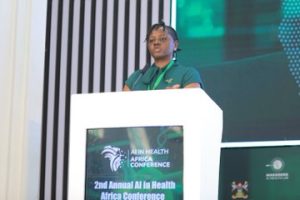
“Does the internet know you? What does it know about you?” she asked participants. “The risk is not the disruption of AI — the risk is institutional irrelevance. We must adopt AI and fundamentally reimagine and re-engineer our educational systems now because the students we are training are already using this technology extensively, while our current policies and approaches are lagging dangerously behind.”
AI as a Collaborative Movement
Dr Rose Nakasikiire of the Makerere AI Health Lab emphasised that innovation must be collaborative to make a real impact. “No one should innovate alone,” she said. “To truly impact African healthcare, we must break silos and collaborate. Together, stakeholders can build an AI-powered future that benefits the Global South.”
Dr Nakasikiire also urged developers to localise AI tools to reflect Africa’s realities. “It’s not just about the tech — it’s about contextualising AI to fit our unique cultures and systems. Let’s tailor solutions like telehealth and diagnostics to serve remote patients and reduce diagnosis times.”
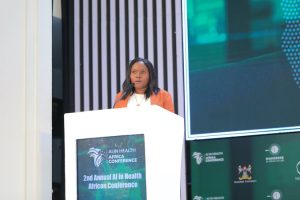
Building an AI-Ready Health Workforce
Prof. Bruce Kirenga, a leading researcher at Makerere University, called for the integration of AI into medical training to prepare Africa’s healthcare professionals for the future.
“AI won’t replace doctors, but doctors who understand AI will replace those who don’t,” he said. “We must embed AI into curricula — from admissions to robotics — so that our medical graduates can compete on the global stage.”
Echoing his sentiments, Dr Godliver Okello underscored the need for capacity building among healthcare workers. “Health practitioners are still hesitant to adopt AI tools,” she noted. “We need to build their confidence and skills to adopt these systems — not to replace them, but to simplify their work.”
AI for the Global South: Nepal’s Experience
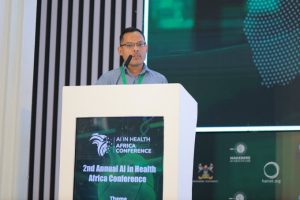
Speaking on AI capacity building in the Global South, Mahesh Shakya from NAAMII Nepal shared insights from Asia’s experience in building sustainable AI ecosystems.
“We are dedicated to fostering innovation through startups and by assisting companies to establish AI teams,” he said. “Our goal is to transform research into globally applicable products that address challenges like shortages of experts and equipment in low-resource health settings.”
He cited NAAMII’s work on smartphone-based microscopes and AI-assisted cervical cancer screening as examples of cost-effective, life-saving tools. “We build a strong educational foundation in AI and science, and we run outreach programs to train everyone — from children to policymakers — to prepare for a digital world,” Shakya added.
Financing the Future of AI in Health
Amref Health Africa in Uganda, one of the partners at the conference, praised the progress made but emphasised that financial resources remain crucial for scaling innovations.
“The innovations and progress made toward setting AI for sustainable and inclusive health systems in Africa are commendable,” said an Amref Uganda representative. “However, without adequate financing, these solutions may remain pilot projects rather than transformative systems.”
The AI in Health Africa Conference has positioned Makerere University as a continental hub for AI-driven health innovation. From predictive malaria mapping to AI-assisted diagnosis, the showcased projects reflect Africa’s readiness to lead in technology tailored for local realities.