



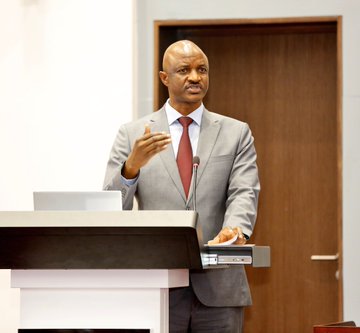
KAMPALA, Uganda — The Permanent Secretary and Secretary to the Treasury of the Ministry of Finance, Planning and Economic Development (Uganda), Ramathan Ggoobi, has called for urgent reforms in Uganda’s internal audit system, urging auditors to transform reports from “archives of failure” into tools of institutional change.
Speaking during a national meeting of internal auditors, Ggoobi challenged heads of internal audit units in district local governments, cities and municipal councils to strengthen financial oversight to improve public service delivery.
He noted that more than one-third of Uganda’s public expenditure occurs at the local government level, warning that weaknesses in internal audit systems directly affect citizens’ access to essential services.
“If internal audit fails at this level, the government also fails to deliver services where citizens live. We cannot achieve fiscal discipline, investor confidence, or long-term growth if the internal audit is weak,” he said.
Financial Control Concerns
Ggoobi highlighted several areas of financial risk within public administration, including pension management and payroll systems.
He revealed that pension overpayments exceeding UGX 31 billion had been recorded among thousands of beneficiaries.
The government has also continued to face challenges related to ghost workers, payroll irregularities, and diversion of funds from approved activities.
Procurement processes were also cited as an area of concern, with authorities observing significant price variations for similar goods and construction works across government entities.

Structural Weaknesses in Internal Audit
The Treasury Secretary identified four key systemic weaknesses affecting Uganda’s internal audit function: compliance-based auditing rather than risk-based auditing, weak follow-up on audit recommendations, skills gaps as government services become more digital and limited operational independence of internal audit units.
He emphasised the need for auditors to adopt data-driven methods, including analysis of the Integrated Financial Management System (Uganda), payroll trends, and procurement price benchmarking.
According to Ggoobi, auditors should track public funds “until action is taken,” rather than only producing reports.
Government Reform Plans
The Ministry of Finance said it plans to strengthen the Office of the Internal Auditor General (Uganda), expand information technology audit capacity, and improve professional development for heads of internal audit units.
Officials believe strengthening public finance governance is essential for Uganda’s long-term economic transformation agenda, including the country’s ambition to achieve high economic growth rates.
Ggoobi warned that inefficient use of public funds ultimately increases taxation, borrowing, and service delivery gaps. “Uganda’s ten-fold growth goal requires strong public finance governance,” he said.
The Ministry says reforms will focus on modern auditing techniques, enhanced accountability mechanisms, and stronger institutional independence for audit professionals.
Uganda has been implementing public financial management reforms over the past decade to improve transparency and reduce leakage of public resources.