



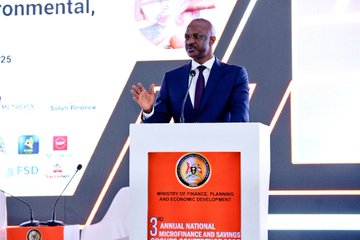
The Permanent Secretary and Secretary to the Treasury (PSST), Ramathan Ggoobi, has said Uganda’s economy continues to show strong performance, with key indicators reflecting steady recovery and growth.
Speaking during several engagements this week, Ggoobi highlighted both the country’s economic progress and the challenges that must be addressed to sustain momentum.
Appearing on NBS Morning Breeze, the PSST announced that Uganda’s economic growth has rebounded to 6.3%, up from 6.1% the previous year, returning the country to pre-COVID growth levels.
“The key numbers of the economy are still very good. We have turned in 6.3% growth from 6.1% the previous year. We are now back to the pre-COVID levels of growth,” Ggoobi said.
Concerns Over Local Government Road Funds
Despite this positive outlook, Ggoobi expressed concern over the utilisation of the Shs1bn disbursed annually to each local government for road maintenance. He revealed that while funding for roads remains insufficient nationally, the money sent to districts is not being used effectively.
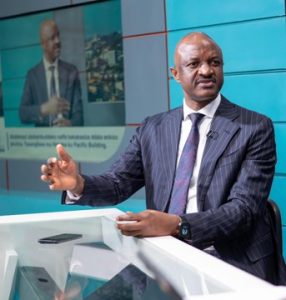
“The budget for roads is not enough, but the Shs1bn sent to each local government is not being used effectively,” he said.
Ggoobi added that a forensic audit will be carried out to establish how the funds have been utilised.
Revenue Mobilisation Remains a Major Challenge
Ggoobi acknowledged that Uganda’s revenue collection remains below potential, with the country’s tax-to-GDP ratio standing at 14%, below the Sub-Saharan Africa average of 16%. “We are not collecting enough. We need to strengthen our revenue effort,” he said.
Uganda is currently collecting Shs 32 trillion—far below the expected Shs 43 trillion—though the target has been revised to Shs 37 trillion.
He noted that tax evasion practices, including under-declaration, falsifying documentation, and smuggling, continue to undermine revenue mobilisation. “Ugandans need to be sensitised on the need to pay taxes,” Ggoobi emphasised.
Microfinance as a Catalyst for Transformation
While speaking at the National Microfinance and Savings Groups Conference 2025, Ggoobi praised the microfinance sector as a foundational driver of socio-economic transformation. “Microfinance has long stood as a transformative force, a catalyst for change that lifts families out of poverty, empowers women, and fuels the growth of micro and small enterprises,” he said.
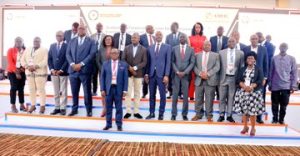
Ggoobi described microfinance and education as the two greatest “opportunity equalisers” in society. He highlighted that financial inclusion in Uganda has risen to 81%, driven mainly by mobile money usage, which now stands at 66%.
He also revealed that the government has invested over Shs 11 trillion in wealth creation programs over the past decade to expand access to finance.
Kasolo Reaffirms Commitment to Financial Empowerment
At the same conference, Minister of State for Microfinance, Al-Hajj Haruna Kyeyune Kasolo, reaffirmed the government’s dedication to building a financially empowered population. “Government remains firmly committed to inclusive prosperity and to realising a Uganda where no one is left behind,” Kasolo said.
He noted that the conference theme—“Sustainable financial inclusion for environmental, economic, and social impact”—aligns with the NRM’s ideology of a modern and prosperous nation anchored on inclusive development.
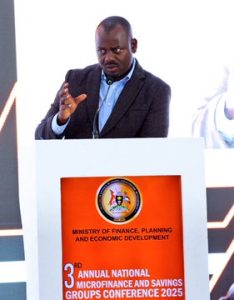
Kasolo praised digital innovations such as Wendi Mobile Wallet, FlexiPay, and Ensibuuko for extending financial access to underserved communities.
He also announced that the Emyooga Program will continue with an expanded scope to support beneficiaries transitioning into viable SMEs. “Government will continue to support these enterprises to have their products certified and to supply goods and services to MDAs,” he said.
Kasolo further underscored the need for strong regulation to protect the microfinance sector from fraud and exploitation. “Effective regulation is crucial to protect the sector from fraudulent brokers and middlemen, and every stakeholder has a role to play,” he said.