


Kampala – FREO2 Foundation on Thursday convened a high-level Strategic Workshop on Oxygen Technology and Alignment with the National Oxygen Program at the Golden Tulip Canaan Hotel.
The event brought together Ministry of Health officials, members of the Oxygen Management Committee, development partners, facility representatives, academics, and media to strengthen coordination and accelerate sustainable access to medical oxygen nationwide.
Since 2018, FREO2 Foundation has partnered with the Ministry of Health and development partners to expand reliable oxygen access, particularly in remote and underserved health facilities. To date, 98 oxygen systems have been installed across 79 facilities, with 35 equipped with remote monitoring systems for real-time oversight and 22 supported with solarised infrastructure to ensure uninterrupted supply.
Highlighting Progress and Impact
Dr Ajambo Miriam, providing an update on the National Oxygen Program Scale-Up Plan, emphasised the benefits of smaller oxygen systems in lower-level facilities.
“When we talk about primary healthcare, we are referring to Health Centre IVs and general hospitals. These facilities have benefited from smaller oxygen systems, not the large PSA plants. These smaller systems generate low-flow oxygen and have made a real difference in neonatal and pediatric care,” she said.
Dr Miriam cited a recent visit to Chivale General Hospital, where twin preterm babies were stabilised using the FreeO2 system before transitioning to CPAP therapy. “Even for babies being weaned off CPAP, these systems are extremely helpful. Health workers are very appreciative of them. This intervention is truly saving lives,” she said, thanking UNICEF and 302 for their support.
Demonstration of Technology
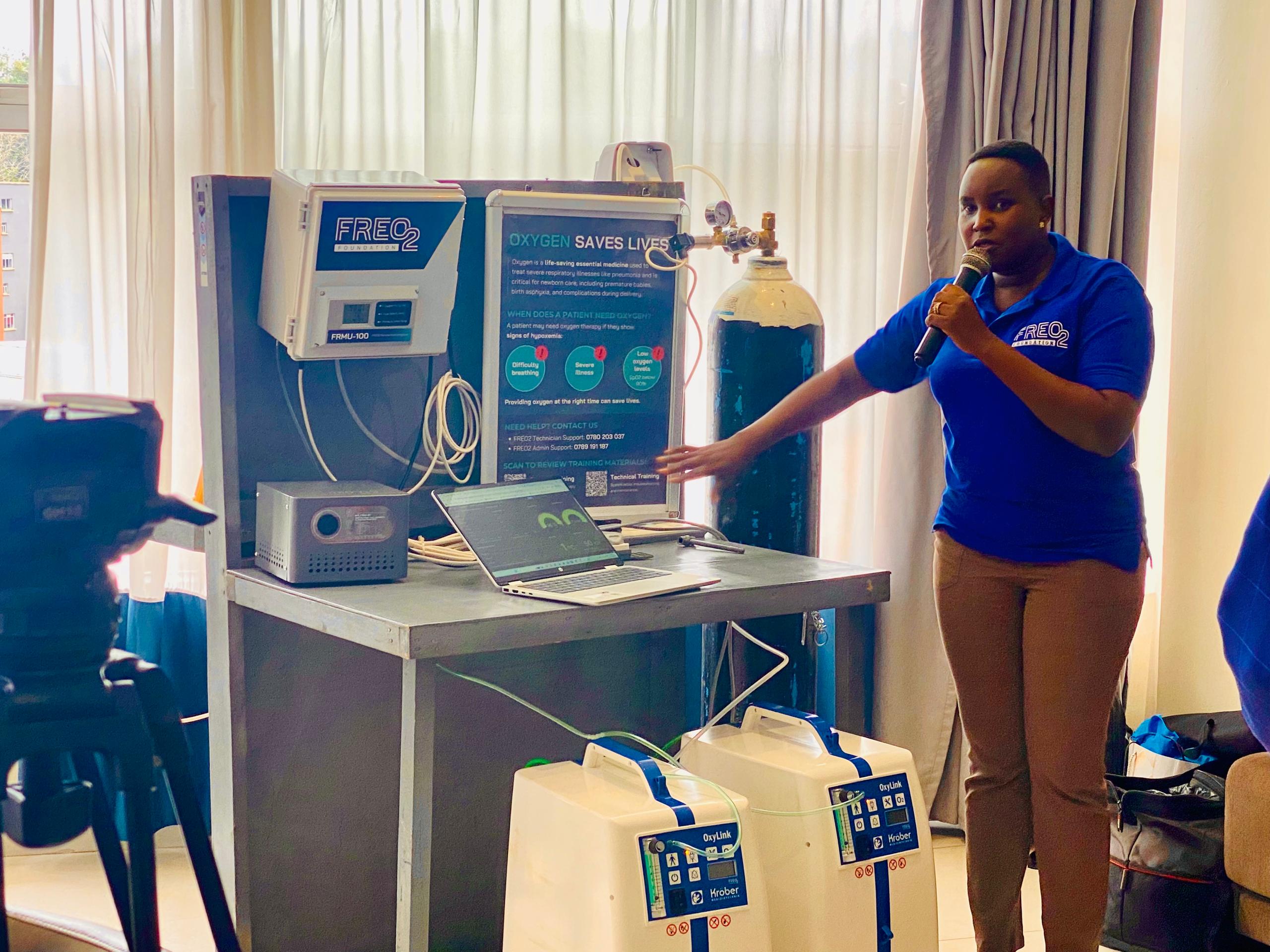
Engineer Hilda Bugingo, an oxygen engineer at FREO2 Uganda, led a practical demonstration of the system. “Here at the bedside, we have a demonstration patient — a six-year-old child. The flow box contains two flow meters, each capable of delivering up to two litres per minute. Clinicians adjust the oxygen and monitor the patient’s response. This is where healthcare workers interact directly with the system,” she explained.
Hilda also outlined the engineering side: “The system has two main oxygen sources: oxygen concentrators as the primary source, and a cylinder as a backup. If power goes off, the cylinder automatically takes over through our prioritizer system, ensuring seamless delivery without interruption.”
She further highlighted the remote monitoring capabilities: “We can monitor oxygen purity, cylinder pressure, voltage, current, and power consumption in real time. This allows us to detect leaks, low purity, and power fluctuations early and proactively support facilities.”
Lessons from the Pandemic
Dr Bahizi Archbald Newton Sebahire, Senior Executive Consultant and Director of Fort Portal Regional Referral Hospital, reflected on oxygen challenges during COVID-19. “During the peak of the pandemic, I found district health officers critically ill due to COVID-19. One was saturating at 51% and another at 43%. We initiated oxygen therapy and stabilised them. They survived. That reinforced my oxygen journey,” he said.
Dr Bahizi stressed the importance of extending access to lower-level facilities. “If someone needs oxygen in Nakapiripirit, and the highest nearby facility is a Health Centre III, they should receive it immediately — not be transferred elsewhere. Diagnosis, functional equipment, and biomedical support are essential. We cannot deliver air when we intend to deliver life-saving oxygen,” he said.
He also highlighted the need for higher-flow systems for preterm babies. “Our current low-flow systems deliver up to two litres per minute. That cannot support CPAP. We need at least five litres per minute to improve neonatal survival rates,” he added.
FREO2 Vision and Innovations
Ms Máire Ruane, CEO of FREO2 Foundation, outlined the organisation’s vision and innovations. “We exist because PSA plans often struggle to maintain oxygen supply chains, especially during rainy seasons and breakdowns. Our system complements PSA plans by reducing dependence on cylinders,” she said.
She described key advantages of the 302 system: “It delivers oxygen silently, with seamless backup during power outages, and allows infection control at the bedside. We are also innovating CPAP support, higher-flow systems for adults, and a two-way prioritizer to make existing concentrators blackout-proof.”
Ms Ruane highlighted the foundation’s remote monitoring initiative: “Anywhere in Uganda, we can now see the health of the oxygen system in real time — from purity to power stability. This allows us to provide remote mentorship, prevent failures, and optimise oxygen delivery.”
Globally, she noted, the systems have helped treat 34,789 children in the past year, reflecting the tangible impact of FREO2’s work alongside UNICEF, Grand Challenges Canada, and other partners.
The workshop concluded with plans to develop a short, actionable roadmap to strengthen oxygen availability, data integration, clinical training, and scale-up strategies nationwide.