


KAMPALA — Government officials and health experts have called for stronger and more sustainable financing of Uganda’s health system to reduce reliance on fragmented external funding and build a resilient, nationally owned healthcare structure.
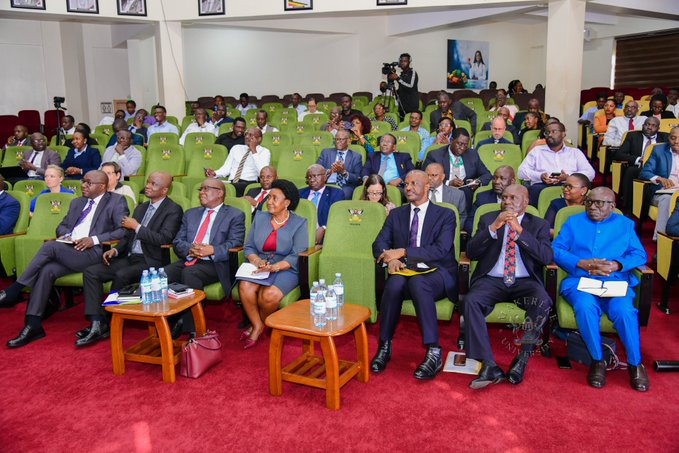
The call was made during a Public Lecture and High-Level Dialogue on Health Financing in Uganda held at Makerere University School of Public Health, jointly organised by the Ministry of Finance, Planning and Economic Development and the Ministry of Health.
The event was officially opened by the Deputy Head of Public Service in the Office of the Prime Minister, Ms Jane Kyarisiima Mwesiga, who stressed the importance of strengthening Uganda’s health systems.
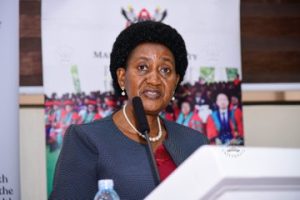
She said the country is at a critical moment to consolidate progress and build a more efficient system. “This is an opportune time to build a resilient, efficient nationally-owned health system that is less dependent on fragmented external financing,” Mwesiga said.
The lecture was delivered by the Permanent Secretary and Secretary to the Treasury, Dr Ramathan Ggoobi, who outlined key improvements in Uganda’s health and socio-economic indicators over recent years.
He noted significant gains in life expectancy, access to health services, and public health infrastructure. “Life expectancy rose from roughly 50 years in 2000 to about 68.8 years in 2024,” Dr Ggoobi said.
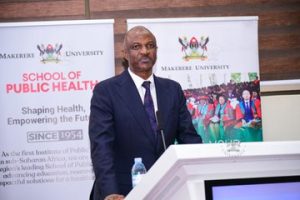
He further highlighted improvements in access to health facilities, noting that proximity to care has expanded nationwide. “The share of the population living within 5KM of a health facility increased from about 80% to 91%,” he said.
Dr Ggoobi also pointed to broader socio-economic progress, linking health outcomes to poverty reduction. “Poverty declined from 24.5% to 16.1% between 2010 and 2024,” he noted.
On disease prevention and digital health transformation, he said Uganda has introduced new tools and systems to strengthen service delivery.
“The malaria vaccine has been introduced into the Expanded Programme on Immunisation for under-fives,” he said, adding that “the e-Medical Records System now operates across National and Regional Referral Hospitals.”
He also cited major investments in medical infrastructure, including oxygen plants, diagnostic equipment, and blood services.
“Strategic investments have been made: 16 high-capacity oxygen plants, three new regional blood banks, CT scans in 14 of 16 regional referral hospitals, and 20 digital X-ray machines in General Hospitals,” Ggoobi said.
The discussions were attended by Makerere University Chancellor Hon. Dr Chrispus Kiyonga, alongside other senior government and academic leaders.
Makerere University Vice Chancellor Barnabas Nawangwe commended the lecture, praising Dr Ggoobi’s analysis and reaffirming the institution’s role in supporting health research and human capital development.
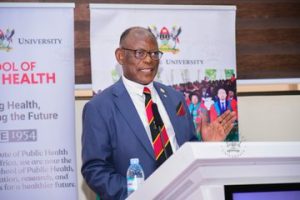
“This morning, Dr Ramathan Ggoobi delivered a thought-provoking public lecture on health financing in Uganda at Makerere University,” Nawangwe said. “He acknowledged Makerere’s role in training and health research and pledged support. Thank you, Dr Ggoobi, for your well-researched lecture.”
The dialogue underscored a growing consensus that sustained investment in health is central to Uganda’s long-term development and economic transformation.