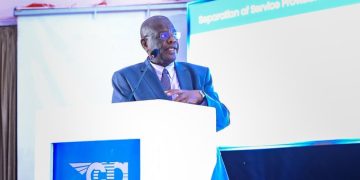




Uganda’s aviation sector continues to show strong recovery and expansion, with Entebbe International Airport recording significant growth in passenger traffic and cargo volumes in 2025, officials revealed during the Uganda Civil Aviation Authority (UCAA) Stakeholders’ Engagement Breakfast held at the Imperial Royale Hotel in Kampala.
The breakfast meeting brought together government officials, aviation industry players, regulators, development partners, and the media to review sector performance, share updates, and discuss the way forward for Uganda’s aviation industry.
Presenting the sector outlook, UCAA Director General Fred Bamwesigye said Entebbe International Airport had registered impressive gains between January and November 2025, outperforming the same period in 2024.

“International passenger traffic grew by 8.8 per cent for disembarking passengers and 13.5 per cent for embarking passengers,” Bamwesigye said. “Domestic travel recorded even stronger growth of between 24 and 26 per cent, while cargo volumes also increased, with imports up by 4.5 per cent and exports by 1.3 per cent.”
He attributed the performance to continued infrastructure investments, improved operational efficiency, and stronger collaboration among aviation stakeholders.
Modern infrastructure and safety upgrades
Bamwesigye highlighted key milestones at Entebbe International Airport, including the completion of a 20,000-square-metre Passenger Terminal Building, which will be opened to the public in phases starting January 2026.

“The new terminal features three additional aerobridges, bringing the total to five, 24 new check-in counters in addition to the existing 22, and 14 self-check-in counters,” he said, noting that the upgrades are aimed at improving passenger experience and handling capacity.
He also disclosed that UCAA successfully conducted a full-scale emergency exercise in May 2025, in line with ICAO standards, to test preparedness, inter-agency coordination, emergency medical response, and stakeholder collaboration. “These exercises are critical to ensuring that our airports remain safe and resilient under high-stress conditions,” Bamwesigye said.
In addition, UCAA has enhanced air-to-ground communication through the rollout of a VHF Extended Range Radio Network covering Entebbe, Soroti, Gulu, Masindi, and Kasese. “This has significantly improved two-way communication between pilots and air traffic control across the Entebbe Flight Information Region,” he added.

Tourism, trade, and sustainability
Emphasising aviation’s wider economic role, Bamwesigye said air transport remains indispensable to tourism and trade. “There is no tourism without aviation, and I say this with authority,” he said. “The COVID-19 pandemic showed us clearly that even with national parks and attractions, tourism comes to a standstill when air travel is disrupted.”
He also revealed that Uganda is positioning itself to benefit from Sustainable Aviation Fuels (SAF), noting that the country has a technical potential of 300 to 850 million litres per year. “With certified pathways and prepared airports, Uganda is well placed to move from feasibility to first-generation production within this decade,” Bamwesigye said.
ICAO praises Uganda’s aviation standing
Delivering the keynote address, Kabbs Twijuke, Uganda’s Representative to the International Civil Aviation Organisation (ICAO), said civil aviation has transformed from a military tool into a powerful driver of peace and development. “ICAO has transformed aviation from weapons of mass destruction into a force for peace, economic growth, job creation, and the safest and most reliable means of regional and international connectivity,” Twijuke said.

He dismissed the perception that aviation only benefits the wealthy. “Some Ugandans ask why the government should invest in aviation, yet air transport is essential for everyone,” he said. “For example, thousands of people earn a living on flower farms, but those flowers reach global markets by air.”
Twijuke noted that Uganda, which joined ICAO in 1967, continues to score highly in global aviation audits. “Uganda has fulfilled its obligations as a member state and performs very well in safety and security, with an excellent global standing,” he said.
Government reaffirms support
Closing the engagement, Minister of State for Transport Fred Byamukama, who was represented by the UCAA Chairman, Board of Directors, Hon. Justice Steven Kavuma, commended UCAA for its achievements and reaffirmed the government’s commitment to aviation development.
“Uganda’s election to the ICAO Council for the 2025–2028 term reflects the trust the international community has placed in our country at a transformative time for global air transport,” Byamukama said.

He highlighted ongoing projects, including Kabalega International Airport in Hoima, expected to support the oil and gas sector, and Kidepo International Airport in Karamoja, being developed under a public-private partnership. “As we prepare to open the new passenger terminal at Entebbe, I urge all service providers to ensure that service delivery matches the upgraded infrastructure,” the minister said.
Byamukama also called for continued collaboration across the sector. “The aviation sub-sector is critical for tourism, trade, and socio-economic development. We fully support all efforts to enhance its vibrancy and efficiency,” he said.
The Stakeholders’ Engagement Breakfast concluded with a call for stronger partnerships, policy alignment, and investment to sustain growth as Uganda positions Entebbe as a competitive regional aviation hub.
