



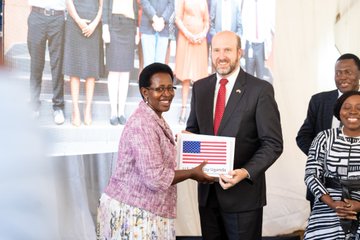
Kampala — The Ministry of Health Uganda has officially taken over a suite of national digital health systems and infrastructure developed over 15 years under a partnership led by the Makerere University School of Public Health.
The handover, conducted on March 31, 2026, marks the conclusion of the Monitoring and Evaluation Technical Support (MakSPH-METS) Programme, which the United States Government has supported through agencies including the Centres for Disease Control and Prevention and PEPFAR.
Speaking at the ceremony, Permanent Secretary Dr Diana Atwine described the milestone as a transformative moment for Uganda’s health sector.

“This morning, we received digital systems and hardware acquired over the past 15 years through the METS programme,” she said, noting that the initiative has significantly strengthened the country’s digital health ecosystem.
According to officials, the programme—launched in 2010—was designed to address longstanding challenges in Uganda’s health system, including fragmented data systems, weak coordination, and limited use of digital tools in decision-making.
Over the years, the initiative has contributed to major improvements in health data management. Reporting rates have risen from 58 percent in 2020 to 98 percent in 2025, while electronic medical record coverage has expanded to over 86 percent nationwide. Disease surveillance has also been scaled up, with more than 1,300 health facilities now implementing case-based surveillance.

The handover includes critical infrastructure such as 725 servers, over 4,700 computing devices, solar power systems for nearly 800 health facilities, and connectivity equipment for more than 1,300 sites. These assets, alongside 16 national digital platforms, are now fully owned by the government.
Dean of Makerere School of Public Health, Dr Rhoda Wanyenze, emphasised that the transition goes beyond physical assets. “This moment goes beyond a transfer of assets. It reflects systems that have been co-created, embedded, and are now fully owned by the government,” she said.
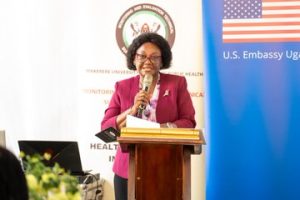
The ceremony was officiated by the U.S. Ambassador to Uganda, William W. Popp, who reaffirmed continued support for Uganda’s health systems strengthening efforts.
Officials say the transition positions the government to sustainably manage and scale digital health innovations, enhancing service delivery, disease surveillance, and data-driven decision-making across the country.